-
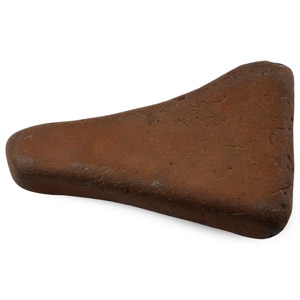
Viking Whetstone Blade Sharpener
8th-12th century A.D.Sold for (Inc. bp): £91
Triangular type with two flat faces, usage wear to edge. 364 grams, 11.4 cm
Found East Anglia, UK. This lot is accompanied by an illustrated lot declaration signed by the Head of the Antiquities Department, Dr Raffaele D'Amato. -
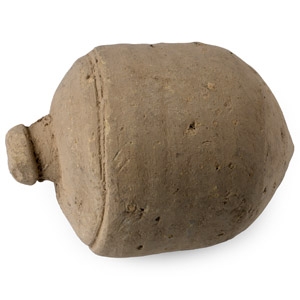
Byzantine 'Greek Fire' Ceramic Fire Bomb or Hand Grenade
9th-11th century A.D.Sold for (Inc. bp): £111
Cylindrical body with pointed tip and domed mouth; intended to be filled with explosive liquid and a wick, and used as a hand grenade. 820 grams, 14 cm
From an important specialist collection, London, UK, 1990s onwards. Accompanied by an academic paper by military specialist Dr Raffaele D'Amato, dated 15 July 2019 and titled 'Eastern Roman Empire - Greek Fire Bomb or Hand Grenade (μεσαίον kακάβιον) 9th-11th century AD'. This lot is accompanied by an illustrated lot declaration signed by the Head of the Antiquities Department, Dr Raffaele D'Amato.
Apart from the use of siphons or manual flame-throwers called cheirosiphona, special corps of Roman soldiers employed terracotta grenades, in the form of small jars, abundantly evidenced in archaeological excavations. They were called μεσαία kακαβιά or κυτροκακάβια where the former had a bulbous shape and the latter a more cylindrical form. -
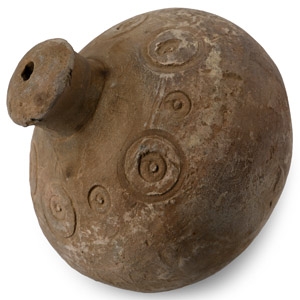
Byzantine 'Greek Fire' Ceramic Fire Bomb or Hand Grenade
9th-11th century A.D.Sold for (Inc. bp): £117
Bulbous body with pointed tip and short neck, a band of ring-and-dot motifs to the upper body; intended to be filled with explosive liquid and a wick, and used as a hand grenade. 467 grams, 10.9 cm
From an important specialist collection, London, UK, 1990s onwards. Accompanied by an academic paper by military specialist Dr Raffaele D'Amato, dated 15 July 2019 and titled 'Eastern Roman Empire - Greek Fire Bomb or Hand Grenade (μεσαίον kακάβιον) 9th-11th century AD'. This lot is accompanied by an illustrated lot declaration signed by the Head of the Antiquities Department, Dr Raffaele D'Amato.
Apart from the use of siphons or manual flame-throwers called cheirosiphona, special corps of Roman soldiers employed terracotta grenades, in the form of small jars, abundantly evidenced in archaeological excavations. They were called μεσαία kακαβιά or κυτροκακάβια where the former had a bulbous shape and the latter a more cylindrical form. -
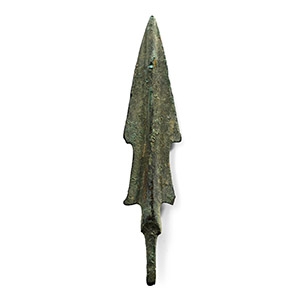
Luristan Bronze Double-Bladed Arrowhead
2nd-1st millennium B.C.Sold for (Inc. bp): £98
With a double triangular point with stem and tang. 21 grams, 10.7 cm
Acquired in the 1990s. Ex Abelita family collection. This lot is accompanied by an illustrated lot declaration signed by the Head of the Antiquities Department, Dr Raffaele D'Amato.
The double-pointed arrowhead belongs to the type II of the Khorasani's classification. These arrowheads were made in cast bronze with a double point with stem and tang, located one above the other and positioned at right angles to each other (see also Muscarella, 1988, figs.411 and 418). Similar examples were found in Marlik, in trench XVIIB, and according to Godard they were made in Luristan. -
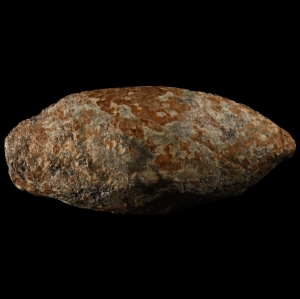
Roman Julius Caesar 'Battle of Munda' Lead Slingshot
45 B.C.Sold for (Inc. bp): £247
A biconical facetted lentoid-section lead sling shot (glans), inscription monogram a combination of letters 'C', 'A' and 'E', for 'C A E S' referring to Julius Caesar. 48.5 grams, 37 mm
Acquired on the UK art market. Property of a gentleman collector. Accompanied by an academic paper by military specialist Dr Raffaele D'Amato, dated 4th May 2022 and titled 'Roman Res Publica - Lead Slingshots (glandes) of Caesarian Age - 45 B.C circa'. This lot is accompanied by an illustrated lot declaration signed by the Head of the Antiquities Department, Dr Raffaele D'Amato.
The shot (type IIb of the Völling classification) is marked with the abbreviated name of Julius Caesar; vast quantities were used at the Battle of Munda (or Monda) against the last supporters of Pompey, the leaders of the Optimates, on the 17th March 45 BC. Similar shots were used during Caesar's wars. The slingers of Caesar's age were part of the light infantry. Caesar speaks of his Balearic slingers during the conquest of Gaul. They wore a short tunic, with leather or rope sandals to the feet, and a warm overcoat which could also have been used to store projectiles. They also used a satchel to carry deadly lead-like stones or bullets. -
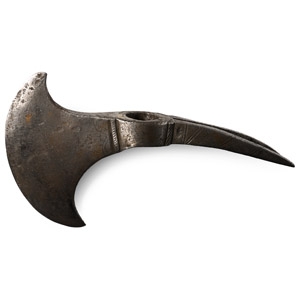
Post-Medieval Iron Decorated Axehead
18th century A.D. or laterSold for (Inc. bp): £111
With curved crescentic blade, round-section socket, a pair of square-section spikes to the rear; incised decoration on both sides. 482 grams, 20 cm
UK private collection before 2000. Acquired on the UK art market. Private collection, London, UK. This lot is accompanied by an illustrated lot declaration signed by the Head of the Antiquities Department, Dr Raffaele D'Amato. -
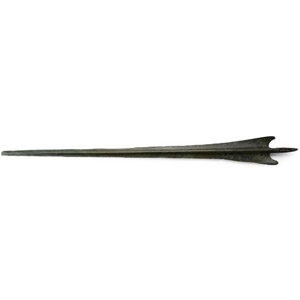
Large Luristan Bronze Sword
2nd-1st millennium B.C.Sold for (Inc. bp): £312
With prominent lateral wings to the shoulder, midrib extending from the ricasso to the tip and developing to form the tang. 378 grams, 53 cm
Acquired in the 1990s. Ex Abelita family collection. This lot is accompanied by an illustrated lot declaration signed by the Head of the Antiquities Department, Dr Raffaele D'Amato. -
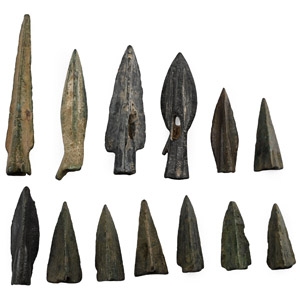
Greek Period Bronze Arrowhead Collection
5th-3rd century B.C.Sold for (Inc. bp): £91
Comprising eleven socketted arrowheads of triangular type, one leaf-shaped with tapering socket, and one tringle-shaped with raised midrib. 31 grams total, 19-46 mm
Ex German art market, 2000s. Acquired from an EU collector living in London. From the collection of a Surrey, UK, gentleman. This lot is accompanied by an illustrated lot declaration signed by the Head of the Antiquities Department, Dr Raffaele D'Amato. -
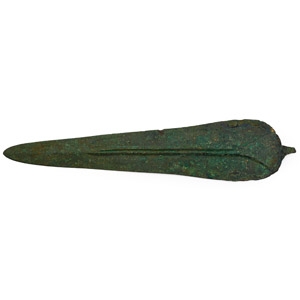
Luristan Bronze Sword Blade with Corrugation
2nd-1st millennium B.C.Sold for (Inc. bp): £98
A two-edged blade, leaf-shaped with short rectangular tang, corrugated midrib extending almost to the tip and flared at the shoulder. 296 grams, 35 cm
Fine condition.
Property of an East Sussex, UK, teacher; formerly with a London gallery; previously acquired on the London art market in the 1990s. From the private collection of John Meredith, acquired since the 1990s; thence by descent. This lot is accompanied by an illustrated lot declaration signed by the Head of the Antiquities Department, Dr Raffaele D'Amato.
The metalworking techniques used in making bronze weapons in Luristan were very complex. Surfaces were often finished in repoussé work, and some of the weapons were chased, others engraved. The ruling elites of warrior horsemen were buried in the graves with their weapons and horses which are the main sources of the Luristan bronze weapons. -
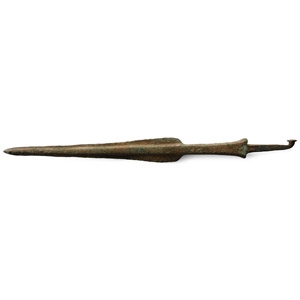
Large Luristan Bronze Spearhead
1200-1100 B.C.Sold for (Inc. bp): £117
With ovate blade, central rib and curved shoulders, the lozenge-section long shaft tapering towards the end, rectangular tang with bent tip. 432 grams, 42.5 cm
Acquired in the 1990s. Ex Abelita family collection. This lot is accompanied by an illustrated lot declaration signed by the Head of the Antiquities Department, Dr Raffaele D'Amato.
The spearhead represents a slender variant of type 1 of Khorasani classification. The type 1 was characterised by the bent tang. It was the evolution of a typology which began much earlier in Mesopotamia and the fertile crescent, the type 4 of the Stronach classification, with straight tang and square section, usually thickened at the base with a button tang. -
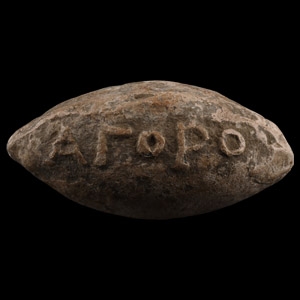
Greek Slingshot with Inscription
4th-1st century B.C.Sold for (Inc. bp): £338
Lentoid in form with raised legend 'AΓOPOY' (maker's name). 35.7 grams, 30 mm
Private collection, Austria. Private collection, Europe. This lot is accompanied by an illustrated lot declaration signed by the Head of the Antiquities Department, Dr Raffaele D'Amato. -
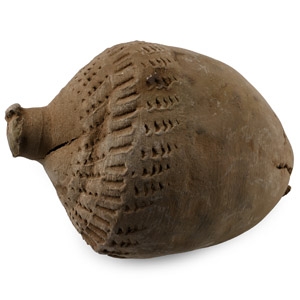
Byzantine 'Greek Fire' Ceramic Fire Bomb or Hand Grenade
9th-11th century A.D.Sold for (Inc. bp): £85
Piriform body with short neck, impressed decorative band on the shoulder; intended to be filled with explosive liquid and a wick, and used as a hand grenade. 683 grams, 13.8 cm
From an important specialist collection, London, UK, 1990s onwards. Accompanied by an academic paper by military specialist Dr Raffaele D'Amato, dated 15 July 2019 and titled 'Eastern Roman Empire - Greek Fire Bomb or Hand Grenade (μεσαίον kακάβιον) 9th-11th century AD'. This lot is accompanied by an illustrated lot declaration signed by the Head of the Antiquities Department, Dr Raffaele D'Amato.
Apart from the use of siphons or manual flame-throwers called cheirosiphona, special corps of Roman soldiers employed terracotta grenades, in the form of small jars, abundantly evidenced in archaeological excavations. They were called μεσαία kακαβιά or κυτροκακάβια where the former had a bulbous shape and the latter a more cylindrical form.

