-
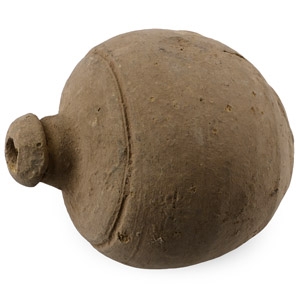
Byzantine 'Greek Fire' Ceramic Fire Bomb or Hand Grenade
9th-11th century A.D.Sold for (Inc. bp): £104
Bulbous body with domed mouth, incised circumferential band on the shoulder; intended to be filled with explosive liquid and a wick, and used as a hand grenade. 392 grams, 10.4 cm
From an important specialist collection, London, UK, 1990s onwards. Accompanied by an academic paper by military specialist Dr Raffaele D'Amato, dated 15 July 2019 and titled 'Eastern Roman Empire - Greek Fire Bomb or Hand Grenade (μεσαίον kακάβιον) 9th-11th century AD'. This lot is accompanied by an illustrated lot declaration signed by the Head of the Antiquities Department, Dr Raffaele D'Amato.
Apart from the use of siphons or manual flame-throwers called cheirosiphona, special corps of Roman soldiers employed terracotta grenades, in the form of small jars, abundantly evidenced in archaeological excavations. They were called μεσαία kακαβιά or κυτροκακάβια where the former had a bulbous shape and the latter a more cylindrical form. -
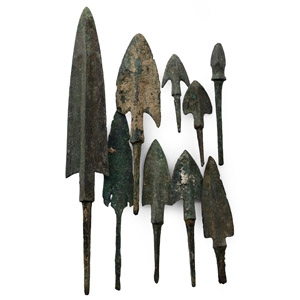
Luristan Bronze Arrowhead Collection
2nd millennium-9th century B.C.Sold for (Inc. bp): £85
Nine arrowheads most of deltoid form, having a sharp flat barbed blade and prominent midrib extending to a long tang; one with head without barbs, but prominent midrib extending to a tang; one with long tang and small pyramidal shape. 149 grams total, 5.4-18 cm
Fine condition.
Formerly from a late Japanese gentleman's collection, 1970-2010. From the private collection of John Meredith, acquired since the 1990s; thence by descent. This lot is accompanied by an illustrated lot declaration signed by the Head of the Antiquities Department, Dr Raffaele D'Amato.
This type of head was in use from the last centuries of the second through to the early centuries of the first millennium BC, with varieties of barbed heads continuing to be employed for a time after the ninth century BC, during the Neo-Assyrian period. -
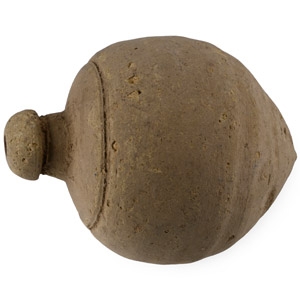
Byzantine 'Greek Fire' Ceramic Fire Bomb or Hand Grenade
9th-11th century A.D.Sold for (Inc. bp): £104
Ovoid body with short neck and domed mouth, incised circumferential band above the shoulder; intended to be filled with explosive liquid and a wick, and used as a hand grenade. 378 grams, 11.2 cm
From an important specialist collection, London, UK, 1990s onwards. Accompanied by an academic paper by military specialist Dr Raffaele D'Amato, dated 15 July 2019 and titled 'Eastern Roman Empire - Greek Fire Bomb or Hand Grenade (μεσαίον kακάβιον) 9th-11th century AD'. This lot is accompanied by an illustrated lot declaration signed by the Head of the Antiquities Department, Dr Raffaele D'Amato.
Apart from the use of siphons or manual flame-throwers called cheirosiphona, special corps of Roman soldiers employed terracotta grenades, in the form of small jars, abundantly evidenced in archaeological excavations. They were called μεσαία kακαβιά or κυτροκακάβια where the former had a bulbous shape and the latter a more cylindrical form. -
.jpg)
Luristan Bronze Dagger
13th-7th century B.C.Sold for (Inc. bp): £260
Comprising a two-edged leaf-shaped lentoid-section blade, crescentic lower guard, ribbed hilt and domed finial. 93 grams, 20.1 cm
Acquired before 1983. Ex London gallery, 1990s. This lot is accompanied by an illustrated lot declaration signed by the Head of the Antiquities Department, Dr Raffaele D'Amato. -
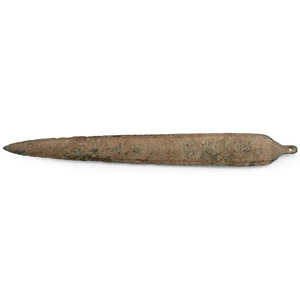
Luristan Bronze Dagger Blade
2nd-1st millennium B.C.Sold for (Inc. bp): £117
Tapering leaf-shaped two-edged blade, lentoid in section, developing to a tubby tang pierced at the end. 230 grams, 32.5 cm
Acquired in the 1990s. Ex Abelita family collection. This lot is accompanied by an illustrated lot declaration signed by the Head of the Antiquities Department, Dr Raffaele D'Amato. -
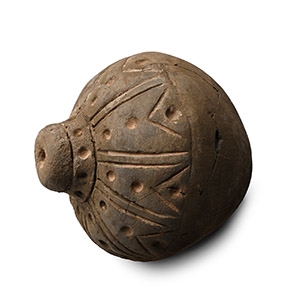
Byzantine 'Greek Fire' Ceramic Fire Bomb or Hand Grenade
9th-11th century A.D.Sold for (Inc. bp): £169
Piriform body with impressed panels and roundels to the shoulder, domed filler-hole, intended to be filled with explosive liquid and wick, used as a hand grenade. 415 grams, 10.7 cm
From a specialist collection of militaria, London, UK, collected 1990s onwards. From the private collection of John Meredith, acquired since the 1990s; thence by descent. Accompanied by an academic paper by military specialist Dr Raffaele D'Amato, dated 15 July 2019 and titled 'Eastern Roman Empire - Greek Fire Bomb or Hand Grenade (μεσαίον kακάβιον) 9th-11th century AD'. This lot is accompanied by an illustrated lot declaration signed by the Head of the Antiquities Department, Dr Raffaele D'Amato.
Apart from the use of siphons or manual flame-throwers called cheirosiphona, special corps of Roman soldiers employed terracotta grenades, in the form of small jars, abundantly evidenced in archaeological excavations. They were called μεσαία kακαβιά or κυτροκακάβια where the former had a bulbous shape and the latter a more cylindrical form. -
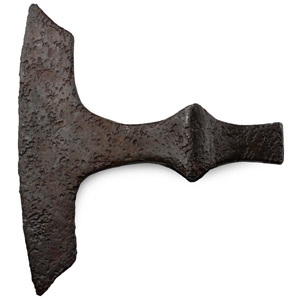
Viking Age Iron T-Shaped Axehead
Circa 9th-11th century A.D.Sold for (Inc. bp): £416
With broad curved edge, narrow neck, round flared socket with triangular flanges to each face and rectangular hammer extension to the rear. 378 grams, 16.5 cm
Ex North American private collection, 1970s. This lot is accompanied by an illustrated lot declaration signed by the Head of the Antiquities Department, Dr Raffaele D'Amato. -
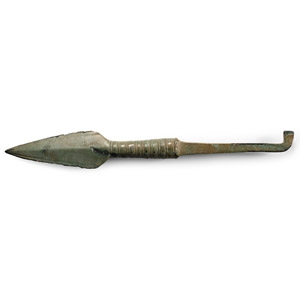
Luristan Decorated Bronze Spearhead
13th-6th century B.C.Sold for (Inc. bp): £176
With broad leaf-shaped blade and tapering square-section tang, ribbed neck. 147 grams, 21.5 cm
From the private collection of Mr K.A., acquired in the 1990s-early 2000s. This lot is accompanied by an illustrated lot declaration signed by the Head of the Antiquities Department, Dr Raffaele D'Amato. -
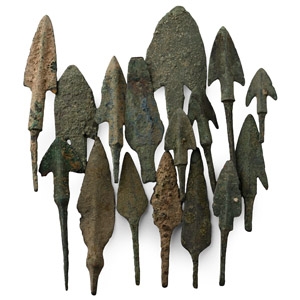
Luristan Bronze Arrowhead Collection
2nd-1st millennium B.C.Sold for (Inc. bp): £130
Comprising leaf-shaped, triangular tanged and other types. 156 grams total, 47-92 mm
From a London collection, 1990s-2000. This lot is accompanied by an illustrated lot declaration signed by the Head of the Antiquities Department, Dr Raffaele D'Amato. -
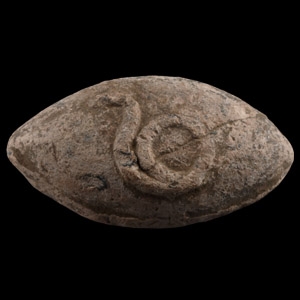
Greek Slingshot with Snakes
4th-1st century B.C.Sold for (Inc. bp): £338
Lentoid in form with raised motif of a coiled snake. 31.9 grams, 30 mm
Private collection, Austria. Private collection, Europe. This lot is accompanied by an illustrated lot declaration signed by the Head of the Antiquities Department, Dr Raffaele D'Amato. -
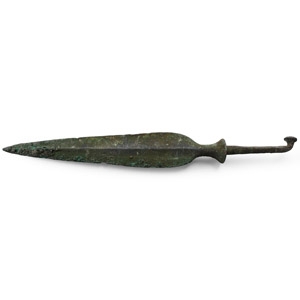
Luristan Bronze Spearhead
2nd-1st millennium B.C.Sold for (Inc. bp): £124
Comprising a leaf-shaped blade with raised midrib extending to the shaft with a flared collar, rectangular section tang with curved end and button finial. 369 grams, 34.5 cm
Acquired in the 1990s. Ex Abelita family collection. This lot is accompanied by an illustrated lot declaration signed by the Head of the Antiquities Department, Dr Raffaele D'Amato. -
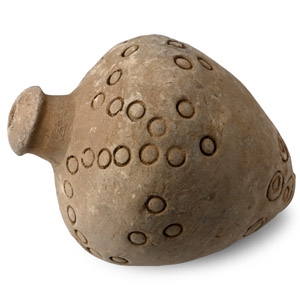
Byzantine 'Greek Fire' Ceramic Fire Bomb or Hand Grenade
9th-11th century A.D.Sold for (Inc. bp): £117
Piriform body with dome mouth, impressed annulets to the body; intended to be filled with explosive liquid and a wick, and used as a hand grenade. 570 grams, 12.2 cm
From an important specialist collection, London, UK, 1990s onwards. Accompanied by an academic paper by military specialist Dr Raffaele D'Amato, dated 15 July 2019 and titled 'Eastern Roman Empire - Greek Fire Bomb or Hand Grenade (μεσαίον kακάβιον) 9th-11th century AD'. This lot is accompanied by an illustrated lot declaration signed by the Head of the Antiquities Department, Dr Raffaele D'Amato.
Apart from the use of siphons or manual flame-throwers called cheirosiphona, special corps of Roman soldiers employed terracotta grenades, in the form of small jars, abundantly evidenced in archaeological excavations. They were called μεσαία kακαβιά or κυτροκακάβια where the former had a bulbous shape and the latter a more cylindrical form.

