-
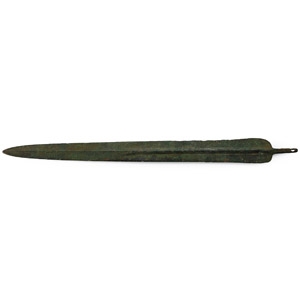
Luristan Bronze Sword Blade
2nd-1st millennium B.C.Sold for (Inc. bp): £312
Tapering leaf-shaped blade with a raised midrib developing to a short rectangular-section tang, pierced at the end. 412 grams, 50 cm
Acquired in the 1990s. Ex Abelita family collection. This lot is accompanied by an illustrated lot declaration signed by the Head of the Antiquities Department, Dr Raffaele D'Amato. -
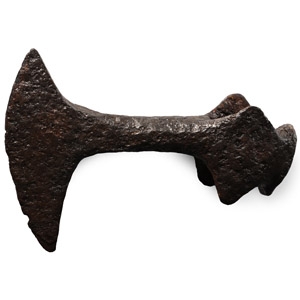
Viking Age Iron Axehead
10th-12th century A.D.Sold for (Inc. bp): £364
With flaring triangular-section blade extending to a curved edge, socket with lateral flanges and hammer extension to the rear. 447 grams, 16 cm
From the private collection of a London gentleman, from his grandfather's collection formed before the early 1970s. This lot is accompanied by an illustrated lot declaration signed by the Head of the Antiquities Department, Dr Raffaele D'Amato.
The axe seems to be product of Baltic workmanship. The Curonians were known as fierce warriors and sailors who were involved in several wars and alliances with the Swedish, Danish and Icelandic Vikings. Baltic tribes created an original and impressive set of weaponry. They included battle knives, battle axes and spears and javelins with medium sized heads of a characteristic shape. -
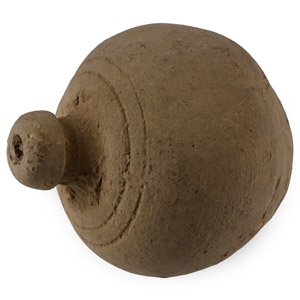
Byzantine 'Greek Fire' Ceramic Fire Bomb or Hand Grenade
9th-11th century A.D.Sold for (Inc. bp): £169
Bulbous body with pointed tip and domed mouth, impressed circumferential bands above the shoulder; intended to be filled with explosive liquid and a wick, and used as a hand grenade. 379 grams, 10.4 cm
From an important specialist collection, London, UK, 1990s onwards. Accompanied by an academic paper by military specialist Dr Raffaele D'Amato, dated 15 July 2019 and titled 'Eastern Roman Empire - Greek Fire Bomb or Hand Grenade (μεσαίον kακάβιον) 9th-11th century AD'. This lot is accompanied by an illustrated lot declaration signed by the Head of the Antiquities Department, Dr Raffaele D'Amato.
Apart from the use of siphons or manual flame-throwers called cheirosiphona, special corps of Roman soldiers employed terracotta grenades, in the form of small jars, abundantly evidenced in archaeological excavations. They were called μεσαία kακαβιά or κυτροκακάβια where the former had a bulbous shape and the latter a more cylindrical form. -
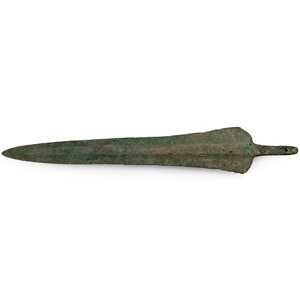
Luristan Bronze Leaf-Shaped Dagger Blade
2nd-1st millennium B.C.Sold for (Inc. bp): £221
With a triangular blade flaring to the shoulders and wide midrib, narrow tang with one hole for rivet. 218 grams, 30 cm
Acquired in the 1990s. Ex Abelita family collection. This lot is accompanied by an illustrated lot declaration signed by the Head of the Antiquities Department, Dr Raffaele D'Amato. -
.jpg)
Luristan Bronze Sword
Late 2nd millennium B.C.Sold for (Inc. bp): £520
Later hilt with mushroom-shaped pommel, openwork grip with 'chain'-shaped pattern, crescentic guard, long sloping blade with rectangular-section mid-ridge. 1.05 kg, 55.2 cm
Acquired 1980-2015. Ex Abelita family collection. This lot is accompanied by an illustrated lot declaration signed by the Head of the Antiquities Department, Dr Raffaele D’Amato. This lot is accompanied by an illustrated lot declaration signed by the Head of the Antiquities Department, Dr Raffaele D'Amato.
These bronze swords were characterised by a solid-cast hilt with penannular guard, a grip equipped with raised shaped figures and a conical, hollow-cast mushroom pommel. The blade had a very pronounced shaped central midrib. In the complete specimens the hilt was usually cast with the blade. -
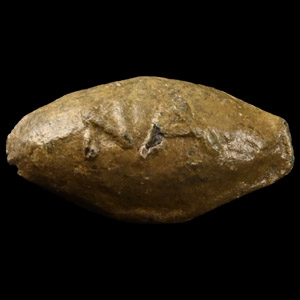
Greek Macedonian Lead Inscribed Slingshot
3rd-1st century B.C.Sold for (Inc. bp): £85
A biconical glans with an inscription 'MEP' to one side and 'NA' to the other. 27.5 grams, 28 mm
Ex German art market, 2000s. Acquired from an EU collector living in London. From the collection of a Surrey, UK, gentleman. This lot is accompanied by an illustrated lot declaration signed by the Head of the Antiquities Department, Dr Raffaele D'Amato.
The leaden bullets, which were thrown from slings, were called in Greek Molivdainai (μολύβδαιναι), and in Latin glandes- the former indicating the material ‘lead’, the latter the shape ‘acorns’. These bullets were cast in a mould, and bore letters or devices or both, on two sides or on only one. In form they were more like an almond than an acorn, but many are pointed at both ends; in size, they are generally about one inch and a half maximum length, and under one inch in maximum width. Bullets from Mecyberna possess the abbreviated inscription MER (obverse) and NA (reverse), which some scholar translated as Mecyberna. The presence of the Mecyberna inscription is expected, since the Polis of Mecyberna produced clay moulds, which suggests local production. Inscribed bullets with the name of a city may also denote the place of manufacture -
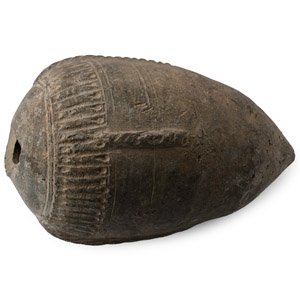
Byzantine 'Greek Fire' Ceramic Fire Bomb or Hand Grenade
9th-11th century A.D.Sold for (Inc. bp): £182
Piriform in profile, four raised lugs on the body; intended to be filled with explosive liquid and wick, used as a hand grenade. 1.46 kg, 19 cm
From an important specialist collection, London, UK, 1990s onwards. Accompanied by an academic paper by military specialist Dr Raffaele D'Amato, dated 15 July 2019 and titled 'Eastern Roman Empire - Greek Fire Bomb or Hand Grenade (μεσαίον kακάβιον) 9th-11th century AD'. This lot is accompanied by an illustrated lot declaration signed by the Head of the Antiquities Department, Dr Raffaele D'Amato.
Apart from the use of siphons or manual flame-throwers called cheirosiphona, special corps of Roman soldiers employed terracotta grenades, in the form of small jars, abundantly evidenced in archaeological excavations. They were called μεσαία kακαβιά or κυτροκακάβια where the former had a bulbous shape and the latter a more cylindrical form. -
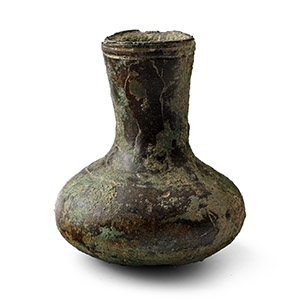
Romano-British Bronze Spearbutt or Staff Head
200-300 A.D.Sold for (Inc. bp): £208
Comprising an onion-shaped terminal developing to a flared socket; incised circumferential line detailing. 139 grams, 54 mm
Found whilst searching with a metal detector in Cumbria, South Lakeland, UK in 2023. Accompanied by a copy of the British Museum's Portable Antiquities Scheme (PAS) report no.LANCUM-DFEA18. This lot is accompanied by an illustrated lot declaration signed by the Head of the Antiquities Department, Dr Raffaele D'Amato. -
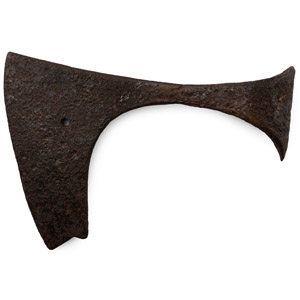
Viking Age Iron Bearded Axehead
Circa 9th-11th century A.D.Sold for (Inc. bp): £364
With long, slightly curved blade widening to a square chin, pierced hole, narrow neck and round flared socket. 200 grams, 14 cm
Ex North American private collection, 1970s. This lot is accompanied by an illustrated lot declaration signed by the Head of the Antiquities Department, Dr Raffaele D'Amato. -
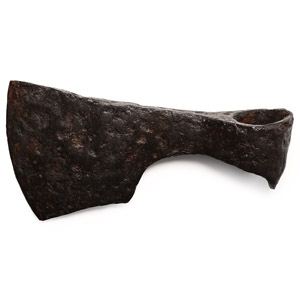
Viking Age Iron Bearded Axehead
10th-12th century A.D.Sold for (Inc. bp): £247
With triangular-section narrow blade widening to a broad bevelled edge and square chin, flared socket. 677 grams, 19 cm
From the private collection of a London gentleman, from his grandfather's collection formed before the early 1970s. This lot is accompanied by an illustrated lot declaration signed by the Head of the Antiquities Department, Dr Raffaele D'Amato.
The more commonly used weapons of the Finno-Ugrian people were axes, commonly found in all Finnic areas, as well as spears. Iron axeheads of this typology show a sub-trapezoidal asymmetrical blade, often perforated through the centre. -
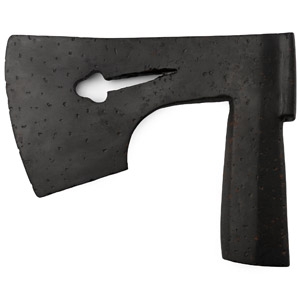
Teutonic Order Iron War Axe with Maker's Mark
13th-14th century A.D.Sold for (Inc. bp): £364
Mazovian or Teutonic Order, hand-forged with rectangular-section socket and expanding bearded blade; a maker's mark to one side of the blade and an openwork three-lobed flower tapering towards the blade; four notches on the upper part of the socket; professionally cleaned, conserved and restored. 805 grams, 17.8 cm
Very fine condition, professionally cleaned, conserved and restored.
Ex property of a London businessman, from his grandfather's collection formed after World War II; thence by descent 1972. This lot is accompanied by an illustrated lot declaration signed by the Head of the Antiquities Department, Dr Raffaele D'Amato.
This typology of axes (type Ig of the Glosek classification) was in use throughout Europe in the 13th-14th centuries. This axe is similar to one excavated during an archaeological survey of the castle at Czersk, dated to the 13th-14th century A.D. Close parallels have also been found in Elbląg, a famous commandery of the Teutonic Order from 1237 to 1454 A.D. The stronghold served as a seat of the Masters of the Teutonic Order. -
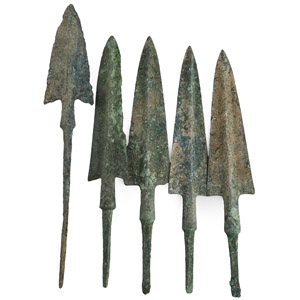
Luristan Bronze Arrowhead Collection
2nd-1st millennium B.C.Sold for (Inc. bp): £195
Comprising mainly triangular tanged types. 162 grams total, 14.3-16.2 cm
From a London collection, 1990s-2000. This lot is accompanied by an illustrated lot declaration signed by the Head of the Antiquities Department, Dr Raffaele D'Amato.

