-
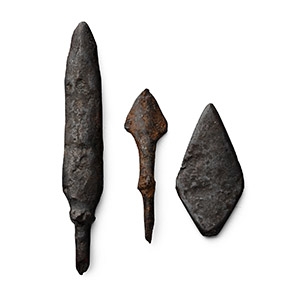
Medieval Iron Arrowhead Group
12th-15th century A.D.Sold for (Inc. bp): £39
Including barbed-and-tanged and other types. 13.7 grams total, 35-67 mm
Found Yorkshire, UK. This lot is accompanied by an illustrated lot declaration signed by the Head of the Antiquities Department, Dr Raffaele D'Amato. -
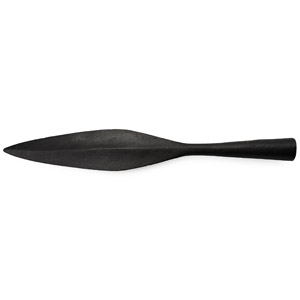
Viking Age Iron Socketted Spearhead
10th-11th century A.D.Sold for (Inc. bp): £468
Leaf-shaped blade with raised midrib extending to round-section tapering socket with fastening hole; restored and conserved. 270 grams, 31.6 cm
From the family collection of a South East London collector; formerly acquired in the late 1950s. This lot is accompanied by an illustrated lot declaration signed by the Head of the Antiquities Department, Dr Raffaele D'Amato. -
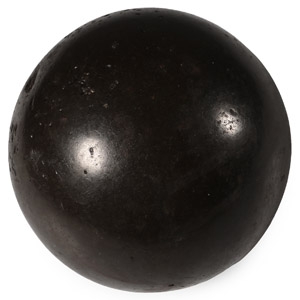
Tudor Period Bronze Cannon Ball
Circa 16th century A.D.Sold for (Inc. bp): £520
A medium-sized cannon ball, likely for a use with demi-cannon or a saker; polished. 2.9 kg, 90 mm
Acquired on the UK art market in the 1970s-1990s. Property of a Nottinghamshire, UK, gentleman. This lot is accompanied by an illustrated lot declaration signed by the Head of the Antiquities Department, Dr Raffaele D'Amato. -
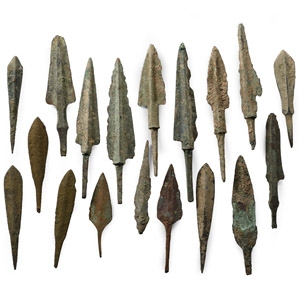
Luristan Bronze Arrowhead Collection
2nd-1st millennium B.C.Sold for (Inc. bp): £98
A group of eighteen tanged mainly triangular and leaf-shaped arrowheads. 246 grams total, 6.1-11.8 cm
From the London art market, 1990s. This lot is accompanied by an illustrated lot declaration signed by the Head of the Antiquities Department, Dr Raffaele D'Amato. -
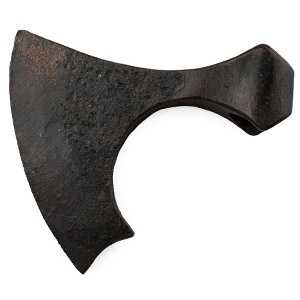
Viking Age Iron Bearded Axehead
9th-11th century A.D.Sold for (Inc. bp): £416
With curved blade and chin to the lower edge, round socket with lateral triangular flanges and flattened rear-edge. 252 grams, 11.2 cm
Fine condition.
Private collection, 1990s. Property of a Sussex, UK, teacher. This lot is accompanied by an illustrated lot declaration signed by the Head of the Antiquities Department, Dr Raffaele D'Amato.
This type of bearded axe seems to correspond to the E2 category of the Viking axe classification. Usually these bearded axeheads (skeggöks) had a longer edge, designed to split tree trunks into planks and beams. Some of the bearded axes were known as halfÞynna öx; the neck on such 'half thin axe' was thinly forged, to make it lighter. Bearded axes of this type appear also in the weaponry of people from the Baltic. -
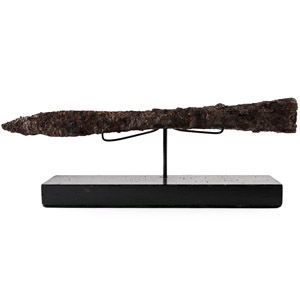
Viking Socketted Iron Spearhead
9th-11th century A.D.Sold for (Inc. bp): £98
Leaf-shaped blade and tapering, round-section socket, pierced for attachment to a shaft; accompanied by a custom-made display stand. 162 grams, 22 cm long (229 grams total including stand)
Fair condition.
UK gallery, acquired in the 2000s. Property of an English gentleman. This lot is accompanied by an illustrated lot declaration signed by the Head of the Antiquities Department, Dr Raffaele D'Amato. -
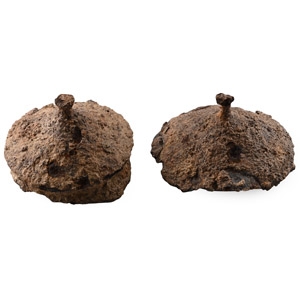
Anglo-Saxon Iron Shield Boss Pair
Circa 6th century A.D.Sold for (Inc. bp): £117
Comprising: ferrous shield boss of Härke & Dickinson's Type 1 with shallow sidewall with carination and low domed cone; tall apex stud with flange; outer flange almost absent; another of Härke & Dickinson's Type 3 with deep sidewall with pronounced carination, domed cone; tall apex stud with flange; outer flange absent. 457 grams total, 11.5-13.2 cm
Found East Anglia, UK. This lot is accompanied by an illustrated lot declaration signed by the Head of the Antiquities Department, Dr Raffaele D'Amato. -
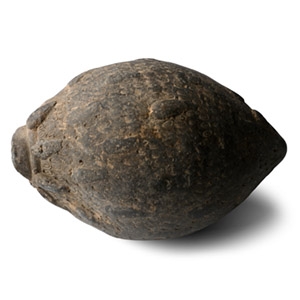
Large Byzantine 'Greek Fire' Ceramic Fire Bomb or Hand Grenade with TL Test
9th-11th century A.D.Sold for (Inc. bp): £182
Piriform body with impressed teardrop-shaped motifs and raised lugs to the upper body; intended to be filled with explosive liquid and a wick, and used as a hand grenade. 1.14 kg, 17.5 cm
From an important specialist collection, London, UK, 1990s onwards. Accompanied by an original thermoluminescence analysis report by Oxford Authentication with sample no.P125g15. Accompanied by an academic paper by military specialist Dr Raffaele D'Amato, dated 15 July 2019 and titled 'Eastern Roman Empire - Greek Fire Bomb or Hand Grenade (μεσαίον kακάβιον) 9th-11th century AD'. This lot is accompanied by an illustrated lot declaration signed by the Head of the Antiquities Department, Dr Raffaele D'Amato.
Apart from the use of siphons or manual flame-throwers called cheirosiphona, special corps of Roman soldiers employed terracotta grenades, in the form of small jars, abundantly evidenced in archaeological excavations. They were called μεσαία kακαβιά or κυτροκακάβια where the former had a bulbous shape and the latter a more cylindrical form. -

Luristan Bronze Dirk with Handle
2nd-1st millennium B.C.Sold for (Inc. bp): £338
Comprising a narrow parallel-sided two-edged lentoid-section blade, integral grip formed with sockets to both faces, lateral flanges to accept organic inserts. 245 grams, 41.5 cm
Acquired in the 1990s. Ex Abelita family collection. This lot is accompanied by an illustrated lot declaration signed by the Head of the Antiquities Department, Dr Raffaele D'Amato. -
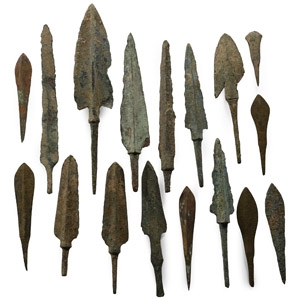
Luristan Bronze Arrowhead Collection
2nd-1st millennium B.C.Sold for (Inc. bp): £91
Comprising fifteen tanged arrowheads, mostly triangular with raised midrib. 239 grams total, 4.1-14 mm
From the London art market, 1990s. This lot is accompanied by an illustrated lot declaration signed by the Head of the Antiquities Department, Dr Raffaele D'Amato. -
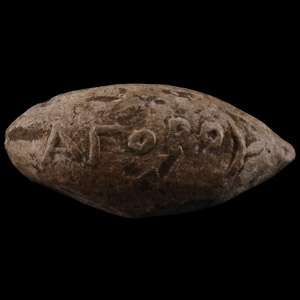
Greek Sling Shot with Inscription
4th-1st century B.C.Sold for (Inc. bp): £286
Lentoid in form with raised legend 'AΓOPOY' (maker's name). 35.4 grams, 31 mm
Private collection, Austria. Private collection, Europe. This lot is accompanied by an illustrated lot declaration signed by the Head of the Antiquities Department, Dr Raffaele D'Amato. -
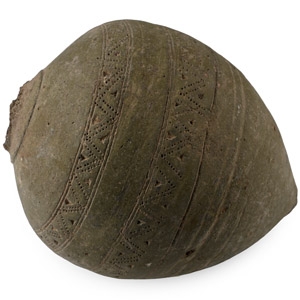
Byzantine 'Greek Fire' Ceramic Fire Bomb or Hand Grenade
9th-11th century A.D.Sold for (Inc. bp): £143
Ovoid in profile with pointillé and linear decoration; intended to be filled with explosive liquid and wick, used as a hand grenade. 1.17 kg, 15.5 cm
From an important specialist collection, London, UK, 1990s onwards. Accompanied by an academic paper by military specialist Dr Raffaele D'Amato, dated 15 July 2019 and titled 'Eastern Roman Empire - Greek Fire Bomb or Hand Grenade (μεσαίον kακάβιον) 9th-11th century AD'. This lot is accompanied by an illustrated lot declaration signed by the Head of the Antiquities Department, Dr Raffaele D'Amato.
Apart from the use of siphons or manual flame-throwers called cheirosiphona, special corps of Roman soldiers employed terracotta grenades, in the form of small jars, abundantly evidenced in archaeological excavations. They were called μεσαία kακαβιά or κυτροκακάβια where the former had a bulbous shape and the latter a more cylindrical form.

