-
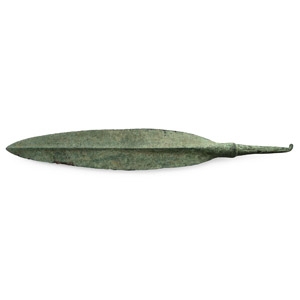
Luristan Bronze Leaf-Shaped Spearhead
2nd-1st millennium B.C.Sold for (Inc. bp): £117
Slender and leaf-shaped with lozenge-sectioned midrib, round-section tang with right-angled termination. 379 grams, 32 cm
Acquired in the 1990s. Ex Abelita family collection. This lot is accompanied by an illustrated lot declaration signed by the Head of the Antiquities Department, Dr Raffaele D'Amato. -
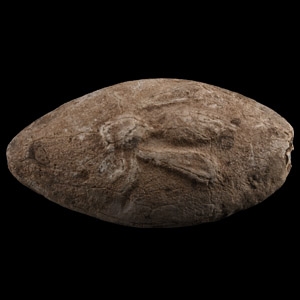
Greek Sling Shot with Bee
4th-1st century B.C.Sold for (Inc. bp): £260
Lentoid in form with raised bee motif to one face, legend 'KAΛ[..]' to reverse. 27.4 grams, 30 mm
Private collection, Austria. Private collection, Europe. This lot is accompanied by an illustrated lot declaration signed by the Head of the Antiquities Department, Dr Raffaele D'Amato. -
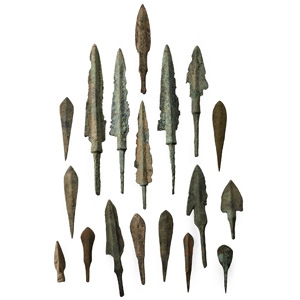
Western Asiatic Bronze Arrowhead Collection
2nd-1st millennium B.C.Sold for (Inc. bp): £85
Comprising: four large tanged arrowheads, mainly of triangular type with mid-rib; six triangular, leaf-shaped, barbed, and paddle-shaped arrowheads with a flat, comparatively wide mid-rib; one small triangular arrowhead with rounded shoulders; two arrowheads with wings, resembling a stylised flying bird; one foliate with herringbone decoration on the midrib; a triangular type with flat mid-rib and raised corners; two small paddle-shaped arrowheads with flat mid-rib; an Achaemenid trilobate socketted arrowhead. 253 grams total, 3.7-15 cm
From the London art market, 1990s. This lot is accompanied by an illustrated lot declaration signed by the Head of the Antiquities Department, Dr Raffaele D'Amato.
The most interesting specimen is the foliate blade with herringbone decoration on the mid-rib. Two examples with similar decoration are published by Muscarella, that according to the publications of Ghirsman are typical of North-West Iranian Plateau. -
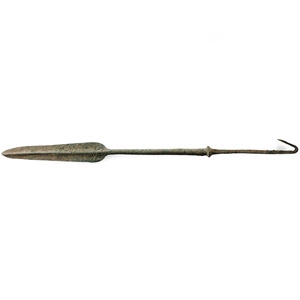
Mesopotamian Bronze Javelin Head
3rd-2nd millennium B.C.Sold for (Inc. bp): £182
With foliate blade, rhomboidal in section, raised mid-rib, medium length stem widening at its base and forming a small stop, rectangular-section tang with bent terminal. 206 grams, 45.4 cm
Acquired in the 1990s. Ex Abelita family collection. This lot is accompanied by an illustrated lot declaration signed by the Head of the Antiquities Department, Dr Raffaele D'Amato.
The specimen belongs to the category of tripartite spears with long pointed biconvex blade and single bevelled tang. They seem to be a Mesopotamian and Susian (Elamite) variant, and this type also includes decorated blades, like the spear from Tello with the inscription 'King of Kish'. -
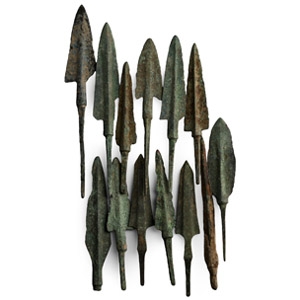
Luristan Bronze Arrowhead Collection
2nd-1st millennium B.C.Sold for (Inc. bp): £143
Comprising mainly barbed-and-tanged and leaf-shaped types. 315 grams total, 11-16.5 cm
From a London collection, 1990s-2000. This lot is accompanied by an illustrated lot declaration signed by the Head of the Antiquities Department, Dr Raffaele D'Amato. -
.jpg)
Luristan Bronze Arrowhead Group
13th-6th century B.C.Sold for (Inc. bp): £234
Comprising triangular types with thick midrib, leaf-shaped and other types. 400 grams total, 9.7-16.2 cm
Acquired 1980-2015. Ex Abelita family collection. This lot is accompanied by an illustrated lot declaration signed by the Head of the Antiquities Department, Dr Raffaele D’Amato. This lot is accompanied by an illustrated lot declaration signed by the Head of the Antiquities Department, Dr Raffaele D'Amato. -
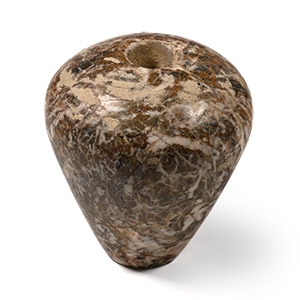
Western Asiatic Stone Macehead
3rd-2nd millennium B.C.Sold for (Inc. bp): £117
Piriform with vertical socket expanding towards the narrower end. 550 grams, 82 mm
Ex London, UK, collection, 1990-2000s. This lot is accompanied by an illustrated lot declaration signed by the Head of the Antiquities Department, Dr Raffaele D'Amato. -
.jpg)
Luristan Bronze Blade Group
14th-10th century B.C.Sold for (Inc. bp): £143
Tanged spearheads with foliate blades, one with accentuated midrib and bent tang, another with squared shoulders and bent tang, the third with slender blade and narrow tang with fastening hole. 342 grams total, 18.7-27 cm
Acquired 1980-2015. Ex Abelita family collection. This lot is accompanied by an illustrated lot declaration signed by the Head of the Antiquities Department, Dr Raffaele D’Amato. This lot is accompanied by an illustrated lot declaration signed by the Head of the Antiquities Department, Dr Raffaele D'Amato.
Spearheads with large foliate blades and bent tangs were excavated in the Marlik Royal cemetery by Dr Negahban, see for example in tomb 47, Trench XXIIE. They were the evolution of a typology which began much earlier in Mesopotamia and the fertile crescent, the type 4 of the Stronach classification, with straight tang and square section, usually thickened at the base with a button tang. The foliate blade was wide and exaggerated in some specimens excavated at Marlik. -
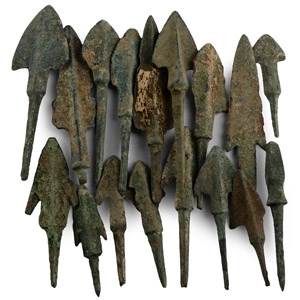
Luristan Bronze Arrowhead Collection
2nd-1st millennium B.C.Sold for (Inc. bp): £117
Comprising mainly barbed-and-tanged and leaf-shaped types. 141 grams total, 44-81 mm
From a London collection, 1990s-2000. This lot is accompanied by an illustrated lot declaration signed by the Head of the Antiquities Department, Dr Raffaele D'Amato. -
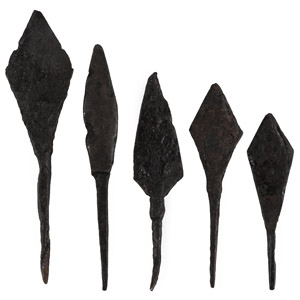
Medieval Iron Arrowhead Collection
Circa 12th-14th century A.D.Sold for (Inc. bp): £78
Comprising tanged arrowheads of various types. 40 grams total, 61-94 mm
From the private collection of a London gentleman, from his grandfather's collection formed before the early 1970s. This lot is accompanied by an illustrated lot declaration signed by the Head of the Antiquities Department, Dr Raffaele D'Amato. -
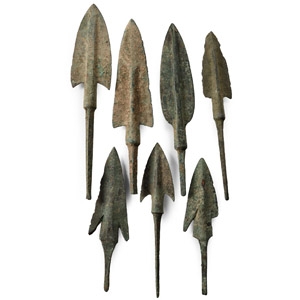
Western Asiatic Bronze Arrowhead Collection
2nd-1st millennium B.C.Sold for (Inc. bp): £117
Comprising: five large elongated triangular arrowheads with raised midrib, sharp central groove, cylindrical stem, barbed shoulders and convex sides; two large tanged arrowheads, one of triangular type with mid-rib, the other with rounded shoulders. 140 grams total, 8.3-12.5 cm
Acquired in the 1990s. Ex Abelita family collection. This lot is accompanied by an illustrated lot declaration signed by the Head of the Antiquities Department, Dr Raffaele D'Amato.
One of the categories of arrowheads coming from Marlik shows a large triangular blade with barbed shoulders, and has been ascribed by Negahban to the subtype C of the type V of Luristan or North Persian arrowheads. -
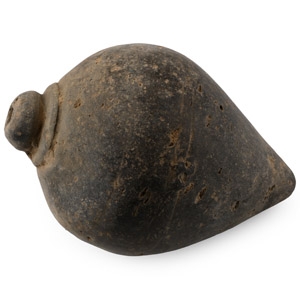
Byzantine 'Greek Fire' Ceramic Fire Bomb or Hand Grenade
9th-11th century A.D.Sold for (Inc. bp): £98
Piriform body with a domed mouth; intended to be filled with explosive liquid and a wick, and used as a hand grenade. 567 grams, 13.2 cm
From an important specialist collection, London, UK, 1990s onwards. Accompanied by an academic paper by military specialist Dr Raffaele D'Amato, dated 15 July 2019 and titled 'Eastern Roman Empire - Greek Fire Bomb or Hand Grenade (μεσαίον kακάβιον) 9th-11th century AD'. This lot is accompanied by an illustrated lot declaration signed by the Head of the Antiquities Department, Dr Raffaele D'Amato.
Apart from the use of siphons or manual flame-throwers called cheirosiphona, special corps of Roman soldiers employed terracotta grenades, in the form of small jars, abundantly evidenced in archaeological excavations. They were called μεσαία kακαβιά or κυτροκακάβια where the former had a bulbous shape and the latter a more cylindrical form.

