-
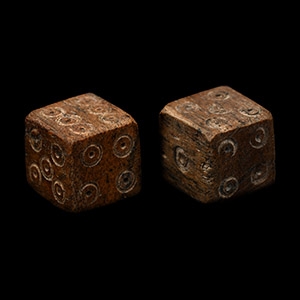
Roman Bone Gaming Dice Pair
1st-4th century A.D.Sold for (Inc. bp): £338
Cuboid with incised annular markings disposed 1:6, 2:5, 3:4. 6.7 grams total, 12 mm each
Ex German art market, 2000s. Acquired from an EU collector living in London. From the collection of a Surrey, UK, gentleman. This lot is accompanied by an illustrated lot declaration signed by the Head of the Antiquities Department, Dr Raffaele D'Amato. -
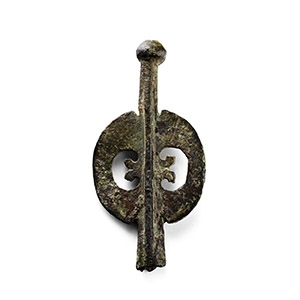
Roman Military Bronze Beneficiarius Insignia Mount
2nd-3rd century A.D.Sold for (Inc. bp): £390
With tapering and collared median spine, two lateral D-shaped flanges with bean-shaped voids. 17.7 grams, 56 mm
Ex Graham Slater (1924-2024) collection, Cambridge, UK; his collection assembled since the 1980s. From a Cambridgeshire, UK, private collection. This lot is accompanied by an illustrated lot declaration signed by the Head of the Antiquities Department, Dr Raffaele D'Amato.
The Beneficiarius was a specially-commissioned soldier whose duties would include undertaking a specific role such as military police. The insignia included a disc with spikes and two circular holes, shown on a military altar. -
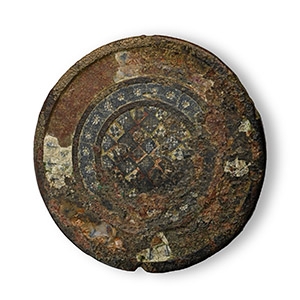
Roman Bronze Plate Mount with Millefiori
2nd century A.D.Sold for (Inc. bp): £72
Comprising a discoid plaque with a stud on the reverse, the obverse divided into three fields, each with a millefiori decoration. 16 grams, 38 mm
Ex German art market, 2000s. Acquired from an EU collector living in London. From the collection of a Surrey, UK, gentleman. This lot is accompanied by an illustrated lot declaration signed by the Head of the Antiquities Department, Dr Raffaele D'Amato. -
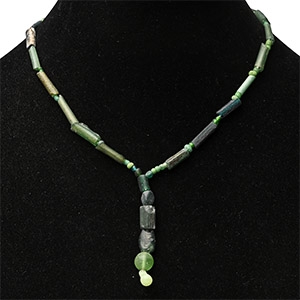
Roman Green Glass Bead Necklace String
1st-4th century A.D. and laterSold for (Inc. bp): £65
Composed of alternating tubular and small oblate beads, larger beads as a central feature; restrung. 14.6 grams, 32.5 cm
From the London, UK, art market in the 1990s. This lot is accompanied by an illustrated lot declaration signed by the Head of the Antiquities Department, Dr Raffaele D'Amato.
In the Roman period there was a strong formal and chromatic diversity of glass beads used for necklaces and bracelets. The most common beads in forms were small biconical (lenticular), barrel-shaped, spherical and annular; the most common colours were dark blue, followed by green and yellow. The succession of glass beads often imitates jewellery made of costly materials (gold, silver, semi-precious and precious stones). -
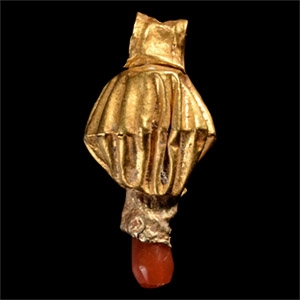
Roman Gold and Glass Pendant
1st-4th century A.D.Sold for (Inc. bp): £117
Comprising a hollow-form biconical pendant with vertical ribbing, cylindrical cell below set with a re-used coral-colour glass bead; applied suspension loop with a small piercing above. 0.41 grams, 17 mm
From the collection of a late Japanese collector, 1970s. This lot is accompanied by an illustrated lot declaration signed by the Head of the Antiquities Department, Dr Raffaele D'Amato.
Coral was regarded by the Romans as a material containing powerful charm. Sometimes it was attached to phalli, which in themselves were a charm to ward off the evil eye, as may be seen from a passage in the Geoponica (XV,1,31). -
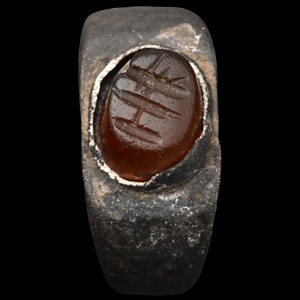
Roman Silver Ring with Carnelian Gemstone
2nd-3rd century A.D.Sold for (Inc. bp): £143
Comprising a flat-section hoop, cell to the bezel with inset carnelian stud, geometric motif. 3.94 grams, 19.72 mm overall, 16.88 mm internal diameter (approximate size British H 1/2, USA 4, Europe 6.81, Japan 6)
Ex German art market, 2000s. Acquired from an EU collector living in London. From the collection of a Surrey, UK, gentleman. This lot is accompanied by an illustrated lot declaration signed by the Head of the Antiquities Department, Dr Raffaele D'Amato. -
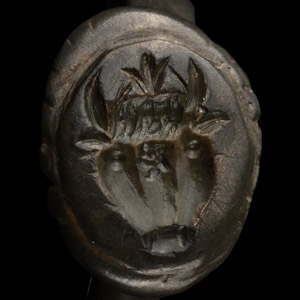
Roman Bronze Signet Ring with Bull's Head
4th-5th century A.D.Sold for (Inc. bp): £221
Ellipsoid bezel with incuse bucranium motif, star between the horns. 5.93 grams, 23.28 mm overall, 19.28 mm internal diameter (approximate size British R, USA 8 1/2, Europe 18 3/4, Japan 18)
Ex German art market, 2000s. Acquired from an EU collector living in London. From the collection of a Surrey, UK, gentleman. This lot is accompanied by an illustrated lot declaration signed by the Head of the Antiquities Department, Dr Raffaele D'Amato.
The bull-head motif is used in Mithraism, where it represents masculine power. -
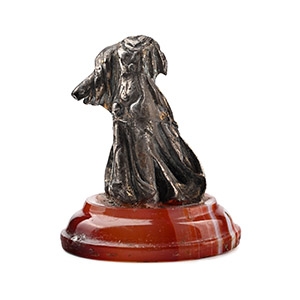
Roman Silver Statuette of a Goddess
1st-4th century A.D.Sold for (Inc. bp): £338
Modelled in the round female figure striding forwards, robe billowing around her form; mounted on a stepped onyx base. 56.7 grams, 49 mm
Acquired 1960s-1990s. From the late Alison Barker collection, a retired London barrister. Property of an Essex, UK, gentleman. This lot is accompanied by an illustrated lot declaration signed by the Head of the Antiquities Department, Dr Raffaele D'Amato. -
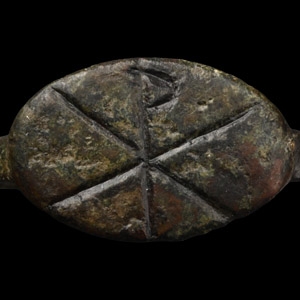
Late Roman Bronze Ring with Chi Rho
4th-6th century A.D.Sold for (Inc. bp): £260
Narrow hoop supporting an ellipsoid bezel, incised Christogram. 2.43 grams, 20.72 mm overall, 17.62 mm internal diameter (approximate size British N 1/2, USA 6 3/4, Europe 14.35, Japan 13)
Ex German art market, 2000s. Acquired from an EU collector living in London. From the collection of a Surrey, UK, gentleman. This lot is accompanied by an illustrated lot declaration signed by the Head of the Antiquities Department, Dr Raffaele D'Amato. -
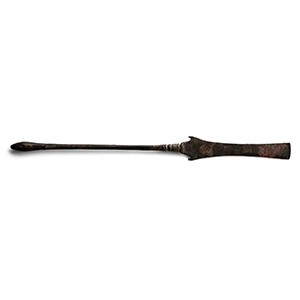
Roman Bronze Cosmetic Implement
1st-4th century A.D.Sold for (Inc. bp): £52
Comprising a flat blade with lateral spurs at the junction with the round-section shank terminating in a bulbous probe. 11.3 grams, 15.3 cm
Acquired on the UK art market during the late 20th century. From the private collection of David King (1940-2024), Hoddesdon, Hertfordshire, UK. This lot is accompanied by an illustrated lot declaration signed by the Head of the Antiquities Department, Dr Raffaele D'Amato. -
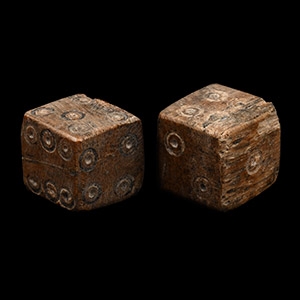
Roman Bone Gaming Dice Pair
1st-4th century A.D.Sold for (Inc. bp): £312
Cuboid with ring-and-dot markings disposed 1:6, 2:5, 3:4. 5.31 grams total, 11 mm each
Ex German art market, 2000s. Acquired from an EU collector living in London. From the collection of a Surrey, UK, gentleman. This lot is accompanied by an illustrated lot declaration signed by the Head of the Antiquities Department, Dr Raffaele D'Amato. -
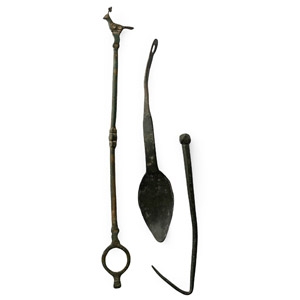
Roman Bronze Spoon, Pin and Distaff
1st-6th century A.D.Sold for (Inc. bp): £72
Comprising a spoon with ovoid, flat bowl; pin with polygonal finial stamped with ring-and-dot motifs, pierced towards the point; distaff with bird finial. 53 grams total, 11.5-20.5 cm
Acquired on the UK art market. Property of an East Anglia private collector. This lot is accompanied by an illustrated lot declaration signed by the Head of the Antiquities Department, Dr Raffaele D'Amato.

