-
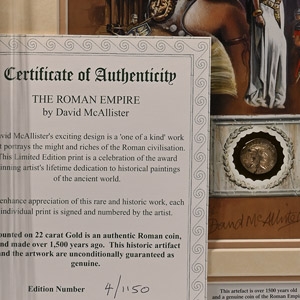
Silver Roman Coin and Framed Limited Edition Print
3rd century A.D. and laterSold for (Inc. bp): £52
The coin of Constantine the Great (272-337 A.D.) mounted on 22 carat gold foil, framed with an art print signed by the artist David McAllister, depicting scenes of Roman military activity; limited edition number 4/1150. 1.26 kg, 49.5 x 37.5 cm
UK gallery, early 2000s. Accompanied by a previous certificate of authenticity. This lot is accompanied by an illustrated lot declaration signed by the Head of the Antiquities Department, Dr Raffaele D'Amato.
David McAllister's exciting design is a 'one of a kind' work that portrays the might and riches of the Roman civilisation. This limited edition print is a celebration of the award winning artist's lifetime dedication to historical paintings of the ancient world. To enhance appreciation of this rare and historic work, each individual print is signed and numbered by the artist. -
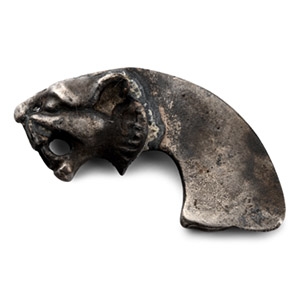
Roman Silver Razor Handle
1st-2nd century A.D.Sold for (Inc. bp): £156
Handle from a twin-bladed triangular razor, in the form of the head and neck of a panther, the head turned backwards, the panther having backwards-pointing ears, the eyes of the animal depicted by a horizontal engraved line within an elongated leaf-shaped moulding, the nose curving downwards and its tip tapering to a rounded end, smooth neck. 5.6 grams, 27 mm
Fine condition.
From a Home Counties collection, formed 1970-1980. From the private collection of John Meredith, acquired since the 1990s; thence by descent. This lot is accompanied by an illustrated lot declaration signed by the Head of the Antiquities Department, Dr Raffaele D'Amato. -
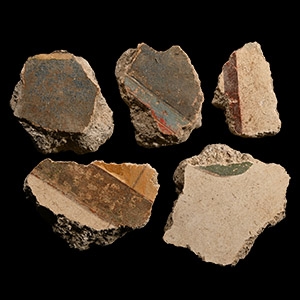
Roman Fresco Wall Plaster Collection
1st century A.D.Sold for (Inc. bp): £104
Fragments of wall plaster with rendered surface painted with mainly red, pale blue and white detailing; some with impression of timber laths to the reverse. 882 grams total, 8-11.3 cm
Acquired in the 19th century. Ex Jeger collection, Switzerland. UK gallery, early 2000s. This lot is accompanied by an illustrated lot declaration signed by the Head of the Antiquities Department, Dr Raffaele D'Amato.
These small fragments, for analogies with the fragments of Pompeii, seem to belong to the second style of Roman painting, red panels representing highlight and shadow, decorated with vegetal interlaces. Some panels were probably framed by a red grenade fillet. A fragment shows alternate blue and red colour over a cream background, maybe pertinent to a socle. -
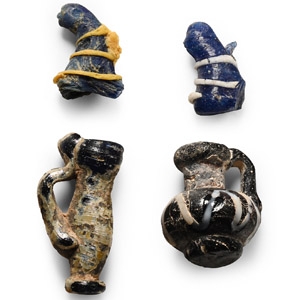
Roman Miniature Glass Group
1st-4th century A.D.Sold for (Inc. bp): £111
Comprising: a blue ewer with applied trails to the body; slender vase with applied handle; two small bottoms of toilet bottles with trails in contrasting colours. 14 grams total, 18-30 mm
From the private collection of Mr K.A., acquired in the 1990s-early 2000s. This lot is accompanied by an illustrated lot declaration signed by the Head of the Antiquities Department, Dr Raffaele D'Amato.
Some fragments of this small group belong to the category of glass toilet bottles decorated with a single trail of glass dropped onto the bottom of a spike, drawn up, then wound around wall and lower neck. -
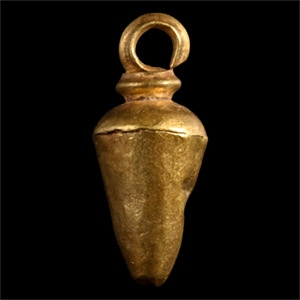
Late Roman Gold Teardrop Pendant
6th century A.D.Sold for (Inc. bp): £254
Comprising a conical body with collared suspension loop above. 0.31 grams, 11 mm
From the collection of a late Japanese collector, 1970s. This lot is accompanied by an illustrated lot declaration signed by the Head of the Antiquities Department, Dr Raffaele D'Amato.
During the Late Empire, earrings with biconical foil applications became widespread in Roman Egypt. The comparison with necklaces containing similar biconical elements used as beads or suspension elements for pendants seems to give consistency to the chronological indication of the 6th century, especially in that geographical area. -
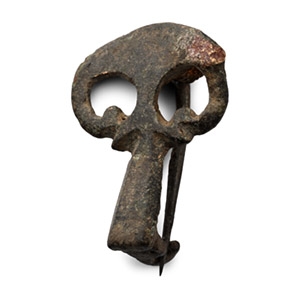
Roman Bronze Plate Brooch
2nd-4th century A.D.Sold for (Inc. bp): £33
Key-shaped with La Tène Style comma-shaped arms, chamfered edges to shank; pin and catch to reverse. 10.3 grams, 37 mm
Acquired on the London art market in the late 1980s-1990s. From the family collection of an East London, UK, gentleman. This lot is accompanied by an illustrated lot declaration signed by the Head of the Antiquities Department, Dr Raffaele D'Amato. -
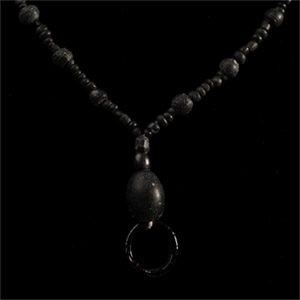
Roman Black Glass Bead Necklace String
1st-4th century A.D. and laterSold for (Inc. bp): £65
A designer necklace composed of mainly oblate beads, central feature composed of large barrel-shaped bead with a suspended glass ring below; restrung. 14.9 grams, 30.3 cm
From the London, UK, art market in the 1990s. This lot is accompanied by an illustrated lot declaration signed by the Head of the Antiquities Department, Dr Raffaele D'Amato.
In the Roman period there was a strong formal and chromatic diversity of glass beads used for necklaces and bracelets. The most common beads in forms were small biconical (lenticular), barrel-shaped, spherical and annular; the most common colours were dark blue, followed by green and yellow. The succession of glass beads often imitates jewellery made of costly materials (gold, silver, semi-precious and precious stones). Green, blue-green, blue, yellow, and black drawn and rounded glass beads (like here) are late Roman types. -
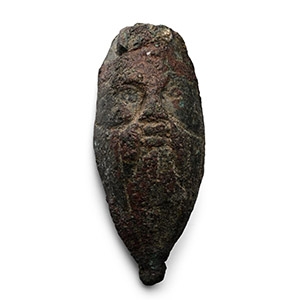
Roman Bronze Silenus Mask
1st-4th century A.D.Sold for (Inc. bp): £52
Lentoid in plan and hollow to the reverse, low-relief mask detailing. 25.9 grams, 43 mm
From the collection of a gentleman, acquired on the London art market in the 1990s. This lot is accompanied by an illustrated lot declaration signed by the Head of the Antiquities Department, Dr Raffaele D'Amato. -
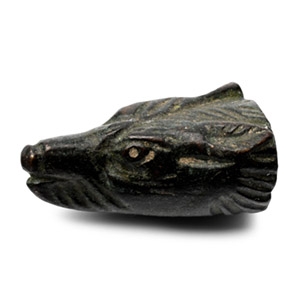
Roman Bronze Wolf's Head Terminal
1st-4th century A.D.Sold for (Inc. bp): £159
Modelled in the round with shallow socket to the reverse, high-relief facial detailing. 17.01 grams, 28 mm
Acquired on the London art market in the late 1980s-1990s. From the family collection of an East London, UK, gentleman. This lot is accompanied by an illustrated lot declaration signed by the Head of the Antiquities Department, Dr Raffaele D'Amato. -
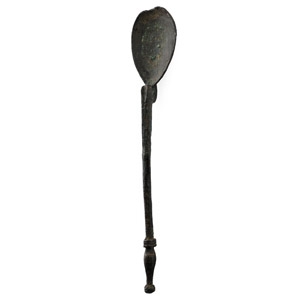
Roman Bronze Swan-Necked Spoon
1st-4th century A.D.Sold for (Inc. bp): £85
Shallow piriform bowl attached to a stepped baluster, hexagonal-section handle with baluster finial. 14.7 grams, 12.1 cm
Acquired on the UK art market during the late 20th century. From the private collection of David King (1940-2024), Hoddesdon, Hertfordshire, UK. This lot is accompanied by an illustrated lot declaration signed by the Head of the Antiquities Department, Dr Raffaele D'Amato. -
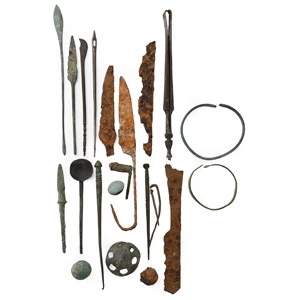
Roman and Other Bronze and Iron Artefact Group
1st-4th century A.D. and laterSold for (Inc. bp): £117
Including: bracelet with clubbed ends; single-edged knife blades; dress pins; brooch chord; and other items. 184 grams total, 1.6-14.6 cm
From a London, UK, collection 2000s. This lot is accompanied by an illustrated lot declaration signed by the Head of the Antiquities Department, Dr Raffaele D'Amato. -
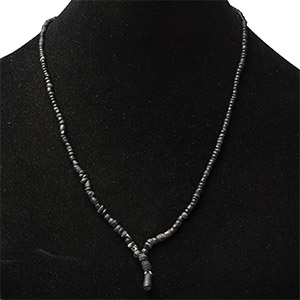
Roman Black Glass Bead Necklace String
4th century A.D. and laterSold for (Inc. bp): £46
Composed of mainly oblate beads restrung to a Y-shape. 9.93 grams, 48 cm
From the London, UK, art market in the 1990s. This lot is accompanied by an illustrated lot declaration signed by the Head of the Antiquities Department, Dr Raffaele D'Amato.
In the Roman period there was a strong formal and chromatic diversity of glass beads used for necklaces and bracelets. The most common beads in forms were small biconical (lenticular), barrel-shaped, spherical and annular; the most common colours were dark blue, followed by green and yellow. The succession of glass beads often imitates jewellery made of costly materials (gold, silver, semi-precious and precious stones). Green, blue-green, blue, yellow, and black drawn and rounded glass beads (like here) are late Roman types.

