-
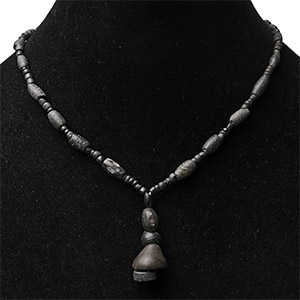
Roman Black Glass Bead Necklace String
4th century A.D. and laterSold for (Inc. bp): £39
A designer necklace string composed of alternating oblate and barrel-shaped beads; central feature composed of larger beads including a conical and an annular bead, restrung. 13.7 grams, 31 cm
From the London, UK, art market in the 1990s. This lot is accompanied by an illustrated lot declaration signed by the Head of the Antiquities Department, Dr Raffaele D'Amato.
In the Roman period there was a strong formal and chromatic diversity of glass beads used for necklaces and bracelets. The most common beads in forms were small biconical (lenticular), barrel-shaped, spherical and annular; the most common colours were dark blue, followed by green and yellow. The succession of glass beads often imitates jewellery made of costly materials (gold, silver, semi-precious and precious stones). Green, blue-green, blue, yellow, and black drawn and rounded glass beads (like here) are late Roman types. -
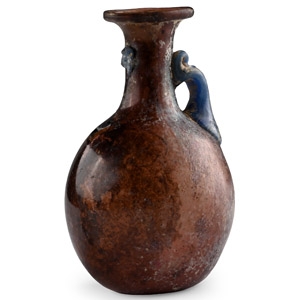
Roman Aubergine Glass Bottle
3rd century A.D.Sold for (Inc. bp): £156
With slightly flattened base and spherical body, tubular neck with flared and rolled rim, one handle absent. 22.77 grams, 77 mm
Ex property of a London collector; acquired 1960s. Property of a North London, UK, lady. This lot is accompanied by an illustrated lot declaration signed by the Head of the Antiquities Department, Dr Raffaele D'Amato. -
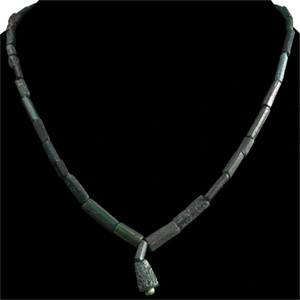
Roman Green Glass Bead Necklace String
1st-4th century A.D. and laterSold for (Inc. bp): £91
Composed of graduated cylindrical beads with a conical pendant bead at the centre; restrung. 19 grams, 39 cm
From the London, UK, art market in the 1990s. This lot is accompanied by an illustrated lot declaration signed by the Head of the Antiquities Department, Dr Raffaele D'Amato.
In the Roman period there was a strong formal and chromatic diversity of glass beads used for necklaces and bracelets. The most common beads in forms were small biconical (lenticular), barrel-shaped, spherical and annular; the most common colours were dark blue, followed by green and yellow. The succession of glass beads often imitates jewellery made of costly materials (gold, silver, semi-precious and precious stones). -
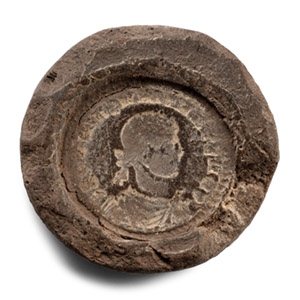
Roman Terracotta Forger's Casting Mould
4th century A.D.Sold for (Inc. bp): £208
Discoid clay mould with design of a coin to each face. 4.74 grams, 27 mmm
From the collection of a gentleman, acquired on the London art market in the 1990s. This lot is accompanied by an illustrated lot declaration signed by the Head of the Antiquities Department, Dr Raffaele D'Amato. -
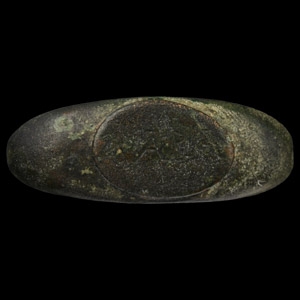
Roman Bronze Ring with APA
2nd-3rd century A.D.Sold for (Inc. bp): £91
Keeled hoop with angled shoulders, oval bezel with incised legend 'APA[I]', probably an abbreviated personal name. 7.43 grams, 26.67 mm overall, 18.25 x 13.32 mm internal diameter (approximate size British H, USA 3 3/4, Europe 6.18, Japan 6)
Acquired on the London art market in the late 1980s-1990s. From the family collection of an East London, UK, gentleman. This lot is accompanied by an illustrated lot declaration signed by the Head of the Antiquities Department, Dr Raffaele D'Amato. -
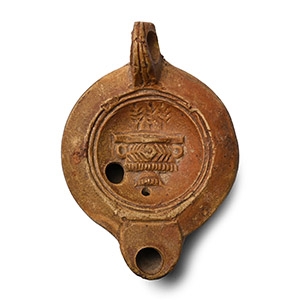
Roman Terracotta Oil Lamp with Amphora
2nd century A.D.Sold for (Inc. bp): £338
Squat in profile with small loop handle and D-shaped nozzle, discus with low-relief vessel and foliage; maker's mark to underside 'MNOVIVST'. 56 grams, 97 mm
From the private collection of a Canadian gentleman living in Essex, UK, formed since the 1920s-circa 1990. Property of an Essex lady until the late 1990s; thence by descent. From the private collection of an Essex gentleman since the late 1990s. This lot is accompanied by an illustrated lot declaration signed by the Head of the Antiquities Department, Dr Raffaele D'Amato.
The lamp belongs to the Bussière type, form D I 3, from a period between the Late Flavian era to the second half of the second century A.D. Like the types of this category, the ring handle shows two grooves on the upper part and the filling hole is in the lower part. -
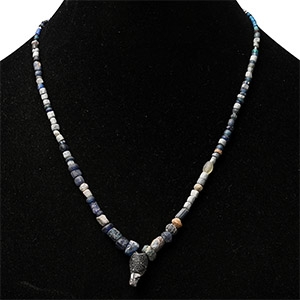
Roman Light Blue Glass and Stone Bead Necklace String
1st-4th century A.D. and laterSold for (Inc. bp): £20
Composed of graduated beads with larger beads as a central feature; restrung. 15.1 grams, 42 cm
From the London, UK, art market in the 1990s. This lot is accompanied by an illustrated lot declaration signed by the Head of the Antiquities Department, Dr Raffaele D'Amato.
Such necklaces testify to the popularity of glass ornaments across the Roman Empire. Roman jewellery at first followed trends set by the Etruscans, using gold and glass beads, but with the extension of the Empire and the adoption of different styles from Greece, Egypt and North Africa, jewellery designs became increasingly various and elaborate. Each bead of this beautiful necklace is unique in shape, lustre and speckling, creating a mosaic-like impression. Blue glass beads can be grouped into opaque mid-blue and deep translucent cobalt blue types. -
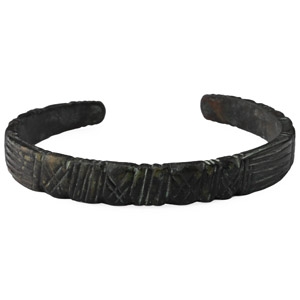
Roman Bronze Decorated Bracelet
1st-4th century A.D.Sold for (Inc. bp): £143
Penannular body with linear and X-motif decoration. 27 grams, 60 mm
Ex German art market, 2000s. Acquired from an EU collector living in London. From the collection of a Surrey, UK, gentleman. This lot is accompanied by an illustrated lot declaration signed by the Head of the Antiquities Department, Dr Raffaele D'Amato. -
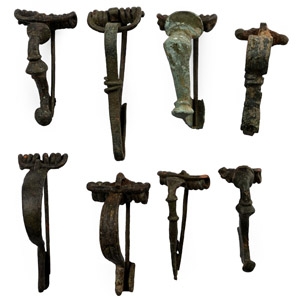
Roman Bronze Bow Brooch Collection
1st century-3rd century A.D.Sold for (Inc. bp): £176
Mainly Colchester-type and trumpet types. 45 grams total, 32-47 mm
From an English collection formed before 2000. This lot is accompanied by an illustrated lot declaration signed by the Head of the Antiquities Department, Dr Raffaele D'Amato. -
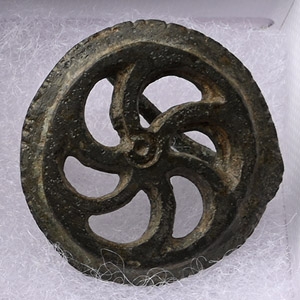
Romano-British Bronze Sun Wheel Plate Brooch
2nd century A.D.Sold for (Inc. bp): £85
With stepped rim, openwork radiating cured arms from a central hub; pin, pin-lugs, and catch to the reverse. 13.1 grams, 30 mm
Found Thames foreshore, London, UK. Acquired from Coincraft, London, UK. From the private collection of Kenneth Machin (1936-2020), Buckinghamshire, UK; his collection of antiquities and natural history was formed since 1948; thence by descent. Accompanied by a Coincraft certificate of authenticity. This lot is accompanied by an illustrated lot declaration signed by the Head of the Antiquities Department, Dr Raffaele D'Amato. -
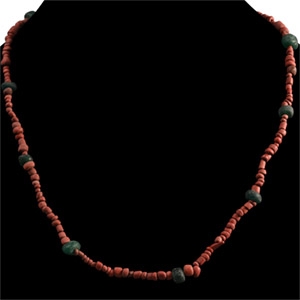
Roman Green and Red Glass Bead Necklace String
1st-4th century A.D. and laterSold for (Inc. bp): £72
Composed of mainly annular and oblate red glass beads interspersed with larger green glass beads; restrung. 24.9 grams, 61 cm long
From the London, UK, art market in the 1990s. This lot is accompanied by an illustrated lot declaration signed by the Head of the Antiquities Department, Dr Raffaele D'Amato.
In the Roman period there was a strong formal and chromatic diversity of glass beads used for necklaces and bracelets. The most common beads in forms were small biconical (lenticular), barrel-shaped, spherical and annular; the most common colours were dark blue, followed by green and yellow, and red. The succession of glass beads often imitates jewellery made of costly materials (gold, silver, semi-precious and precious stones). -
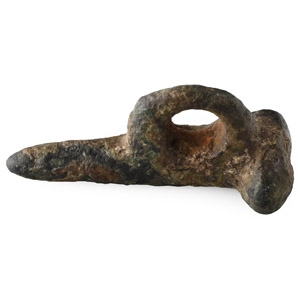
Roman Bronze Phallic Pendant
1st-2nd century A.D.Sold for (Inc. bp): £59
Formed as a stylised phallus with rounded testes and large suspension loop above. 15.1 grams, 38 mm
Acquired on the UK art market during the late 20th century. From the private collection of David King (1940-2024), Hoddesdon, Hertfordshire, UK. This lot is accompanied by an illustrated lot declaration signed by the Head of the Antiquities Department, Dr Raffaele D'Amato.

