-
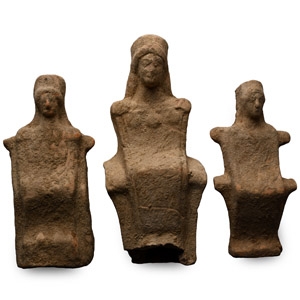
Archaic Greek Terracotta Seated Goddess Group
5th century B.C.Sold for (Inc. bp): £715
Each depicting a goddess seated on a wide high-backed throne and wearing a long dress, her hands resting on the lap. 778 grams total, 15.5-20 cm
with H.A.C., Basel, prior 1999. This lot is accompanied by an illustrated lot declaration signed by the Head of the Antiquities Department, Dr Raffaele D'Amato. -
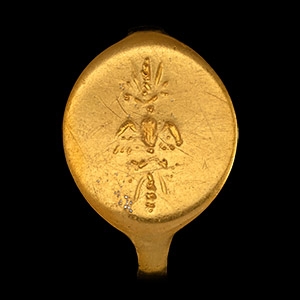
Greek Gold Ring with Thunderbolt
4th-3rd century B.C.Sold for (Inc. bp): £1,690
Flat-section hoop expanding to a flat discoid bezel with engraved stylised Zeus's thunderbolt. 3.78 grams, 21.88 mm overall, 20.32 mm internal diameter (approximate size British R 1/2, USA 8 3/4, Europe 19.38, Japan 18)
UK private collection before 2000. Acquired on the UK art market. Private collection, London, UK. This lot has been cleared against the Art Loss Register database, and is accompanied by an illustrated lot declaration signed by the Head of the Antiquities Department, Dr Raffaele D'Amato. -
.jpg)
Thracian Gold Clad Ribbed Torc with Decorated Terminals
4th-3rd century B.C.Sold for (Inc. bp): £13,000
Penannular in form with round-section shank and flat tongue-shaped terminals; the shank formed as a series of transverse rings modelled to represent granulation; the outer face of each terminal formed with punched detailing to the border and transverse final bars, two rows of punched annulets separated by a median gusset; some modern polishing. 467 grams, 29 cm
Swiss private collection, 1987. Private collection, London. This lot has been checked against the Interpol Database of stolen works of art and is accompanied by a search certificate number no.12859-241328. This lot has been cleared against the Art Loss Register database, and is accompanied by an illustrated lot declaration signed by the Head of the Antiquities Department, Dr Raffaele D'Amato. -
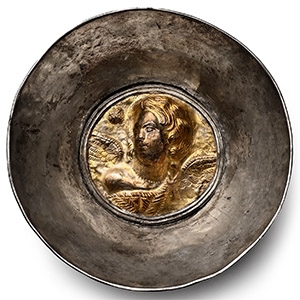
Hellenistic Silver-Gilt Cup with Nike
2nd-1st century B.C.Sold for (Inc. bp): £9,750
A hammered, chased and soldered silver-gilt cup with central medallion of Nike in high-relief; the bowl formed as a truncated cone with a shallow foot comprising an irregular circular 'ropework' border enclosing a floral motif, or double rosette; the bust of Nike showing the goddess draped in a goat skin with knot and ungulate leg with hoof at right shoulder, wings spread, hair dressed in curls, torc at neck, gazing left; face with almond-shaped eyes, straight nose and full, closed lips; with the exception of the face, all elements of the central medallion were originally gilt; housed in a custom-made velvet-lined box. 96.8 grams, 12.6 cm wide
Private collection, Mainz, Germany, 1980s. Acquired by the current owner from the above, 2006. Accompanied by a copy of a seven page examination report number 114/2019 by Dr Habil Mikhail Treister. This lot has been checked against the Interpol Database of stolen works of art and is accompanied by search certificate number no.12764-237139. This lot has been cleared against the Art Loss Register database, and is accompanied by an illustrated lot declaration signed by the Head of the Antiquities Department, Dr Raffaele D'Amato.
Nike was the winged goddess of victory. Goat-skin clothing was an attribute of Artemis, but here it is worn by Nike, attesting to the syncretic nature of the art embodied by this object. The workmanship of this piece suggests a local workshop in the Kuban basin. -
.jpg)
Minoan Carnelian Stamp Seal
2nd millennium B.C.Sold for (Inc. bp): £3,900
Discoid type with incuse motif of two stags placed symmetrically with their horns pointing inwards to the centre; supplied with a museum-quality impression. 1.98 grams, 14 mm
From the private collection of the late R Priday, Brookman Hall, Hertfordshire, UK; thence by descent. This lot has been checked against the Interpol Database of stolen works of art and is accompanied by search certificate number no.12808-240846. This lot has been cleared against the Art Loss Register database, and is accompanied by an illustrated lot declaration signed by the Head of the Antiquities Department, Dr Raffaele D'Amato. -
.jpg)
Minoan Rock Crystal Gemstone with Ship
1500-1200 B.C.Sold for (Inc. bp): £1,040
Discoid body, on one face engraving of a ship with curved body, paddles and cross-hatched sail; pierced vertically for suspension. 3.1 grams, 16 mm
From an old London, UK, collection formed before 1975. Property of a Middlesex, UK, gentleman antiquarian. This lot is accompanied by an illustrated lot declaration signed by the Head of the Antiquities Department, Dr Raffaele D'Amato. -
.jpg)
Etruscan Silver Ring with Amethyst Scarab Seal
4th century B.C.Sold for (Inc. bp): £546
Wire hoop with ends wound round the shank at each shoulder with one end detached, swivel-mounted amethyst scarab seal with flat underside, segmented border around a dolphin with putto mounted on its back. 5.44 grams, 30.77 mm overall, 25.27 mm internal diameter (approximate size British W, USA 11, Europe 25, Japan 24)
From the private collection of Mr K.A., acquired in the 1990s-early 2000s. This lot is accompanied by an illustrated lot declaration signed by the Head of the Antiquities Department, Dr Raffaele D'Amato.
Egyptian-style scarabs and scaraboids were characteristic of Etruscan art from the 8th century B.C. Originally made in Phoenicia, Cyprus or Rhodes, these objects were made of faience, blue paste, glass paste and bone, or semi-precious stones of varying hardness, from steatite to quartz, onyx and jasper. Mounted in settings on revolving pendants of precious metal, which were later imitated by Etruscan goldsmiths, these Egyptianising items performed prophylactic-religious functions, through the use of sacred or magical imagery taken from hieroglyphic language: royal names or titles, theonyms, sacred symbols, and auspicious formulas. -
.jpg)
Greek Bronze Ring with Standing Hermes
4th-3rd century B.C.Sold for (Inc. bp): £1,690
Ellipsoid plaque with intaglio Hermes standing on a baseline with petasos, marsupium and caduceus; supplied with a museum-quality impression. 11.41 grams, 25.26 mm overall, 20.87 mm internal diameter (approximate size British P, USA 7 1/2, Europe 16.23, Japan 15)
European private collection, 1980s. Private collection, acquired on the German art market in 2001. This lot has been cleared against the Art Loss Register database, and is accompanied by an illustrated lot declaration signed by the Head of the Antiquities Department, Dr Raffaele D'Amato. -
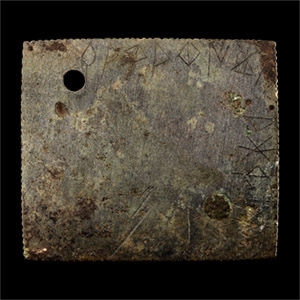
Northeastern Iberian Votive Plaque with Inscription
3rd-2nd century B.C.Sold for (Inc. bp): £260
Rectangular in plan with hatched edges; two rivet holes, one with rivet in situ; legend in Northeastern Iberian around, apparently: r-a-r-a-r-i-co-[..]-a-bo-r-a-[..]-ca-a. 25.78 grams, 43 mm
From an old London, UK, collection since circa 1985. This lot is accompanied by an illustrated lot declaration signed by the Head of the Antiquities Department, Dr Raffaele D'Amato. -
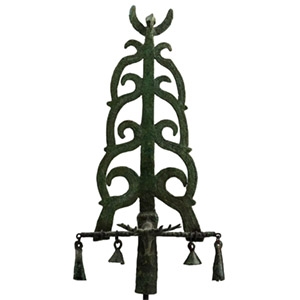
Scythian Bronze Military Standard Finial with Animals
4th century B.C.Sold for (Inc. bp): £18,200
An elaborate finial, likely from a ceremonial staff or pole, comprising a vertical shaft supporting an openwork plate in the form of stylised stag's antlers; shaft with a sculpted stag’s head with elongated ears and simplified features, extending to antlers with four branches on each side; flat plate above with ornament consisting of four graduated tiers of scrolled 'antlers', each with detailed decorative chasing (incised bands with diagonal lines); above, a crescent (possibly representing wings) flanking a frontal raptor's head with a hooked beak and engraved notching (probably a symbolic addition); a horizontal tube or sleeve passing through the base of the plate, decorated with transverse grooves with bells suspended below and from small loops near the stag’s head; each bell made from thin bronze sheet, conical in shape; accompanied by a custom-made display stand. 2.39 kg total, 49 cm including stand
Franz Heger (1853–1931), Austrian traveller and ethnographer, acquired in the Caucasus during his 1890 expedition. Believed to have been gifted circa 1930 to Franz Hancar (1893–1968), noted scholar and expert in ancient Caucasian cultures. Thence by descent, acquired in the 1950s by Mr R.D., Vienna. Acquired from the above in 1998 by N.M., former Israeli Ambassador to Austria (1998–2000). Accompanied by a copy of a nine page examination report number 137/2015 by Dr Habil Mikhail Treister. This lot has been checked against the Interpol Database of stolen works of art and is accompanied by a search certificate number no.12861-240722. This lot has been cleared against the Art Loss Register database, and is accompanied by an illustrated lot declaration signed by the Head of the Antiquities Department, Dr Raffaele D'Amato.
This piece resembles a pair of bronze finials discovered in 1913, now in the Museum of Novocherkassk. However, there are notable differences: the Novocherkassk examples have paired birds at the top rather than a single bird, and lack antlers or suspended bells. Experts have dated the Novocherkassk pieces to around 500-400 BC. This example, though unique, shares key stylistic traits, particularly the scrollwork antlers with other bronze horse gear fittings and finials found in the Kuban Basin, many securely dated to the 4th century BC based on associated amphora finds. Comparable decorative styles such as bands of oblique lines appear on horse harnesses from known Scythian burial sites. This, along with the concentration of similar finds in the Kuban region, supports the idea that this finial also originated there. Scholars have suggested that finials like this symbolise the Tree of Life, especially when birds are present. The bird at the top of this piece may reflect that idea. Similar imagery appears on a bronze finial from Alexandropol and another from Lysaya Gora, the latter depicting the Scythian god Papaeus (akin to Zeus). While exact dating is difficult due to lack of archaeological context, stylistic parallels suggest a 4th century BC origin is most likely. Its unusual combination of sculpted and openwork elements, along with its symbolic imagery, makes it a rare and important example of Scythian or Maiotian bronze craftsmanship. -
.jpg)
Roman Silver-Gilt Statuette of Harpocrates
1st-2nd century A.D.Sold for (Inc. bp): £650
Standing nude with his right forefinger to his mouth, with crescent headdress and cornucopia supported on his left arm. 7.19 grams, 32 mm
Acquired in the late 1980s-early 1990s. Private collection, London, UK. This lot is accompanied by an illustrated lot declaration signed by the Head of the Antiquities Department, Dr Raffaele D'Amato. -
.jpg)
Roman Silver-Gilt Statuette of Fortuna
1st-2nd century A.D.Sold for (Inc. bp): £780
Modelled in the round and finely detailed, the goddess standing with a cornucopia in the crook of her left arm, wearing a floor-length palla. 18.48 grams, 39 mm
Acquired in the late 1980s-early 1990s. Private collection, London, UK. This lot is accompanied by an illustrated lot declaration signed by the Head of the Antiquities Department, Dr Raffaele D'Amato.

