-
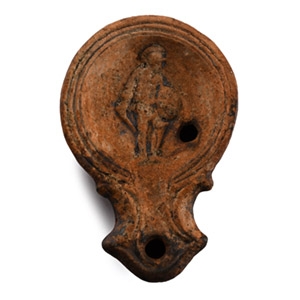
Roman Terracotta Oil Lamp
1st century A.D.Sold for (Inc. bp): £468
Short nozzle with lateral volute scrolls, broad discus with concentric circles, central motif of a standing figure in crested helmet and one greave holding a round shield and short sword; probably a scutarius gladiator; incise 'VIL' maker's mark to underside. 103 grams, 10.2 cm
From a private UK collection formed in the 1980s. This lot is accompanied by an illustrated lot declaration signed by the Head of the Antiquities Department, Dr Raffaele D'Amato. -
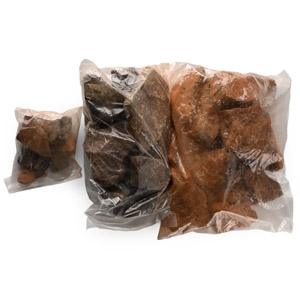
Roman Roof Tile and Pottery Sherd Group
1st-4th century A.D.Sold for (Inc. bp): £26
A large quantity of variously sized fragments. 2.81 kg total, 3.1-10.6 cm
Found whilst searching in Devon, Somerset and Wiltshire, UK. This lot is accompanied by an illustrated lot declaration signed by the Head of the Antiquities Department, Dr Raffaele D'Amato.
N.B. This lot is for UK buyers only. -
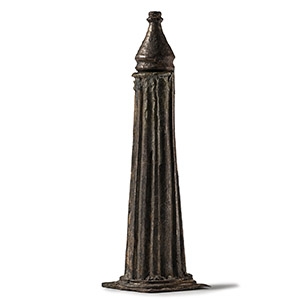
Roman Sheet-Silver Pyxis in the form of a Column
1st-2nd century A.D.Sold for (Inc. bp): £351
Formed as a fluted column on a square, stepped base; separate poppy-shaped lid; fine cracks to the rim. 14.2 grams, 83 mm
Ex Herbert A. Cahn, Basel, 1990s. Accompanied by a copy of an Art Loss Register certificate no.S00037854. This lot is accompanied by an illustrated lot declaration signed by the Head of the Antiquities Department, Dr Raffaele D’Amato. This lot is accompanied by an illustrated lot declaration signed by the Head of the Antiquities Department, Dr Raffaele D'Amato. -
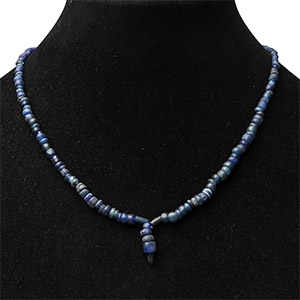
Roman Blue Glass Bead Necklace String
1st-4th century A.D. and laterSold for (Inc. bp): £98
Composed of mainly oblate and annular beads; restrung to a Y-shape. 11.9 grams, 38.2 cm
From the London, UK, art market in the 1990s. This lot is accompanied by an illustrated lot declaration signed by the Head of the Antiquities Department, Dr Raffaele D'Amato.
Such necklaces testify to the popularity of glass ornaments across the Roman Empire. Roman jewellery at first followed trends set by the Etruscans, using gold and glass beads, but with the extension of the Empire and the adoption of different styles from Greece, Egypt and North Africa, jewellery designs became increasingly various and elaborate. Each bead of this beautiful necklace is unique in shape, lustre and speckling, creating a mosaic like impression. Blue glass beads are distinguished by the scholars in opaque mid-blue and deep translucent cobalt blue. -
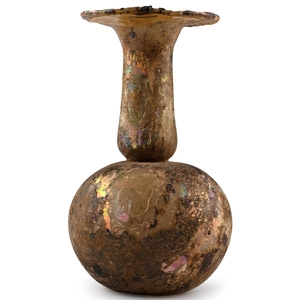
Roman Glass Bottle
3rd-4th century A.D.Sold for (Inc. bp): £130
With broad flange rim, tapering neck and globular body with narrow base. 27 grams, 82 mm
From the private collection of Kenneth Machin (1936-2020), Buckinghamshire, UK; his collection of antiquities and natural history was formed since 1948; thence by descent. This lot is accompanied by an illustrated lot declaration signed by the Head of the Antiquities Department, Dr Raffaele D'Amato. -
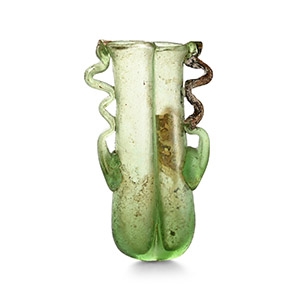
Roman Green Glass Handled Double Unguentarium
4th-5th century A.D.Sold for (Inc. bp): £234
Comprising two parallel tubes with rolled rims, joined at the base; applied handle styled as 'waves', iridescence to the surface. 77 grams, 10.9 cm
Acquired on the European art market in the early 2000s. with Galerie Rhéa, Zurich, Switzerland. This lot is accompanied by an illustrated lot declaration signed by the Head of the Antiquities Department, Dr Raffaele D'Amato. -
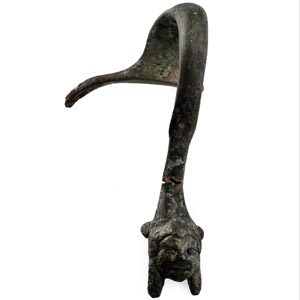
Roman Bronze Vessel Handle with Face
Circa 2nd century B.C.Sold for (Inc. bp): £78
Comprising a crescentic head with arched bow and leaf-shaped finial displaying the head of Medusa with snakes in her hair in high-relief, surrounded by leaf detailing; bow with stylised vegetal detailing and spur serving as a thumb-pad; repaired. 55.6 grams, 95 mm
Acquired on the UK art market circa 2005. From an old North Country, UK, collection. This lot is accompanied by an illustrated lot declaration signed by the Head of the Antiquities Department, Dr Raffaele D'Amato. -
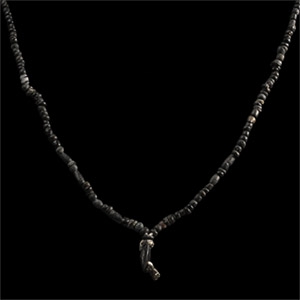
Roman Black Glass Bead Necklace String
1st-4th century A.D. and laterSold for (Inc. bp): £85
Composed of mainly oblate and annular beads; restrung. 8.52 grams, 48 cm
From the London, UK, art market in the 1990s. This lot is accompanied by an illustrated lot declaration signed by the Head of the Antiquities Department, Dr Raffaele D'Amato.
In the Roman period there was a strong formal and chromatic diversity of glass beads used for necklaces and bracelets. The most common beads in forms were small biconical (lenticular), barrel-shaped, spherical and annular; the most common colours were dark blue, followed by green and yellow. The succession of glass beads often imitates jewellery made of costly materials (gold, silver, semi-precious and precious stones). Green, blue-green, blue, yellow, and black drawn and rounded glass beads (like here) are late Roman types. -
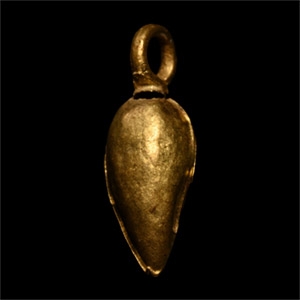
Roman Gold Teardrop Pendant
1st-4th century A.D.Sold for (Inc. bp): £234
A delicate pendant formed from sheet-gold with a loop above. 0.13 grams, 10 mm
From the collection of a late Japanese collector, 1970s. This lot is accompanied by an illustrated lot declaration signed by the Head of the Antiquities Department, Dr Raffaele D'Amato. -
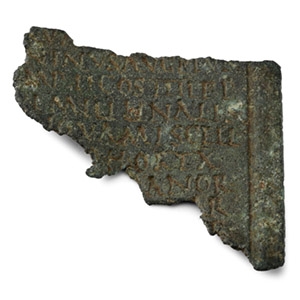
Roman Bronze Military Diploma Fragment Issued Under Antoninus Pius to Auxiliaries Stationed in Moesia Superior
22 April 157 A.D.Sold for (Inc. bp): £780
The edge of a diploma with eight partial lines of text to one side, and six partial lines to the other side; the restored text to the point of textual overlap between obverse and reverse; full stop is used for subscript dot: remains of letter with uncertain reading: Tabella I extrinsecus (obverse): [imp(erator) caes(ar) divi hadriani f(ilius) divi traiani] [part(hici) nepos divi ne]RVA.[e pron(epos) t(itus) aelius] [hadrianus anto]NINVS AVG(ustus) PIVS [pont(ifex) max(imus) trib(unicia) pot(estate) xx i]MP(erator) II CO(n)S(ul) IIII P(ater) P(atriae) [equitib(us) et peditib(us) q]VI MILIT(averunt) IN ALIS [ii quae appell(antur) i claudia] N.OVA MISCELL(anea) [et i gallor(um) flaviana et c]OHORT(ibus) X [v gallor(um) et pannonior(um) et v hisp]ANOR(um) [et i montanor(um) et i antioch(ensium) sagit]T.AR(iorum)1 [et i cretum sagittar(ia) et III campestr(is) c(ivium)] R(omanorum) et ii gallor(um) macedon(ica) et iii britton(um) vet(eranorum) et i aug(usta) lusitanor(um) et i pannonior(um) vet(eranorum) et sunt in moesia sup(eriore)] etc Tabella I intus (reverse): [... et sunt in moesia superior(e) sub] [c]VRTIO. [iusto leg(ato) xxv stip(endis) emer(itis) dimis(sis)] [h]ON(esta) M.[ission(e) quor(um) nomina subscr(ipta)] SVNT C.[ivit(atem) Roman(am) qui eor(um) non haber(ent)] [d]EDIT ET [conub(ium) cum uxorib(us)] [qu]A{s=B} {t=I}VN[c habuis(sent) cum est civit(as) is dat(a) aut cum is] Q.VA{s=C} POST(ea) [duxiss(ent) dumtax(at) singulis] etc on tabella II intus. 7.33 grams, 42 mm
Acquired on the UK art market. Property of a gentleman collector. Accompanied by a copy of an illustrated transliteration report by Dr Ittai Gradel. This lot is accompanied by an illustrated lot declaration signed by the Head of the Antiquities Department, Dr Raffaele D'Amato.
Text reconstruction following Eck-Pangerl, ‘Moesia und seine Truppen. Neue Diplome für Moesia und Moesia Superior’, Chiron 38 (2008), 369-77 – all these fragments naming Curtius Iustus go back to a constitutio dated 23. April 157 (see Eck-Pangerl for discussion: they list nine copies, including a complete one; this is the second largest number known of any constitutio; yet another – the tenth - copy published by Eck-MacDonald-Pangerl in ZPE 165 (2008), 237-9). -
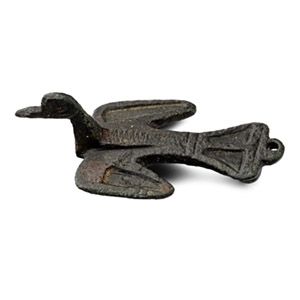
Late Roman Bird in Flight Plate Brooch
6th century A.D.Sold for (Inc. bp): £143
Aviform brooch with inset panels to to wings, tail and head to accept enamel; pin-lug and catchplate below. 6.19 grams, 39 mm
Property of a gentleman; acquired in the 1970s. This lot is accompanied by an illustrated lot declaration signed by the Head of the Antiquities Department, Dr Raffaele D'Amato. -
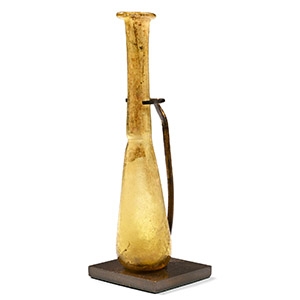
Roman Yellow Glass Bottle
3rd-4th century A.D.Sold for (Inc. bp): £111
Piriform body with long tubular neck and everted rim; accompanied by a custom-made display stand. 57 grams total, 96 mm (10.1 cm including stand)
Private collection of Mr K.A., acquired in the 1990s-early 2000s. This lot is accompanied by an illustrated lot declaration signed by the Head of the Antiquities Department, Dr Raffaele D'Amato.

