-
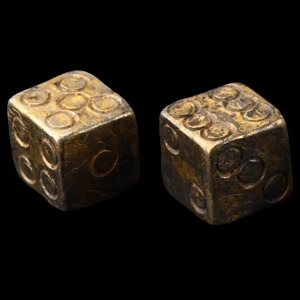
Silver-Gilt Gaming Dice Pair
Roman, 1st-4th century A.D. or laterSold for (Inc. bp): £260
Each cuboid with punched rings disposed 1:6, 2:4, 3:5. 8.63 grams total, 8 mm each
Ex German art market, 2000s. Acquired from an EU collector living in London. From the collection of a Surrey, UK, gentleman. This lot is accompanied by an illustrated lot declaration signed by the Head of the Antiquities Department, Dr Raffaele D'Amato. -
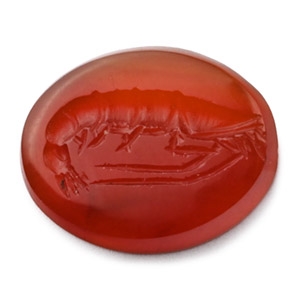
Roman Carnelian Gemstone with Shrimp
2nd-3rd century A.D.Sold for (Inc. bp): £234
Intaglio shrimp motif with articulated body. 0.60 grams, 13 mm
Acquired on the London art market in the late 1980s-1990s. From the family collection of an East London, UK, gentleman. This lot is accompanied by an illustrated lot declaration signed by the Head of the Antiquities Department, Dr Raffaele D'Amato. -
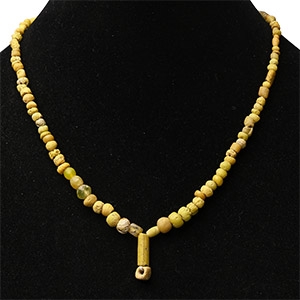
Roman Yellow Glass Bead Necklace String
1st-4th century A.D. and laterSold for (Inc. bp): £39
Composed mainly of oblate beads, central feature composed of a tubular bead with a facetted bead suspended below; restrung. 16.8 grams, 39.7 cm
From the London, UK, art market in the 1990s. This lot is accompanied by an illustrated lot declaration signed by the Head of the Antiquities Department, Dr Raffaele D'Amato.
In the Roman period there was a strong formal and chromatic diversity of glass beads used for necklaces and bracelets. The most common beads in forms were small biconical (lenticular), barrel-shaped, spherical and annular; the most common colours were dark blue, followed by green and yellow. The succession of glass beads often imitates jewellery made of costly materials (gold, silver, semi-precious and precious stones). -
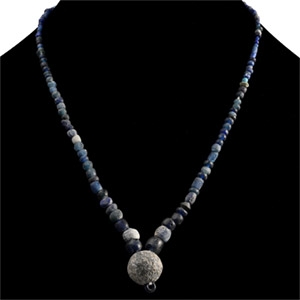
Roman and Other Blue Glass Bead Necklace String
1st-4th century A.D. and laterSold for (Inc. bp): £182
Composed of graduated oblate and other beads, central feature a large spherical bead; restrung. 23.7 grams, 43.5 cm
From the London, UK, art market in the 1990s. This lot is accompanied by an illustrated lot declaration signed by the Head of the Antiquities Department, Dr Raffaele D'Amato.
Such necklaces testify to the popularity of glass ornaments across the Roman Empire. Roman jewellery at first followed trends set by the Etruscans, using gold and glass beads, but with the extension of the Empire and the adoption of different styles from Greece, Egypt and North Africa, jewellery designs became increasingly various and elaborate. Each bead of this beautiful necklace is unique in shape, lustre and speckling, creating a mosaic like impression. Blue glass beads are distinguished by the scholars in opaque mid-blue and deep translucent cobalt blue -
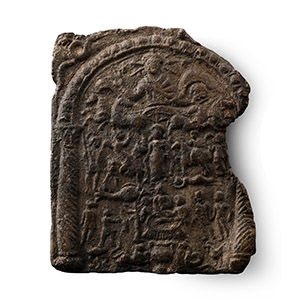
Roman Danubian Votive Lead Plaque with Dioscuri and Helen of Troy
2nd-3rd century A.D.Sold for (Inc. bp): £247
Displaying a figural scene in relief with an arch decorated with egg-and-dart motifs and resting on smooth pillars with foliate capitals; the upper field dominated by Sol wearing a radiate crown with seven rays and driving a facing quadriga, holding a globe in his left hand; the central field showing the Dioscuri on horseback, raising their right arm in salutation of their divine sister Helen of Troy at the centre, the twin on the left, whose horse is trampling a naked prisoner, followed by an armoured warrior holding an oval shield and spear, wearing a crested helmet in pseudo-Attic style, the twin on the right, whose horse is trampling over a big fish, followed by a character dressed in long garment and raising his hand in salute; the lower field showing worshippers preparing an offering meal; a coiled serpent to each top corner (one absent). 137 grams, 94 mm
Acquired on the UK art market during the late 20th century. From the private collection of David King (1940-2024), Hoddesdon, Hertfordshire, UK. This lot is accompanied by an illustrated lot declaration signed by the Head of the Antiquities Department, Dr Raffaele D'Amato.
The complex iconography of the plaque relates to the pre-Christian religions of the Lower Danube region. It was concentrated on the figure of Sol Invictus, the sun god, who was often represented driving a quadriga. This cult came from the Near East but spread into the Roman Empire with imperial patronage; symbolism like this was part of the cult of Mithras that was found throughout the empire from Britain (a temple to Mithras can still be seen in the modern City of London) to its eastern coasts in the ancient colonies of Thracia and Dacia, Moesia, Pannonia and Dalmatia. The rest of the plaque shows worshippers (probably the donors of the votive plaque) who are preparing the offering meal, while the riders on horseback, the divine twins Castor and Pollux, evoke the cult of the Danubian rider. Their sister Helen of Troy stands at an altar of Sol like a priestess, representing fertility. As suggested by Aimone, the presence of the two horsemen seems suggest a military context, a connection underlined by the presence of the fully armoured soldier at the left. This iconography was very popular in the Roman Empire and lasted until the 4th century A.D., being also the subject of other artworks, like the fabulous tray in the recently published Wyvern collection (Aimone, 2020, pp.95ff.). -
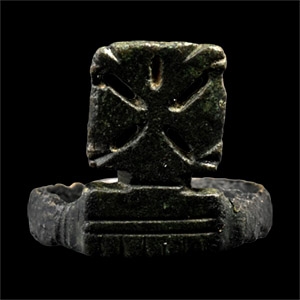
Romano-British Key Ring with Saltire Cross
4th century A.D.Sold for (Inc. bp): £98
Comprising a large D-section hoop with 'faux twist' decoration and a rectangular panel at the base, rectangular section bezel with linear decoration expanding to an openwork shank with saltire cross. 5.98 grams, 25.50 mm overall, 21.47 mm internal diameter (approximate size British U 1/2, USA 10 1/4, Europe 23.15, Japan 22)
Found near Ragby, Lincolnshire, UK This lot is accompanied by an illustrated lot declaration signed by the Head of the Antiquities Department, Dr Raffaele D'Amato.
Rotary type ring-keys are recorded from excavations in Colchester and associated with small boxes and caskets of personal possessions, rather than doors or cupboards. -
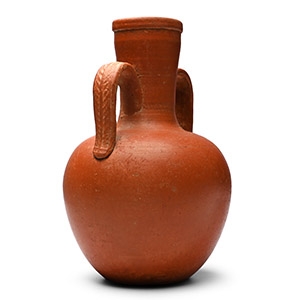
Roman Redware Amphora-Shaped Vase with Leaf-Decorated Handles
3rd-4th century A.D.Sold for (Inc. bp): £338
Squat in profile with flared neck and ribbed mouth, lateral strap handles with laurel leaf ornament. 337 grams, 18.6 cm
From the private collection of a Canadian gentleman living in Essex, UK, formed since the 1920s-circa 1990. Property of an Essex lady until the late 1990s; thence by descent. From the private collection of an Essex gentleman since the late 1990s. This lot is accompanied by an illustrated lot declaration signed by the Head of the Antiquities Department, Dr Raffaele D'Amato.
A wide range of types, dates and origins of amphorae excavated demonstrate the extensive and changing trading contacts between the centres of the Roman Empire. For example, the vessels from sites excavated by the Trust in different areas of Roman York, comprise one almost complete amphora, some 200 rims, handles and spikes and numerous body sherds, witnessing a wide rage of commercial movement between Roman Hispania, Germania and Britannia. -
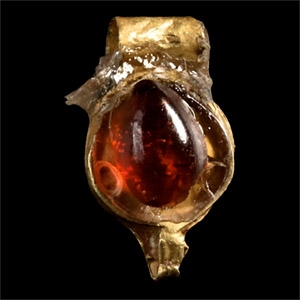
Roman Gold Pendant with Garnet
4th-5th century A.D.Sold for (Inc. bp): £156
Discoid pendant with cell, inset cabochon garnet, integral loop above. 0.15 grams, 9 mm
From the collection of a late Japanese collector, 1970s. This lot is accompanied by an illustrated lot declaration signed by the Head of the Antiquities Department, Dr Raffaele D'Amato.
The object reflect Late Antique/Early Eastern Roman decorative and manufacturing traditions. Flat garnet plates originate with one class of ring-stone intaglios from the Late Hellenistic and Imperial Roman periods, but developed especially in the 4th-6th century, where they preserved the Romano-Greco traditions with the influence of Sassanian and Pontic peoples. They were used for jewellery, weaponry and decorative expensive objects. -
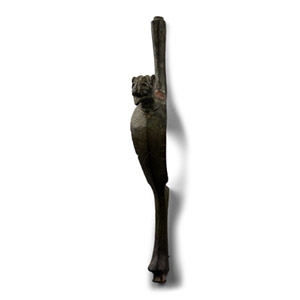
Roman Bronze Miniature Table Leg with Face of a Lion
1st-4th century A.D.Sold for (Inc. bp): £46
The shank formed as two octagonal-section bulbs with median carinated bow; incuse geometric pattern, lion-mask modelled in the round with protruding tongue. 60 grams, 13.2 cm
Acquired on the UK art market. Property of an East Anglia private collector. This lot is accompanied by an illustrated lot declaration signed by the Head of the Antiquities Department, Dr Raffaele D'Amato. -
.jpg)
Roman Bone Gaming Dice Pair
1st-4th century A.D.Sold for (Inc. bp): £182
Cuboid with ring-and-dot markings disposed 1:6, 2:5, 3:4. 2.36 grams, 8-9 mm
Ex German art market, 2000s. Acquired from an EU collector living in London. From the collection of a Surrey, UK, gentleman. This lot is accompanied by an illustrated lot declaration signed by the Head of the Antiquities Department, Dr Raffaele D'Amato. -
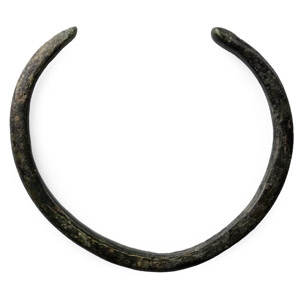
Roman Bronze Snake-Headed Bracelet
1st-4th century A.D.Sold for (Inc. bp): £156
Penannular rectangular-section bracelet with stylised snake-head finials. 16.5 grams, 60 mm
Ex German art market, 2000s. Acquired from an EU collector living in London. From the collection of a Surrey, UK, gentleman. This lot is accompanied by an illustrated lot declaration signed by the Head of the Antiquities Department, Dr Raffaele D'Amato. -
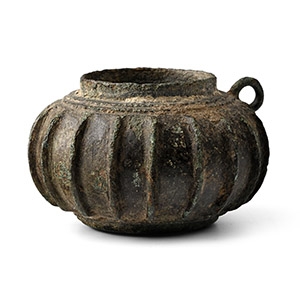
Roman Bronze Fluted Pyxis
1st-4th century A.D.Sold for (Inc. bp): £260
Squat in profile with discoid foot, vertical flanges to the sidewall, raised rings to the shoulder and low neck; loop handle. 99 grams, 65 mm
Acquired on the UK art market during the late 20th century. From the private collection of David King (1940-2024), Hoddesdon, Hertfordshire, UK. This lot is accompanied by an illustrated lot declaration signed by the Head of the Antiquities Department, Dr Raffaele D'Amato.

