-
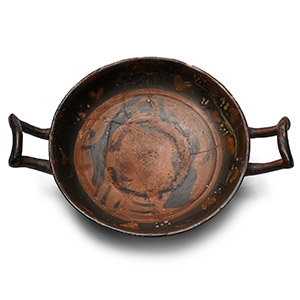
Greek Blackware Kylix
Circa 5th century B.C.Sold for (Inc. bp): £182
Broad and shallow with two strap handles, tondo displaying a wreath of ivy-leaves with tendrils and volutes underneath; the underside of the bowl with acanthus motifs; restored. 215 grams, 21.5 cm wide
Acquired on the UK art market, early 2000s. This lot is accompanied by an illustrated lot declaration signed by the Head of the Antiquities Department, Dr Raffaele D'Amato.
Drinking cups (kylikes and skyphoi), along with mixing bowls and wine coolers (kraters and psykters), wine jars (amphorae), water jars (hydrai), pitchers (oinochoai), and ladles (kyathoi), were essential equipment for drinking parties. The kylix appears to have been the most popular form of drinking cup, probably because it was especially well suited to the Greek custom of eating and drinking while reclining on a couch. These Attic kylikes were usually presented with a stemmed base, a deep bowl and two upturned loop handles, on a concave base. -
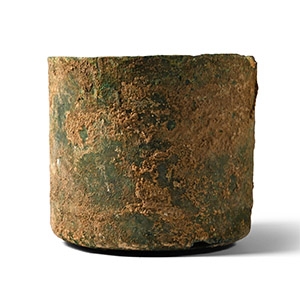
Etruscan Bronze Cup
7th-6th century B.C.Sold for (Inc. bp): £208
With rounded base and cylindrical body gently tapering towards the top. 137 grams, 94 mm wide
Ex London, UK, collections, 1990s-2000s. This lot is accompanied by an illustrated lot declaration signed by the Head of the Antiquities Department, Dr Raffaele D'Amato.
Such small cylindrical cups were destined for everyday use, and some bronze specimens of the same typology, were often engraved on their outer surface with groups of animals. A large variety of drinking-cups were in use among the ancients; Athenaeus in the eleventh book of his Deipnosophists gives a long list of names of such cups, but his descriptions are not sufficient to identify them with any known shapes; moreover, a great many appear to be fanciful names that had come into favour at the time. -
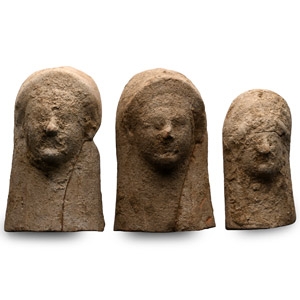
Greek Terracotta Female Protome Group
Early 5th century B.C.Sold for (Inc. bp): £208
Each tongue-shaped in plan and hollow to the reverse, female bust in high-relief with palla head-covering. 350 grams total, 9.5-11.4 cm
with H.A.C., Basel, prior 1999. This lot is accompanied by an illustrated lot declaration signed by the Head of the Antiquities Department, Dr Raffaele D'Amato. -
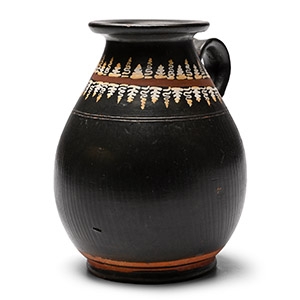
Greek Gnathian Black-Glazed Jug with Grape Vines
South Italic, 5th-3rd century B.C.Sold for (Inc. bp): £442
Blackware juglet with pedestal base, bulbous body, waisted neck and everted rim; the applied handle to the rear; band of red flanked by cream and white fronds to the shoulder. 155 grams, 11 cm
From the private collection of a Canadian gentleman living in Essex, UK, formed since the 1920s-circa 1990. Property of an Essex lady until the late 1990s; thence by descent. From the private collection of an Essex gentleman since the late 1990s. This lot is accompanied by an illustrated lot declaration signed by the Head of the Antiquities Department, Dr Raffaele D'Amato. -
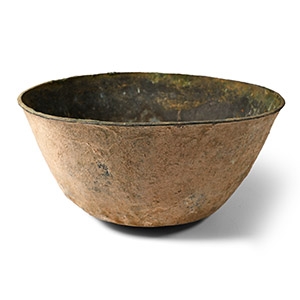
Villanovan Bronze Cup
750-730 B.C.Sold for (Inc. bp): £182
Hemispherical in profile with flat rim. 183 grams, 12.9 cm
Ex London, UK, collections, 1990s-2000s. This lot is accompanied by an illustrated lot declaration signed by the Head of the Antiquities Department, Dr Raffaele D'Amato.
In the necropolises of Southern Etruria, around the second half of the 8th century B.C., new technologies were used, which also involved metalworking. Alongside simple bronze cups intended for everyday use, similar magnificent examples containing a flourish of impressed or engraved geometric motifs were made. -
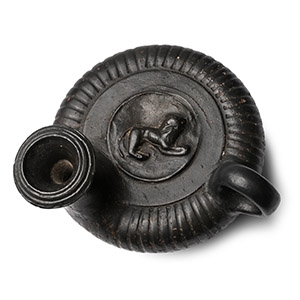
Greek Black-Glazed Guttos with Lion
South Italic, circa 4th century B.C.Sold for (Inc. bp): £286
High-angled spout and loop handle to the shoulder, the body decorated with vertical ribs around the perimeter, central image of a crouching lion in profile. 210 grams, 11.3 cm
From the private collection of a Canadian gentleman living in Essex, UK, formed since the 1920s-circa 1990. Property of an Essex lady until the late 1990s; thence by descent. From the private collection of an Essex gentleman since the late 1990s. This lot is accompanied by an illustrated lot declaration signed by the Head of the Antiquities Department, Dr Raffaele D'Amato. -
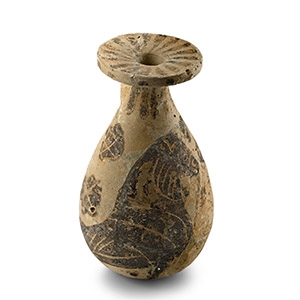
Corinthian Terracotta Black-Figure Alabastron
6th century B.C.Sold for (Inc. bp): £338
With broad mouth and pierced-lug handle below; the body decorated with a figure of a crouching lion in profile and a sphinx; stylised flowers of varying sizes in the field, dashes to the neck and upper face of the mouth, dots around the rim, rosette to base. 38.9 grams, 83 mm
Private collection, Tokyo, Japan, since the 1980s. Private European collection, acquired in 2010. This lot is accompanied by an illustrated lot declaration signed by the Head of the Antiquities Department, Dr Raffaele D'Amato. -
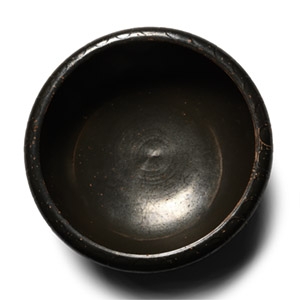
Greek Black-Glazed Terracotta Bowl with Stamped Decoration
Circa 330 B.C.Sold for (Inc. bp): £182
Flat bowl on a ring-base, convex rim decorated with a flat-profiled tongue-leaf frieze and fine groove beneath. 183 grams, 12.2 cm
with Galerie Gilgamesh, prior 2003. Accompanied by a copy of an Art Loss Register certificate no.S00035402. This lot is accompanied by an illustrated lot declaration signed by the Head of the Antiquities Department, Dr Raffaele D’Amato. This lot is accompanied by an illustrated lot declaration signed by the Head of the Antiquities Department, Dr Raffaele D'Amato. -
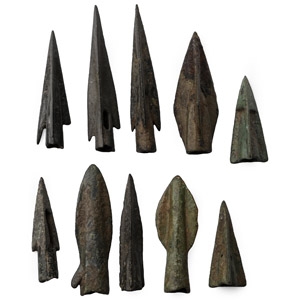
Greek Period High Quality Bronze Arrowhead Collection
5th-3rd century B.C.Sold for (Inc. bp): £156
Mainly triangular-section and leaf-shaped types. 21 grams total, 20-36 mm
From an English collection formed before 2000. This lot is accompanied by an illustrated lot declaration signed by the Head of the Antiquities Department, Dr Raffaele D'Amato. -

Greek Terracotta Figure Fragment Group
6th-4th century B.C.Sold for (Inc. bp): £104
Including hollow-formed busts, body fragments and other types. 632 grams total, 3.8-15.5 cm
with H.A.C., Basel, prior 1999. This lot is accompanied by an illustrated lot declaration signed by the Head of the Antiquities Department, Dr Raffaele D'Amato. -
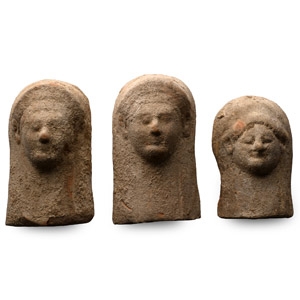
Greek Terracotta Female Protome Group
Early 5th century B.C.Sold for (Inc. bp): £286
Each tongue-shaped in plan and hollow to the reverse, female bust in high-relief with palla head-covering. 408 grams total, 9.5-11.6 cm
with H.A.C., Basel, prior 1999. This lot is accompanied by an illustrated lot declaration signed by the Head of the Antiquities Department, Dr Raffaele D'Amato. -
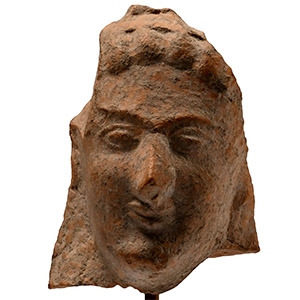
Greek Terracotta Female Protome
6th-5th century B.C.Sold for (Inc. bp): £390
Head of a girl with long hair and curls framing the forehead; elongated, oval face with almond-shaped eyes, slender nose and round chin; the lips forming an Archaic smile; mounted on a custom-made display stand. 33 grams total, 79 mm including stand
with Herbert A. Cahn, Basel, 1990s. Accompanied by a copy of an Art Loss Register certificate no.S00075470. This lot is accompanied by an illustrated lot declaration signed by the Head of the Antiquities Department, Dr Raffaele D'Amato.
Small mould-made heads were used for female divinities, sphinxes and sirens, or attached to pottery as ornaments. The figure was wearing a polos, a small, drum-shaped headdress designating in this period a divinity.

