-
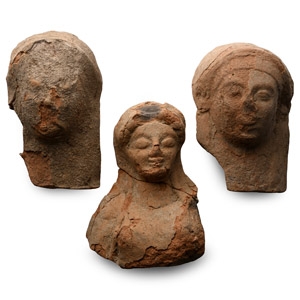
Greek Terracotta Female Protome Group
Early 5th century B.C.Sold for (Inc. bp): £156
Each tongue-shaped in plan and hollow to the reverse, female bust in high-relief with palla head-covering. 376 grams total, 10.5-11.5 cm
with H.A.C., Basel, prior 1999. This lot is accompanied by an illustrated lot declaration signed by the Head of the Antiquities Department, Dr Raffaele D'Amato. -
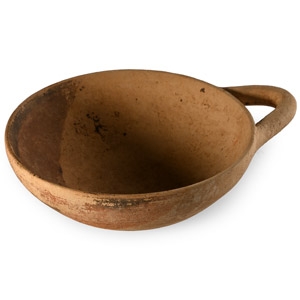
Greek Terracotta Dipper Cup
Apulian, circa 4th century B.C.Sold for (Inc. bp): £104
With a hemispherical body, narrow foot and a round-section loop handle. 117 grams, 13.1 cm
Acquired on the UK art market during the late 20th century. From the private collection of David King (1940-2024), Hoddesdon, Hertfordshire, UK. This lot is accompanied by an illustrated lot declaration signed by the Head of the Antiquities Department, Dr Raffaele D'Amato. -
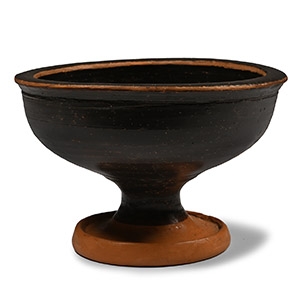
Greek Terracotta Blackware Chalice
4th century B.C.Sold for (Inc. bp): £234
Bucchero stemmed footed cup, bell-shaped in profile with carination, stem and lipped foot, raised horizontal concentric bands. 195 grams, 11.6 cm wide
with Rolf Wegmüller, Switzerland. Acquired in the 2000s from H.U.S. Humbel, Kilchberg. This lot is accompanied by an illustrated lot declaration signed by the Head of the Antiquities Department, Dr Raffaele D’Amato. This lot is accompanied by an illustrated lot declaration signed by the Head of the Antiquities Department, Dr Raffaele D'Amato. -
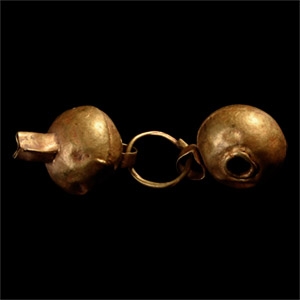
Greek Gold Pomegranate-Shaped Pendant
Circa 5th-3rd century B.C.Sold for (Inc. bp): £234
Comprising a hollow-form body with detailed calyx below, the suspension formed as a hollow collared bead with a thin connecting loop. 0.29 grams, 18 mm
From the collection of a late Japanese collector, 1970s. This lot is accompanied by an illustrated lot declaration signed by the Head of the Antiquities Department, Dr Raffaele D'Amato.
Fruit were generally considered to be a symbol of sensuality, temptation and fertility; the giving and accepting of fruit may be regarded as a symbolic sexual act, or at least a prelude to marriage. It follows naturally that the pomegranate, with its innumerable fleshy seeds symbolising life and fecundity, was an attribute of Aphrodite. -
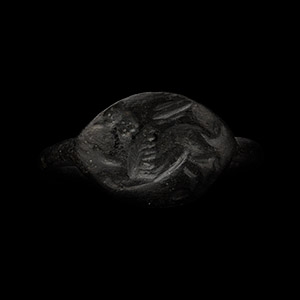
Eastern Greek Bronze Ring with Gryphon
4th-3rd century B.C.Sold for (Inc. bp): £195
Narrow hoop, scaphoid bezel with intaglio advancing gryphon motif. 1.40 grams, 21.04 mm overall, 18.91 mm internal diameter (approximate size British P, USA 7 1/2, Europe 16.23, Japan 15)
Ex German art market, 2000s. Acquired from an EU collector living in London. From the collection of a Surrey, UK, gentleman. This lot is accompanied by an illustrated lot declaration signed by the Head of the Antiquities Department, Dr Raffaele D'Amato. -
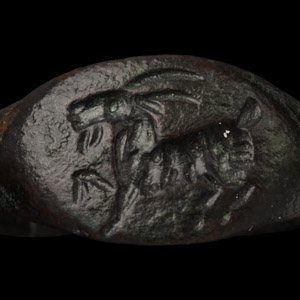
Eastern Greek Bronze Ring with Ibex
4th-3rd century B.C.Sold for (Inc. bp): £169
Ellipsoid bezel with incuse advancing ibex. 3.83 grams, 22.12 mm overall, 18.44 mm internal diameter (approximate size British Q, USA 8, Europe 17.49, Japan 16)
Ex German art market, 2000s. Acquired from an EU collector living in London. From the collection of a Surrey, UK, gentleman. This lot is accompanied by an illustrated lot declaration signed by the Head of the Antiquities Department, Dr Raffaele D'Amato. -
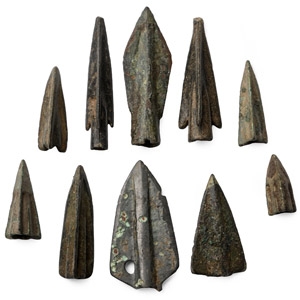
Greek Period High Quality Bronze Arrowhead Collection
5th-3rd century B.C.Sold for (Inc. bp): £143
Mainly triangular-section socketted and deltoid types. 28 grams total, 16-35 mm
From an English collection formed before 2000. This lot is accompanied by an illustrated lot declaration signed by the Head of the Antiquities Department, Dr Raffaele D'Amato. -
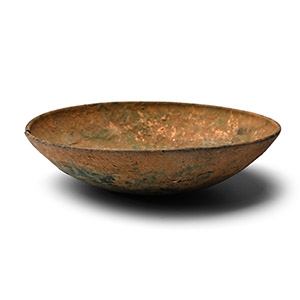
Greek Shallow Bronze Bowl
5th-3rd century B.C.Sold for (Inc. bp): £98
Shallow with chamfered rim, pierced beneath the rim to accept a chain. 152 grams, 14.5 cm
Fine condition.
From a private Netherlands collection; previously in an old collection since before 1980. From the private collection of John Meredith, acquired since the 1990s; thence by descent. This lot is accompanied by an illustrated lot declaration signed by the Head of the Antiquities Department, Dr Raffaele D'Amato. -
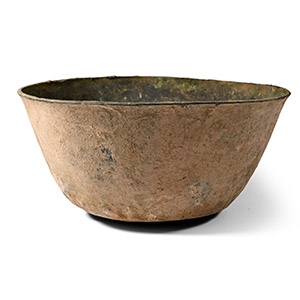
Etruscan Bronze Bowl
750-730 B.C.Sold for (Inc. bp): £130
A deep bowl with out-turned rim, convex base with concentric ring detailing. 197 grams, 16.6 cm
Ex London, UK, collections, 1990s-2000s. This lot is accompanied by an illustrated lot declaration signed by the Head of the Antiquities Department, Dr Raffaele D'Amato.
In the necropolises of Southern Etruria, around the second half of the 8th century B.C., new technologies were used, which also involved metalworking. Alongside simple bronze cups intended for everyday use, similar magnificent examples containing a flourish of impressed or engraved geometric motifs were made. -
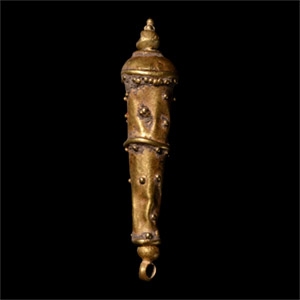
Hellenistic Gold Herakles Club Pendant
2nd-1st century B.C.Sold for (Inc. bp): £572
Formed as a tapering club with applied granule decoration, applied sphere with granulation at the top of the club, suspension loop at the handle end. 2.01 grams, 32 mm
From the collection of a late Japanese collector, 1970s. This lot is accompanied by an illustrated lot declaration signed by the Head of the Antiquities Department, Dr Raffaele D'Amato. -
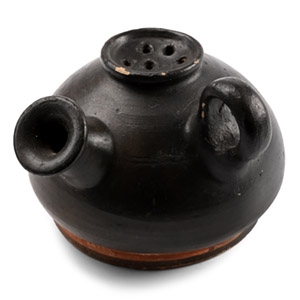
Greek Black-Glazed Guttos with Strainer
South Italic, circa 4th century B.C.Sold for (Inc. bp): £169
Discoid in plan with trumpet-shaped spout and one loop handle; strainer to centre. 130 grams, 10 cm
From the private collection of a Canadian gentleman living in Essex, UK, formed since the 1920s-circa 1990. Property of an Essex lady until the late 1990s; thence by descent. From the private collection of an Essex gentleman since the late 1990s. This lot is accompanied by an illustrated lot declaration signed by the Head of the Antiquities Department, Dr Raffaele D'Amato. -
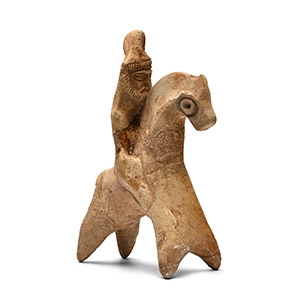
Parthian Terracotta Horse and Rider Statue
3rd-1st century B.C.Sold for (Inc. bp): £390
Figure of a horseman with carefully modelled facial features, stylised body and horse. 153 grams, 12.5 cm
Fine condition, repaired.
Property of a Dutch gentleman; formerly in an old collection formed in the 1970s. From the private collection of John Meredith, acquired since the 1990s; thence by descent. This lot is accompanied by an illustrated lot declaration signed by the Head of the Antiquities Department, Dr Raffaele D'Amato.

