-
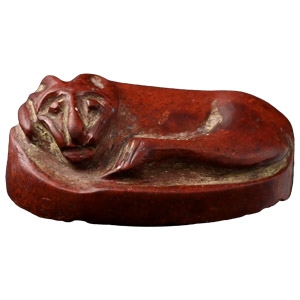
Egyptian Red Jasper Cat Amulet
Ptolemaic Period, 332-30 B.C.Sold for (Inc. bp): £234
Comprising a discoid flat base with high-relief carving of stylised zoomorphic figure with long pointed ears, possibly a hare, pierced for suspension. 4.58 grams, 22 mm
From a Mayfair, London, UK, gallery, 1990s. From a private UK collection. This lot is accompanied by an illustrated lot declaration signed by the Head of the Antiquities Department, Dr Raffaele D'Amato. -
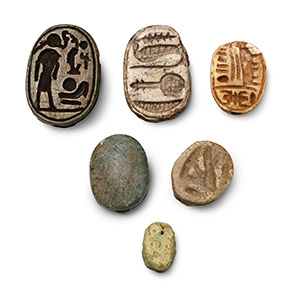
Egyptian Steatite Scarab Collection
New Kingdom-Late Period, 1550-332 B.C.Sold for (Inc. bp): £312
Designs include: a line border encloses the standing figure of a falcon-headed deity wearing a sun disc and uraeus, standing before the hieroglyphs user, Maat, Re, setep, n, Re); a line border enclosing n, cobra, nefer, and neb signs; a line border enclosing numerous hieroglyphs, including those spelling the throne name of Thutmose III (men-kheper-Re); a falcon; and two plain scarabs. 13.18 grams total, 10-21 mm
From a London collection, 2000s, some previously ex Mustaki collection pre 1950. This lot is accompanied by an illustrated lot declaration signed by the Head of the Antiquities Department, Dr Raffaele D'Amato.
The design of the first scarab incorporates Ramesses II’s throne name ‘the justice of Re is powerful, chosen of Re (user-Maat-Re setep-n-Re) -
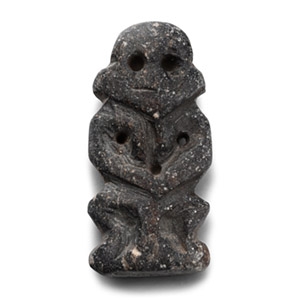
Egyptian Black Serpentine Pataikos Amulet
Late Period, 664-332 B.C. or laterSold for (Inc. bp): £72
Standing nude with hands clasped to the midriff, pierced at the shoulders and with drilled eyes, pierced across the head for suspension. 7.76 grams, 35 mm
Fine condition.
Property of a London gentleman; acquired in the 1970s. From the private collection of John Meredith, acquired since the 1990s; thence by descent. This lot is accompanied by an illustrated lot declaration signed by the Head of the Antiquities Department, Dr Raffaele D'Amato.
From the New Kingdom onward, Bes became one of ancient Egypt's most popular apotropaic deities. Despite his somewhat fearsome appearance, Bes served as the patron and protector of pregnant women and children, and was also believed to shield them from snakes. -
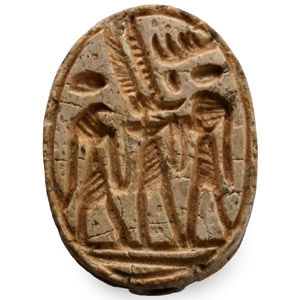
Egyptian Stone Scarab
Late Period, 664-332 B.C.Sold for (Inc. bp): £169
Incised detailing to the carapace and legs, pierced longitudinally; underside with three deities (possibly Amun-Ra, flanked by figures of Re). 3.74 grams, 20 mm
From the Gustave Mustaki collection before 1948. Ex London, UK, gallery. From a private UK collection. This lot is accompanied by an illustrated lot declaration signed by the Head of the Antiquities Department, Dr Raffaele D'Amato. -
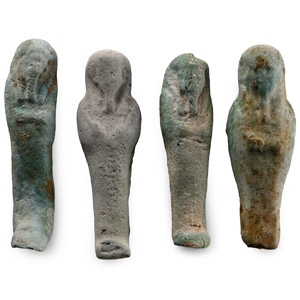
Egyptian Faience Shabti Collection
Ptolemaic Period, 332-30 B.C.Sold for (Inc. bp): £312
Comprising four mummiform shabtis with worn detail, three blue-glazed. 38.5 grams total, 60-65 mm
Acquired on the UK art market before 2000. Property of an Essex, UK, gentleman. This lot is accompanied by an illustrated lot declaration signed by the Head of the Antiquities Department, Dr Raffaele D'Amato. -
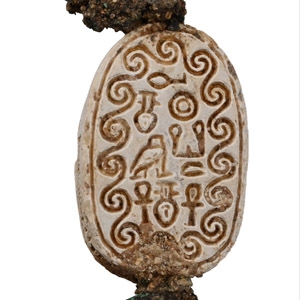
Egyptian Ring with Scarab
Second Intermediate Period, circa 1660-1500 B.C.Sold for (Inc. bp): £169
Comprising a bronze D-shaped finger ring, the bezel formed by a faience scarab with hieroglyphs and running scrolls to the underside. 5.15 grams, 38.41 mm overall, 26.58 mm internal diameter
Ex London, UK, art market, 1990s. From a private UK collection. This lot is accompanied by an illustrated lot declaration signed by the Head of the Antiquities Department, Dr Raffaele D'Amato. -
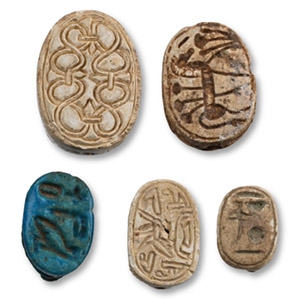
Egyptian Steatite and Other Scarab Group
Mainly Second Intermediate Period, circa 1660-1500 B.C.Sold for (Inc. bp): £364
Designs include: a line border enclosing a decorative symmetrical scroll-work pattern; a line border enclosing a horse with papyrus clumps above and in front; deeply impressed bird and other signs behind; a line border enclosing a nwb (gold) sign flanked by Red Crowns, with a bee above flanked by coiled cobras; a line border enclosing a djed, neb, and sun disc, with narrow neb(?) signs above and below. 8.76 grams total, 12-21 mm
Acquired on the European art market in the early 2000s. with Galerie Rhéa, Zurich, Switzerland. This lot is accompanied by an illustrated lot declaration signed by the Head of the Antiquities Department, Dr Raffaele D'Amato. -
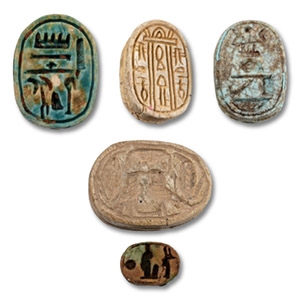
Egyptian Steatite Scarab Group
Mainly Second Intermediate Period-New Kingdom, circa 1600-1069 B.C.Sold for (Inc. bp): £260
Designs include: a line border enclosing the name of Amenhotep III and the epithet ‘Ruler of Thebes’; a line border enclosing a central shrine-like motif containing a sa and nefer sign, flanked by mirrored djed, ro, and nefer signs; a line border enclosing a bark, sun disc, wedjat, and neb signs; a Line border enclosing two facing falcons flanked by rearing cobras and a nwb (gold) sign above; a line border enclosing the phrase ‘powerful is the justice of Re’ (user-Maat-Re), which formed part of the throne name of several Ramesside pharaohs. 11.2 grams total, 9-19 mm
Acquired on the European art market in the early 2000s. with Galerie Rhéa, Zurich, Switzerland. This lot is accompanied by an illustrated lot declaration signed by the Head of the Antiquities Department, Dr Raffaele D'Amato. -
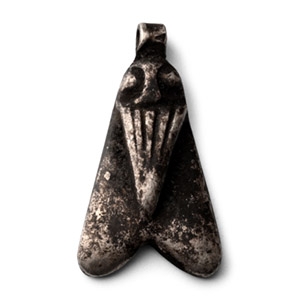
Egyptian Silver Fly Amulet
Late-Ptolemaic Period, 664-30 B.C.Sold for (Inc. bp): £124
With linear detailing to wings, raised eyes, pierced for suspension. 1.18 grams, 19 mm
Ex London, UK, art market, 1990s. This lot is accompanied by an illustrated lot declaration signed by the Head of the Antiquities Department, Dr Raffaele D'Amato. -
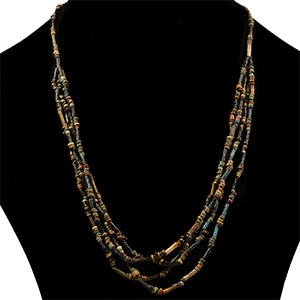
Egyptian Multi-Stranded Mummy Bead Necklace
Late Period, 664-332 B.C.Sold for (Inc. bp): £338
Three-stranded designer necklace composed of polychrome beads of mainly annular and tubular types. 18.2 grams, 63 cm
Acquired before 1979. From the private collection of Mr F.A., South Kensington, London, UK; thence by descent 2014. This lot is accompanied by an illustrated lot declaration signed by the Head of the Antiquities Department, Dr Raffaele D'Amato.
For thousands of years, artisans in Egypt created vibrant ceramics to echo the beauty of rare jewels. These ornaments were created with almost every material, colour, and texture imaginable and they come from across Egypt and beyond: vibrant blue lapis lazuli from Afghanistan, glossy black obsidian from Turkey, and aqua-green turquoise from the Sinai. They were worn in life and, after death, they served as precious ornamentation for mummies. -
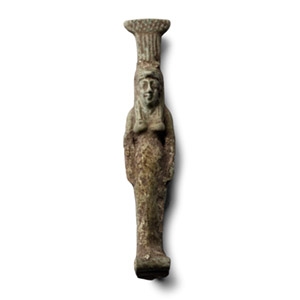
Egyptian Faience Amulet Representing Nephthys
Late Period, 664-332 B.C.Sold for (Inc. bp): £182
Modelled in the round on a small base, wearing columnar headdress, with dorsal pillar pierced behind the elbows. 4.15 grams, 55 mm
Private collection, Carouge, Switzerland, assembled in the 1980s-1990s. Thence by descent to the collection of Mr S.P., since 2020. This lot is accompanied by an illustrated lot declaration signed by the Head of the Antiquities Department, Dr Raffaele D'Amato.
Nephthys was a protective goddess linked to mourning, magic, and the afterlife. As the sister of Isis, she played a vital role in the funerary rites of Osiris. Amulets like this were placed on the deceased to invoke her protection and aid in rebirth. Typically made of faience or semi-precious stone, they were especially common in the Late Period. -
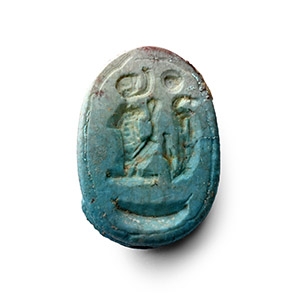
Egyptian Faience Frog Scaraboid with Hieroglyphs
Ptolemaic Period, circa 300 B.C.Sold for (Inc. bp): £195
Ellipsoid in plan with crouching frog to the upper face, incuse legend to the underside. 3.92 grams, 20 mm
Acquired on the European art market in the early 2000s. with Galerie Rhéa, Zurich, Switzerland. This lot is accompanied by an illustrated lot declaration signed by the Head of the Antiquities Department, Dr Raffaele D'Amato.

