-
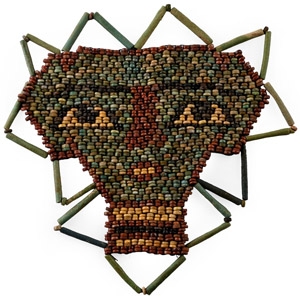
Egyptian Faience Mummy Bead Face Mask
Ptolemaic Period, 332-30 B.C.Sold for (Inc. bp): £234
Restrung; a beadwork panel of annular and tubular glazed composition beads in blues, greens, black, cream and red-brown colours, depicting a mummy face mask with false beard. 40 grams, 14.5 cm
Acquired 1990s. Ex Mariaud des Serres, Paris, France. This lot is accompanied by an illustrated lot declaration signed by the Head of the Antiquities Department, Dr Raffaele D'Amato. -
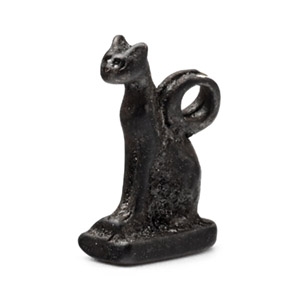
Egyptian Silver Bastet as Seated Cat Amulet
Late-Ptolemaic Period, 664-30 B.C.Sold for (Inc. bp): £208
Seated figure of a cat with pointed ears mounted on a rectangular base with a rounded end; suspension loop on the back. 0.34 grams, 8 mm
Ex London, UK, gentleman 1980-1990s. This lot is accompanied by an illustrated lot declaration signed by the Head of the Antiquities Department, Dr Raffaele D'Amato.
The cat was sacred to Bastet, a protective mother goddess and the daughter of the sun god Re. Amulets offered the wearer the goddess's protection. Her name means ‘she of the bast [ointment jar],’ which may have contained a substance favoured by or exclusive to royalty. Originally, Bastet was depicted as a woman with the head of a lioness, but by the late New Kingdom, she was usually shown with a cat's head. She is sometimes portrayed with kittens, emphasising her maternal role as a fierce protector of offspring. -
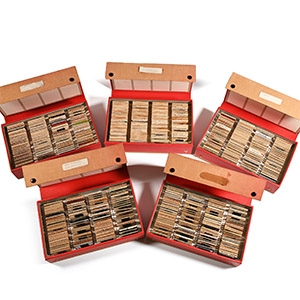
Historic Collection of 825 Slides of Archaeological Objects From Egypt
1960s-1980s A.D.Sold for (Inc. bp): £1,040
Housed in five linen-covered boxes, covering regalia, jewellery, chariots, daggers, bows, sticks, Old Kingdom sculpture, Saite sculpture, canopic, sarcophagi, Middle Kingdom and general objects etc. 4.43 kg total, 26.5 x 16.5 x 6.5 cm each box
Property of archaeologist Stephanie Gee, N.W. London, UK, 1960s-1980s. This lot is accompanied by an illustrated lot declaration signed by the Head of the Antiquities Department, Dr Raffaele D'Amato.
Stephanie Gee was a prominent archaeologist who took part in several expeditions in Egypt. She was a trusted assistant to the British-Australian archaeologist Veronica Seton-Williams, who excavated in Egypt, Britain, and the Near East. Stephanie also took part in the Tell El-Farâ'în expeditions of 1965-1968, and assisted Seton-Williams with preparing the 1966 expedition report. Their collaboration continued and Stephanie helped with the manuscript of Seton-Williams’ book ‘The Road to El-Aguzein’, a narrative account of her life that was first published in 1988. -
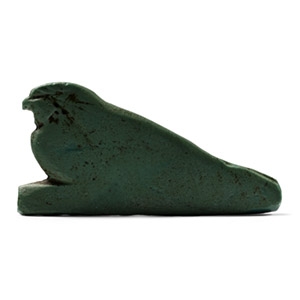
Egyptian Green-Blue Glass Inlay of the Horus Falcon
Ptolemaic Period, circa 332-30 B.C.Sold for (Inc. bp): £468
Modelled in silhouette with painted detailing; mounted on a custom-made stand. 24.15 grams total, 73 mm including stand
with Eternal Egypt, London, UK. Private collection, London, UK, acquired from the above on the 21 May 1992. Accompanied by a copy of the Eternal Egypt invoice. This lot is accompanied by an illustrated lot declaration signed by the Head of the Antiquities Department, Dr Raffaele D'Amato. -
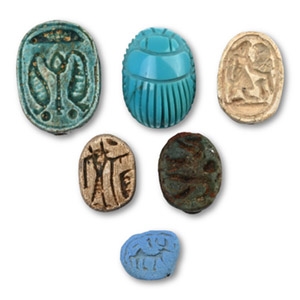
Egyptian Steatite Scarab Group
Mainly Late Period, 664-332 B.C.Sold for (Inc. bp): £247
The designs include: a line border enclosing a central nefer sign, flanked by two rearing cobras with sun discs above, and a neb sign below; a turquoise scarab with deeply incised body detailing; a line border enclosing a striding figure before a cobra(?) and a nefer sign, with a neb sign below; a standing figure with a long staff and a sun disc above, facing an indeterminate object; indeterminate symbols with a sun disc above; and a quadruped with a long tail and erect ears or horns (possibly a jackal or an ibex). 11.7 grams total, 10-20 mm
Acquired on the European art market in the early 2000s. with Galerie Rhéa, Zurich, Switzerland. This lot is accompanied by an illustrated lot declaration signed by the Head of the Antiquities Department, Dr Raffaele D'Amato. -
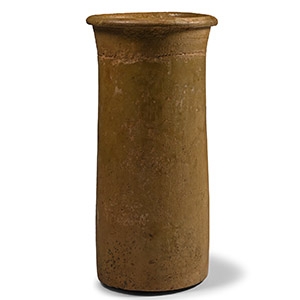
Egyptian Terracotta Cylindrical Jar
Early Dynastic Period, Naqada IIIC, circa 3100 B.C.Sold for (Inc. bp): £520
Band of imitation rope-twist decoration encircling the top of the jar, the mouth slightly flaring with a slightly damaged rolled lip. 950 grams, 22 cm
with Bonhams, London, 1 May 2008, no.432 [Part]. Accompanied by a copy of an Art Loss Register certificate no.S00035996. Accompanied by a copy of relevant Bonhams catalogue pages. This lot is accompanied by an illustrated lot declaration signed by the Head of the Antiquities Department, Dr Raffaele D’Amato. This lot is accompanied by an illustrated lot declaration signed by the Head of the Antiquities Department, Dr Raffaele D'Amato.
These vessels often exhibit different surface treatments; the rim and area above the rope twist show marks where the vessel was rotated to produce the rim, and below, the rest of the jar has a scrape-smoothed surface. -
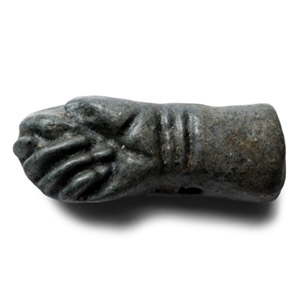
Egyptian Faience Fist Amulet
Ptolemaic-Roman Period, 323 B.C.-323 A.D.Sold for (Inc. bp): £124
Modelled as a right hand in fica protective gesture; pierced at wrist. 1.48 grams, 20 mm
From an early 20th century collection. This lot is accompanied by an illustrated lot declaration signed by the Head of the Antiquities Department, Dr Raffaele D'Amato. -
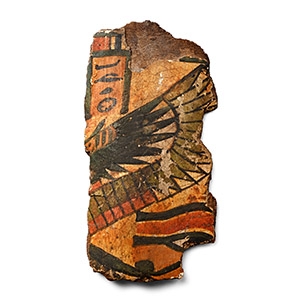
Egyptian Cartonnage Section with Eye and Wing
Third Intermediate Period, circa 1069-860 B.C.Sold for (Inc. bp): £416
Sub-rectangular in plan with irregular and fragmented edge; prepared plaster surface featuring a line-bordered column with four cursive hieroglyphs naming Behedet (bḥdt); a section of finely painted outstretched wing with feather detailing to lower edge in red and blue; below, a wedjat eye in black with red medial band; fabric back to reverse. 48 grams, 17 cm
Formerly from an old collection of a Wiltshire, UK, collector, acquired before 1980. Property of a private collector, West London, UK. This lot is accompanied by an illustrated lot declaration signed by the Head of the Antiquities Department, Dr Raffaele D'Amato.
This fragment most likely originates from the lower chest section of a so-called anthropoid 'yellow coffin' from the Third Intermediate Period. The wing belongs to a protective deity; as Behedet is a name given to several locations (Edfu, Tell el-Balamun, and Lepidotonpolis) associated with Horus, it seems probable that the wing belongs to the falcon form of this god. -
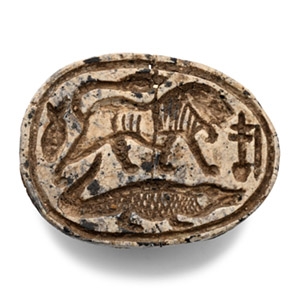
Large Egyptian Steatite Scarab
Second Intermediate Period–New Kingdom, circa 1600-1069 B.C.Sold for (Inc. bp): £442
Modelled body of a beetle with detailed carapace and legs; the underside carved with a border enclosing the depictions of an advancing lion, a crocodile below, with a fish behind, and a nefer sign in front. 13.3 grams, 34 mm
From the collection of a gentleman, acquired on the London art market in the 1990s. This lot is accompanied by an illustrated lot declaration signed by the Head of the Antiquities Department, Dr Raffaele D'Amato.
It is believed that the lion symbolised the king and his strength in overcoming dangerous forces. -
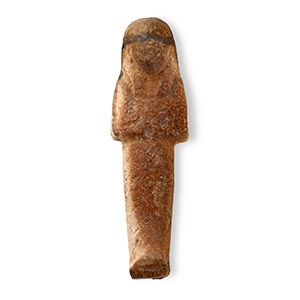
Egyptian Brown Faience Shabti
Third Intermediate Period, 1069-860 B.C.Sold for (Inc. bp): £156
Mummiform figure with agricultural implements held in crossed arms, wearing a tripartite wig with a painted hair tie. 7.53 grams, 59 mm
Ex London, UK, collection, 1990s. This lot is accompanied by an illustrated lot declaration signed by the Head of the Antiquities Department, Dr Raffaele D'Amato. -
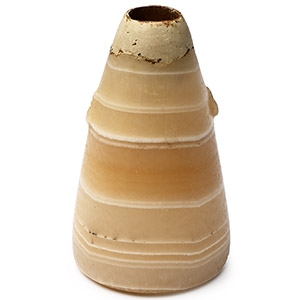
Egyptian Banded Agate Kohl Pot
Late Period, 664-332 B.C.Sold for (Inc. bp): £124
Cone-shaped body with traces of lug handles on the upper third; narrow opening at the top with a thin, flattened rim. 94 grams, 75 mm
UK private collection before 2000. Acquired on the UK art market. Private collection, London, UK. This lot is accompanied by an illustrated lot declaration signed by the Head of the Antiquities Department, Dr Raffaele D'Amato.
This vessel's unusual triangular shape is thought to be limited to the Late Period; other comparable examples are known (e.g., Barbotin, C., Collection égyptienne: Musée Granet - Aix-en-Provence, Aix-en-Provence, 1995, p. 166, no. 97). -
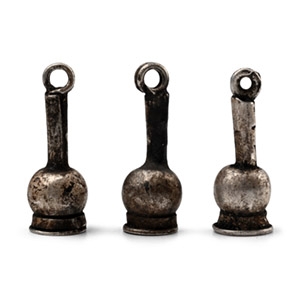
Egyptian Silver Poppy Amulet Group
Late-Ptolemaic Period, 664-30 B.C.Sold for (Inc. bp): £143
Three pendants each with poppy-head and loop at the apex. 3.05 grams, 17 mm each
Ex London, UK, gentleman 1980-1990s. This lot is accompanied by an illustrated lot declaration signed by the Head of the Antiquities Department, Dr Raffaele D'Amato.
Amulets in the form of poppies were used to heal and alleviate pain and to ward off death. These types of amulets were also linked to Osiris, the Egyptian deity of agriculture, death, and the afterlife.

