-
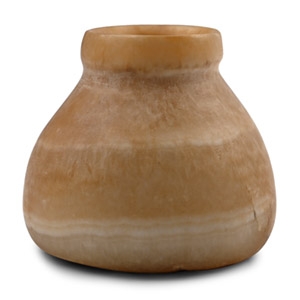
Egyptian Alabaster Cosmetic Jar
New Kingdom, 13th-11th century B.C.Sold for (Inc. bp): £221
Squat, globular vessel with a flat bottom and thick, carinated rim. 129 grams, 56 mm
From the private collection of a Canadian gentleman living in Essex, UK, formed since the 1920s-circa 1990. Property of an Essex lady until the late 1990s; thence by descent. From the private collection of an Essex gentleman since the late 1990s. This lot is accompanied by an illustrated lot declaration signed by the Head of the Antiquities Department, Dr Raffaele D'Amato.
Such vessels were used to hold cosmetics. The low shape and wide base prevented tipping when extracting the cosmetic with an applicator. -
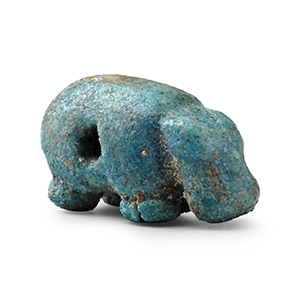
Egyptian Light Blue Faience Hippopotamus Amulet
Late Period, 664-332 B.C.Sold for (Inc. bp): £195
Blue glazed figure modelled in the round as a standing hippopotamus, pierced to the centre. 3.63 grams, 20 mm
From an early 20th century collection. This lot is accompanied by an illustrated lot declaration signed by the Head of the Antiquities Department, Dr Raffaele D'Amato.
In ancient Egypt, hippos symbolised both danger and protection, representing chaos and fertility. Feared for their aggression along the Nile, they were also associated with the protective goddess Taweret and the river’s life-giving power. -
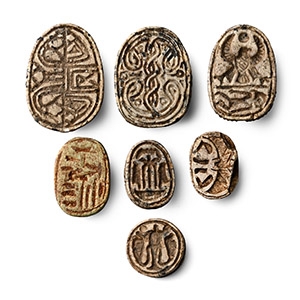
Egyptian Steatite Scarab Collection
Mostly Late Middle Kingdom, Second Intermediate Period, 1780-1500 B.C.Sold for (Inc. bp): £780
Mixed group of design scarabs and scaraboids, including: stylised foliate motif with a sa sign; central entwined cords with curled tops and tails, and nefer signs; a falcon with outspread wings and sun disc above, surmounting a fallen enemy; a group of hieroglyphs: a central mes flanked by reed leaves, with a water sign n above, and a neb sign below; a falcon with outspread wings, with two maat feathers and stylised cobras above; a central hes vase flanked by rearing cobras. 32.6 grams total, 15-28 mm
From the collection of a gentleman, acquired on the London art market in the 1990s. This lot is accompanied by an illustrated lot declaration signed by the Head of the Antiquities Department, Dr Raffaele D'Amato. -
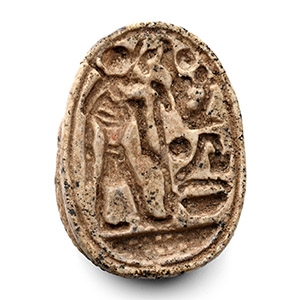
Large Egyptian Steatite Scarab
Late Period, 664-332 B.C.Sold for (Inc. bp): £234
A line border encloses the standing figure of a falcon-headed deity wearing a sun disc and uraeus, and holding a was-sceptre, standing before the hieroglyphs user, Maat, Re, setep, n, Re, neb), all surmounting a larger neb sign. 9.92 grams, 28 mm
From the collection of a gentleman, acquired on the London art market in the 1990s. This lot is accompanied by an illustrated lot declaration signed by the Head of the Antiquities Department, Dr Raffaele D'Amato.
The design incorporates much of Ramesses II’s throne name, ‘the justice of Re is powerful, chosen of Re (user-Maat-Re setep-n-Re). -
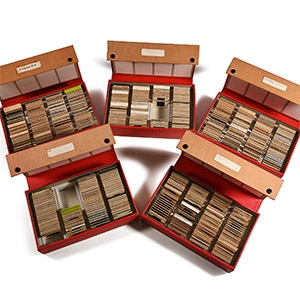
Historic Collection of 969 Slides of Archaeological Sites in Egypt
1960s-1980s A.D.Sold for (Inc. bp): £845
Housed in five linen-covered boxes, covering Dendereh, Karnak, Valley of the Kings, Seti I, Medinewt Habu, Luxor, Saqqara etc. 4.52 kg total, 26.5 x 16.5 x 6.5 cm each box
Property of archaeologist Stephanie Gee, N.W. London, UK, 1960s-1980s. This lot is accompanied by an illustrated lot declaration signed by the Head of the Antiquities Department, Dr Raffaele D'Amato.
Stephanie Gee was a prominent archaeologist who took part in several expeditions in Egypt. She was a trusted assistant to the British-Australian archaeologist Veronica Seton-Williams, who excavated in Egypt, Britain, and the Near East. Stephanie also took part in the Tell El-Farâ'în expeditions of 1965-1968, and assisted Seton-Williams with preparing the 1966 expedition report. Their collaboration continued and Stephanie helped with the manuscript of Seton-Williams’ book ‘The Road to El-Aguzein’, a narrative account of her life that was first published in 1988. -
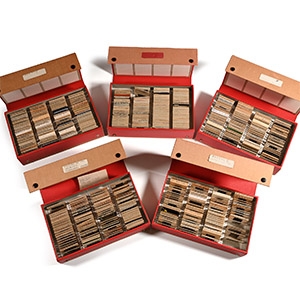
Historic Collection of 794 Slides of Archaeological Sites in Egypt
1960s-1980s A.D.Sold for (Inc. bp): £780
Housed in five linen-covered boxes, covering Karnak, Hypostyle Hall, Ptah Khonsu, Tombs of the Nobles, Rekh Mire Ramuse, Deir el Medina, and general sites etc. 4.11 kg total, 26.5 x 16.5 x 6.5 cm each box
Property of archaeologist Stephanie Gee, N.W. London, UK, 1960s-1980s. This lot is accompanied by an illustrated lot declaration signed by the Head of the Antiquities Department, Dr Raffaele D'Amato.
Stephanie Gee was a prominent archaeologist who took part in several expeditions in Egypt. She was a trusted assistant to the British-Australian archaeologist Veronica Seton-Williams, who excavated in Egypt, Britain, and the Near East. Stephanie also took part in the Tell El-Farâ'în expeditions of 1965-1968, and assisted Seton-Williams with preparing the 1966 expedition report. Their collaboration continued and Stephanie helped with the manuscript of Seton-Williams’ book ‘The Road to El-Aguzein’, a narrative account of her life that was first published in 1988. -
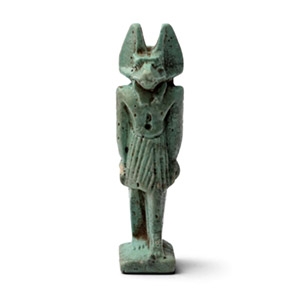
Egyptian Faience Anubis Amulet
664-332 B.C.Sold for (Inc. bp): £286
With rectangular base and dorsal pillar pierced at the shoulders, Anubis in human form with short klt, jackal's head with large ears. 4.92 grams, 46 mm
Collection of an amateur, Carouge, Switzerland, assembled in the 1980s-1990s. Thence by descent to the collection of Mr S.P., since 2020. This lot is accompanied by an illustrated lot declaration signed by the Head of the Antiquities Department, Dr Raffaele D'Amato. -
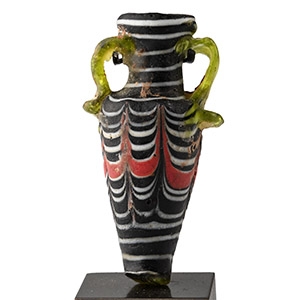
Egyptian Mosaic Glass Amphora
Ptolemaic Period, 332-30 B.C.Sold for (Inc. bp): £364
Mosaic glass amphora with trumpet mouth, applied lateral loop handles, bands of marvered trails; mounted on a custom-made stand. 35 grams total, 62 mm including stand
Ex Mayfair, London, UK, gallery, 1990s-2000s. From an important collection of glass, the property of a London gentleman. This lot is accompanied by an illustrated lot declaration signed by the Head of the Antiquities Department, Dr Raffaele D'Amato.
Cf. Hall, E.H., 'A Collection Made of Antique Glass,' The Museum Journal IV, 4 (1913), p.120, fig. 96, for examples of this vessel type. -
.jpg)
Roman Bronze Trumpet Whorl Brooch
Circa 2nd century A.D.Sold for (Inc. bp): £104
S-shaped La Tène scroll with trumpet and bulb detailing, catch and pin to the reverse. 8.89 grams, 33 mm
From the collection of a Suffolk, UK, gentleman, established from the early 2000s. This lot is accompanied by an illustrated lot declaration signed by the Head of the Antiquities Department, Dr Raffaele D'Amato. -
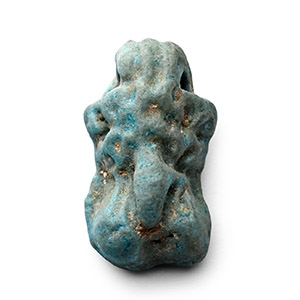
Phoenician-Egyptian Faience Phallic Amulet
Late-Ptolemaic Period, 664-30 B.C.Sold for (Inc. bp): £130
Amuletic pendant of male genitals with loop above. 1.24 grams, 17 mm
Ex early 20th century Home Counties, UK, collection. This lot is accompanied by an illustrated lot declaration signed by the Head of the Antiquities Department, Dr Raffaele D'Amato. -
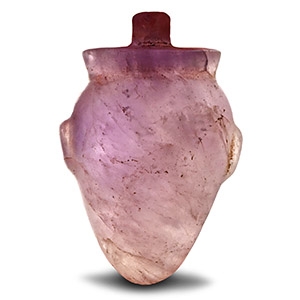
Large Egyptian Amethyst Heart Amulet
Late Period, 664-332 B.C.Sold for (Inc. bp): £572
Carved with a suspension loop and lateral spurs; loop chipped. 9.75 grams, 31 mm
Ex early 20th century Home Counties, UK, collection. This lot is accompanied by an illustrated lot declaration signed by the Head of the Antiquities Department, Dr Raffaele D'Amato. -
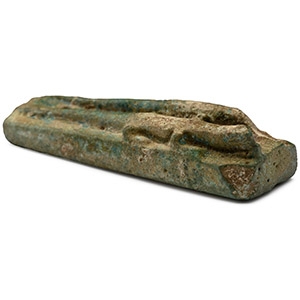
Egyptian Faience Double Lizard Amulet
Late Period, 664-332 B.C.Sold for (Inc. bp): £169
Gentle trapezoidal plinth with modelled depictions of two long-tailed lizards on the top; four evenly spaced holes pierce the plinth for attachment. 12 grams, 54 mm
From a UK dealer since the 1970s. From an old London, UK, collection since circa 1985. This lot is accompanied by an illustrated lot declaration signed by the Head of the Antiquities Department, Dr Raffaele D'Amato.
The lizard was the animal manifestation of the creator god Atum. His sun-god aspect is embodied in the lizard's need to bask in sunshine.

