-
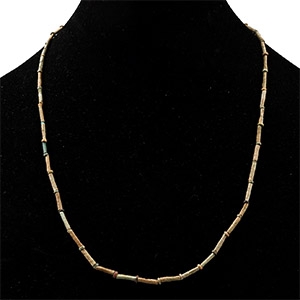
Egyptian Faience Mummy Bead Necklace String
Late Period, 664-332 B.C.Sold for (Inc. bp): £98
Restrung group of tubular beads with cylindrical and small disc-shaped bead spacers. 4.97 grams, 62 cm
From the private collection of a Canadian gentleman living in Essex, UK, formed since the 1920s-circa 1990. Property of an Essex lady until the late 1990s; thence by descent. From the private collection of an Essex gentleman since the late 1990s. This lot is accompanied by an illustrated lot declaration signed by the Head of the Antiquities Department, Dr Raffaele D'Amato. -
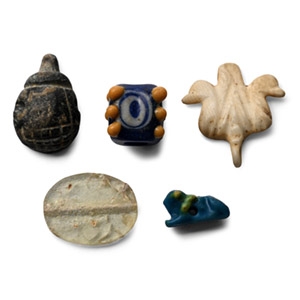
Egyptian Stone and Glass Artefact Group
Late 1st millennium B.C. and laterSold for (Inc. bp): £338
Including cuboid hot-worked eye bead with applied granules to the edges, a recumbent lion, double bird, and stylised hedgehog amulets, and iridescent plaque. 83.7 grams total, 13-22 mm
Acquired on the European art market in the early 2000s. with Galerie Rhéa, Zurich, Switzerland. This lot is accompanied by an illustrated lot declaration signed by the Head of the Antiquities Department, Dr Raffaele D'Amato. -
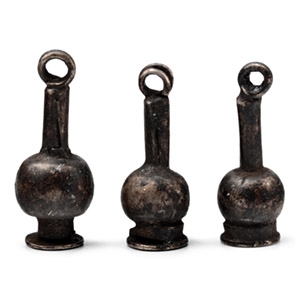
Egyptian Silver Poppy Amulet Group
Late-Ptolemaic Period, 664-30 B.C.Sold for (Inc. bp): £143
Three pendants each with poppy-head and loop at the apex. 3.22 grams total, 16-18 mm
Ex London, UK, art market, 1990s. This lot is accompanied by an illustrated lot declaration signed by the Head of the Antiquities Department, Dr Raffaele D'Amato.
Amulets in the form of poppies were used to heal and alleviate pain and to ward off death. These types of amulets were also linked to Osiris, the Egyptian deity of agriculture, death, and the afterlife. -
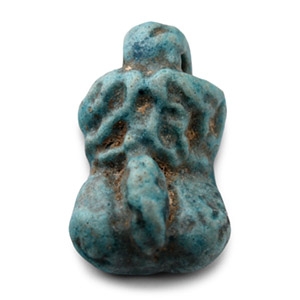
Egyptian Faience Phallic Amulet
Ptolemaic-Roman Period, 323 B.C.-323 A.D.Sold for (Inc. bp): £46
Pendant plaque of male genitals with loop above. 1.08 grams, 17 mm
From an early 20th century collection. This lot is accompanied by an illustrated lot declaration signed by the Head of the Antiquities Department, Dr Raffaele D'Amato. -
.jpg)
Egyptian Body of Anubis Glass Inlay
Late Period-Ptolemaic Period, 664-30 B.C.Sold for (Inc. bp): £208
With gently curved obverse and flat reverse, section of an inlay depicting Anubis, with thick neck and beginning of extended foreleg. 110 grams, 96 mm
Acquired on the French art market, 1980s. with Bonhams, London, 13 April 2011, lot 21. Accompanied by copies of the relevant Bonhams catalogue pages. This lot is accompanied by an illustrated lot declaration signed by the Head of the Antiquities Department, Dr Raffaele D'Amato.
This coloured glass inlay depicts Anubis, the jackal-headed god of mummification and protector of the dead. Likely part of a coffin or shrine, it demonstrates the use of glass to imitate precious materials in elite funerary art. The figure’s profile and predominantly black colour evoke Anubis’s role in preservation and the afterlife. -
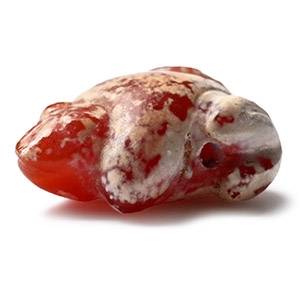
Egyptian Carnelian Frog Amulet
Late Period, 664-332 B.C.Sold for (Inc. bp): £572
Carved in the round, pierced through the body for suspension. 298 grams, 19 mm
UK private collection before 2000. Acquired on the UK art market. Private collection, London, UK. This lot is accompanied by an illustrated lot declaration signed by the Head of the Antiquities Department, Dr Raffaele D'Amato.
Frog amulets in ancient Egypt symbolised fertility, rebirth, and regeneration. Associated with the goddess Heqet, linked to childbirth and life-giving forces, these amulets were especially popular in contexts related to fertility and protection during pregnancy and childbirth. Their connection to the annual Nile flood, which brought new life to the land, further reinforced their symbolism of renewal and abundance. -
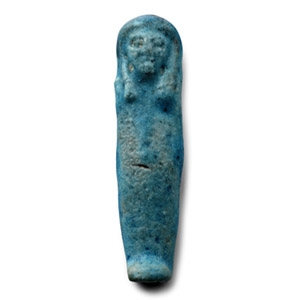
Egyptian Bright Blue Faience Shabti
Ptolemaic Period, 332-30 B.C.Sold for (Inc. bp): £130
Mummiform figure with facial detailing and wearing a lappet wig. 7.05 grams, 54 mm
Ex London, UK, collection, 1990s. This lot is accompanied by an illustrated lot declaration signed by the Head of the Antiquities Department, Dr Raffaele D'Amato. -
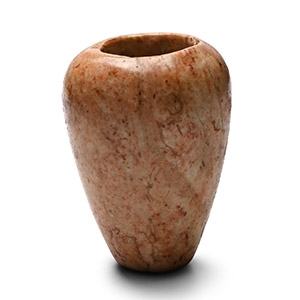
Egyptian Red Mottled Stone Piriform Jar
Predynastic Period, Naqada II, 3500-3200 B.C.Sold for (Inc. bp): £312
With narrow base and broad rounded shoulder. 248 grams, 76 mm
From the private collection of a Canadian gentleman living in Essex, UK, formed since the 1920s-circa 1990. Property of an Essex lady until the late 1990s; thence by descent. From the private collection of an Essex gentleman since the late 1990s. This lot is accompanied by an illustrated lot declaration signed by the Head of the Antiquities Department, Dr Raffaele D'Amato. -
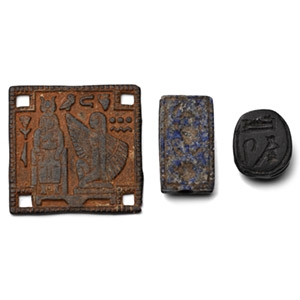
Egyptian Artefact Group
Late Period, 664-332 B.C. and laterSold for (Inc. bp): £117
Comprising: a scarab with text to underside; a plano-convex section bead; a bifacial square plaque with worship scene and hieroglyphs to each face, after the antique. 8.16 grams total, 13-25 mm
From the collection of a gentleman, acquired on the London art market in the 1990s. This lot is accompanied by an illustrated lot declaration signed by the Head of the Antiquities Department, Dr Raffaele D'Amato. -
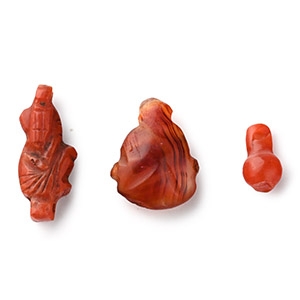
Egyptian Carnelian Amulet Group
Late Period, 664-332 B.C.Sold for (Inc. bp): £286
Comprising a poppy head amulet, a stylised head amulet, and a seated figure amulet. 1.42 grams total, 8-16 mm
From an Israeli collection, 1990s. This lot is accompanied by an illustrated lot declaration signed by the Head of the Antiquities Department, Dr Raffaele D'Amato. -
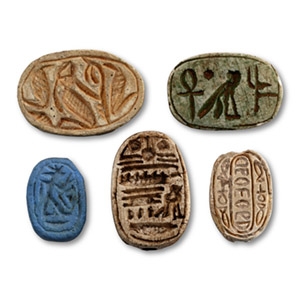
Egyptian Steatite Scarab Group
Mainly Late Period, 664-332 B.C.Sold for (Inc. bp): £442
Designs include: a line border enclosing a kneeling figure holding a staff, flanked by coiled cobras; a line border enclosing user, m, Re, and ankh signs; a line border enclosing a standing figure before a rearing cobra, with both figures surmounting a neb sign; a line border enclosing numerous hieroglyphs: a nefer sign flanked by sun discs, men, m, meru, neb signs with a falcon in front; a line border enclosing a central cartouche-shaped panel with neb, a, and ro signs, flanked by nefer and wadj signs. 10.6 grams total, 13-20 mm
Acquired on the European art market in the early 2000s. with Galerie Rhéa, Zurich, Switzerland. This lot is accompanied by an illustrated lot declaration signed by the Head of the Antiquities Department, Dr Raffaele D'Amato. -
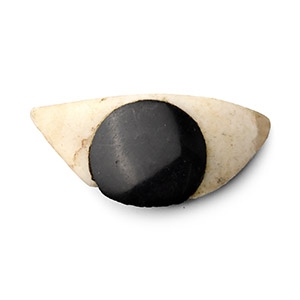
Egyptian Stone Mummy Eye
Late Period, 664-332 B.C.Sold for (Inc. bp): £117
Carved insert for a mask, white with large inset black pupil. 9.94 grams, 39 mm
From the collection of a gentleman, acquired on the London art market in the 1990s. This lot is accompanied by an illustrated lot declaration signed by the Head of the Antiquities Department, Dr Raffaele D'Amato.

