-
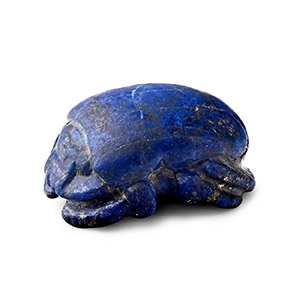
Egyptian Lapis Lazuli Heart Scarab
Late Period, 664-332 B.C. or laterSold for (Inc. bp): £780
Carved in the round with carapace detailing to the upper face, ribbed loop to the underside. 6.59 grams, 23 mm
From an early 20th century collection. This lot is accompanied by an illustrated lot declaration signed by the Head of the Antiquities Department, Dr Raffaele D'Amato. -
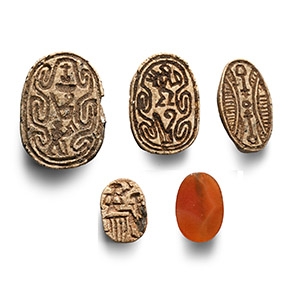
Egyptian Mixed Scarab Collection
2nd-1st millennium B.C. and laterSold for (Inc. bp): £468
Comprising three faience scarabs with detailed bodies and decorated undersides, featuring: a scroll border with central design consisting of a nefer, neb, Red Crown, and a striding human figure holding a flail; a scroll border with a central figure of a bowman with a Red Crown beneath; a seated figure before an offering table(?); an oval scaraboid featuring a central sun disc with opposed nefer signs flanked by hatched panels; and a plain carnelian scarab. 22.75 grams total, 15-28 mm
From the collection of a gentleman, acquired on the London art market in the 1990s. This lot is accompanied by an illustrated lot declaration signed by the Head of the Antiquities Department, Dr Raffaele D'Amato. -
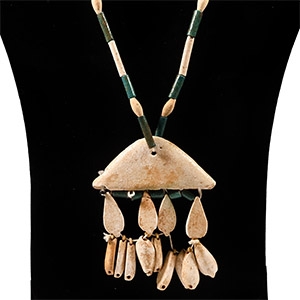
Egyptian Faience Necklace with Pendant
New Kingdom, 1400-1100 B.C.Sold for (Inc. bp): £780
Designer necklace composed of alternating white and turquoise tubular beads with oval spacer bead; a collar terminal as a central pendant with two rows of petal-shaped beads incorporating tubular and ring spacers suspended below. 41 grams, 76 cm long
Acquired in the mid 1980s-1990s. Private collection, Switzerland, thence by descent. Private collection, since the late 1990s. This lot is accompanied by an illustrated lot declaration signed by the Head of the Antiquities Department, Dr Raffaele D’Amato. This lot is accompanied by an illustrated lot declaration signed by the Head of the Antiquities Department, Dr Raffaele D'Amato. -
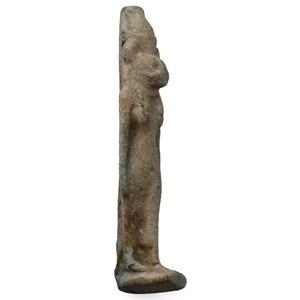
Egyptian Faience Standing Lioness Amulet
Ptolemaic Period, 332-30 B.C.Sold for (Inc. bp): £85
Standing figure of lioness-headed goddess in a striding pose with arms at the sides, sporting a black coloured tripartite wig surmounted by the double-crown; dorsal pillar. 3.96 grams, 56 mm
Acquired on the UK art market during the late 20th century. From the private collection of David King (1940-2024), Hoddesdon, Hertfordshire, UK. This lot is accompanied by an illustrated lot declaration signed by the Head of the Antiquities Department, Dr Raffaele D'Amato.
Throughout ancient Egyptian mythology, lion-headed goddesses played a significant role in the religious beliefs of the people. These goddesses, including Sekhmet, Wadjet, and Bastet, were revered as powerful and fierce protectors. Their presence was believed to ward off evil and safeguard the people from harm. -
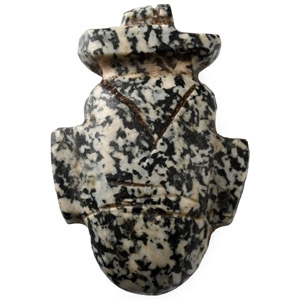
Egyptian Diorite Heart Amulet
Late Period, 664-332 B.C.Sold for (Inc. bp): £338
A large heart, ib, amulet of classic egg-form with shallow lugs on either side, with flared top and incised lines to one side. 10.7 grams, 31 mm
From an early 20th century collection. Ex London, UK, gallery. From a private UK collection This lot is accompanied by an illustrated lot declaration signed by the Head of the Antiquities Department, Dr Raffaele D'Amato.
According to ancient Egyptian beliefs, the heart (ib) was considered the centre of intelligence, emotions, and behaviour. It was also believed to store an individual's memories. During the Weighing of the Heart ceremony in the afterlife, the heart could speak on behalf of the deceased and account for their lifetime of actions before Osiris. For this reason, heart amulets were placed on the mummy to safeguard the organ and ensure a favourable outcome during judgment. -
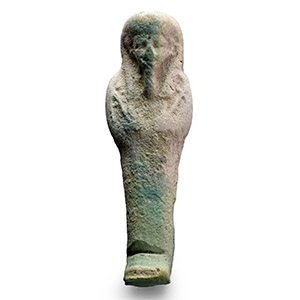
Egyptian Pale Blue Faience Shabti
Ptolemaic Period, 332-30 B.C.Sold for (Inc. bp): £169
Mummiform figure with false beard and holding agricultural implements in the crossed hands. 9.17 grams, 63 mm
Ex London, UK, collection, 1990s. This lot is accompanied by an illustrated lot declaration signed by the Head of the Antiquities Department, Dr Raffaele D'Amato. -
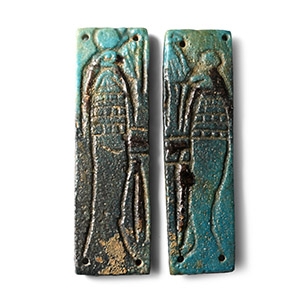
Egyptian Blue Faience Sons of Horus Plaques
Late Period, 664-332 B.C.Sold for (Inc. bp): £286
Two rectangular plaques, each depicting one of the 'Four Sons of Horus' - Qebehsenuef and Hapi - shown mummiform, wearing a tripartite wig and broad collar, both pierced at the upper and lower edges. 26.8 grams total, 79-80 mm
Professor Haeberlin collection, acquired in Egypt in the late 19th century. Acquired by E.S., Germany, in 1962. Private collection of Mr K.A., acquired in the 1990s-early 2000s. This lot is accompanied by an illustrated lot declaration signed by the Head of the Antiquities Department, Dr Raffaele D'Amato.
The Four Sons of Horus were deities tasked with protecting the internal organs of the deceased. The human-headed Imsety safeguarded the liver, the baboon-headed Hapy looked after the lungs, the jackal-headed Duamutef defended the stomach, and the falcon-headed Qebehsenuef protected the intestines. Amulets featuring these deities were included within the mummy wrappings. -
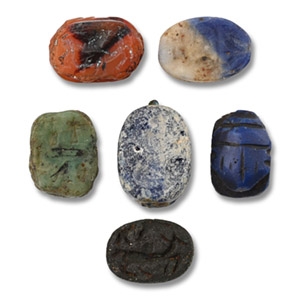
Egyptian Hardstone Scarab Group
Mainly Late Period, 664-332 B.C.Sold for (Inc. bp): £468
Most with an incuse design to the underside including cartouche of Thutmose III, lion attacking a deer, hieroglyphic text and others. 11.5 grams total, 14-18 mm
Acquired on the European art market in the early 2000s. with Galerie Rhéa, Zurich, Switzerland. This lot is accompanied by an illustrated lot declaration signed by the Head of the Antiquities Department, Dr Raffaele D'Amato. -
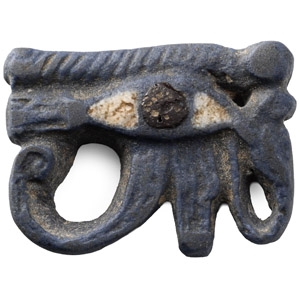
Egyptian Faience Eye of Horus Amulet
Late Period, 664-332 B.C.Sold for (Inc. bp): £520
Openwork wedjat eye amulet with black and white inlay to the eye, with a rearing cobra wearing a sun disc crown at the front. 2.28 grams, 23 mm
From an early 20th century collection. Ex London, UK, gallery. From a private UK collection This lot is accompanied by an illustrated lot declaration signed by the Head of the Antiquities Department, Dr Raffaele D'Amato.
The wedjat-eye amulet (also called the Eye of Horus) became one of the most recognisable symbols in ancient Egyptian culture. It represents the idea of protection, healing, and restoration. In myth, Horus lost his eye during his battle with Seth, and it was later magically restored, symbolising healing and the restoration of wholeness. The Eye of Horus came to represent divine power and protection and was often used in amulets for safeguarding and well-being. -
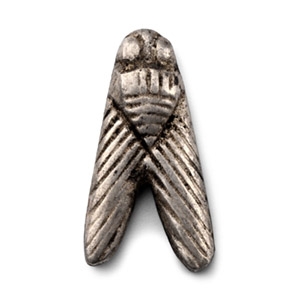
Egyptian Silver Fly Amulet
Late-Ptolemaic Period, 664-30 B.C.Sold for (Inc. bp): £130
With detailing to wings and eyes, loop for suspension above the head. 1.05 grams, 17 mm
Ex London, UK, gentleman 1980-1990s. This lot is accompanied by an illustrated lot declaration signed by the Head of the Antiquities Department, Dr Raffaele D'Amato.
Considering that Egyptian artists often depicted fly whisks in the hands of pharaohs and high officials, one might assume that flies were merely a nuisance. However, the Egyptians held flies in high regard for their speed, quick reactions, and persistence. Small fly amulets first appeared in burials during the Naqada II Period, around 3200 B.C. These amulets gained popularity, and the materials used to make them varied during the New Kingdom. They were crafted from various materials such as gold, silver, lapis lazuli, carnelian, amethyst, faience, and bone. These amulets were believed to protect against insect bites and to ward off troublesome flying creatures through apotropaic magic. Some believe they may have even symbolised the fly’s fecundity. Additionally, pharaohs would bestow gold fly-shaped pendants as military awards to honour the bravery and persistence of soldiers in battle. -
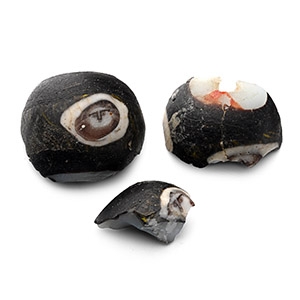
Phoenician Glass Eye Bead Fragments
1st century B.C.-1st century A.D.Sold for (Inc. bp): £124
Glass fragments from spherical beads with eyes within a white panel on black field. 6.9 grams, 15-18 mm
From the collection of a gentleman, acquired on the London art market in the 1990s. This lot is accompanied by an illustrated lot declaration signed by the Head of the Antiquities Department, Dr Raffaele D'Amato. -
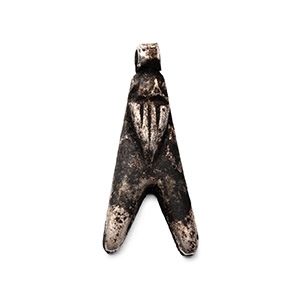
Egyptian Silver Fly Amulet
Late-Ptolemaic Period, 664-30 B.C.Sold for (Inc. bp): £78
With linear detailing to wings, raised eyes, pierced for suspension. 0.84 grams, 19 mm
Ex London, UK, art market, 1990s. This lot is accompanied by an illustrated lot declaration signed by the Head of the Antiquities Department, Dr Raffaele D'Amato.
Although flies might seem like mere nuisances—often shown being swatted by pharaohs or officials—ancient Egyptians admired them for their speed, agility, and persistence. Fly-shaped amulets, first appearing in Naqada II burials around 3200 B.C., became especially popular in the New Kingdom. Made from materials like gold, silver, faience, lapis lazuli, and bone, they served apotropaic purposes, protecting against bites and warding off pests. Some may have also symbolised fertility. Gold fly pendants were even awarded by pharaohs to honour soldiers’ bravery and tenacity.

