-
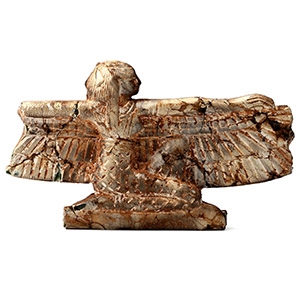
Egyptian Green Glass Winged Goddess Pectoral
Ptolemaic Period, 300-30 B.C.Sold for (Inc. bp): £1,950
A fragmentary rectangular-section figure of a kneeling goddess with outstretched wings; accurate detailing to the goddess, wearing a tripartite wig with a seshed headband tied at the back, a menat broad collar and a tightly wrapped sheath held up by two straps leaving the breasts exposed, the dress decorated with a lozenge pattern possibly representing beadwork. 15.3 grams, 54 mm
Swiss private collection, 1970s. Galerie Nefer, Zurich, early 1990s. with Christie's New York, 9 December 2008, no.39. Accompanied by copies of the relevant Christie's catalogue pages. This lot has been checked against the Interpol Database of stolen works of art and is accompanied by a search certificate number no.12843-241338. This lot has been cleared against the Art Loss Register database, and is accompanied by an illustrated lot declaration signed by the Head of the Antiquities Department, Dr Raffaele D'Amato.
Although it is not possible to spot holes in the upper and lower edges, this figure was probably a pectoral or chest ornament with an apotropaic function that would have been attached to the wrapping of the mummy. -
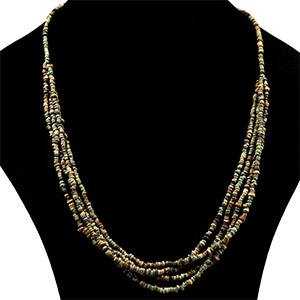
Egyptian Multi-Stranded Mummy Bead Necklace
Late Period, 664-332 B.C.Sold for (Inc. bp): £312
Multi-stranded designer necklace composed of polychrome beads of mainly annular types. 26 grams, 72 cm
Acquired before 1979. From the private collection of Mr F.A., South Kensington, London, UK; thence by descent 2014. This lot is accompanied by an illustrated lot declaration signed by the Head of the Antiquities Department, Dr Raffaele D'Amato.
For thousands of years, artisans in Egypt created vibrant ceramics to echo the beauty of rare jewels. These ornaments were created with almost every material, colour, and texture imaginable and they come from across Egypt and beyond: vibrant blue lapis lazuli from Afghanistan, glossy black obsidian from Turkey, and aqua-green turquoise from the Sinai. They were worn in life and, after death, they served as precious ornamentation for mummies. -
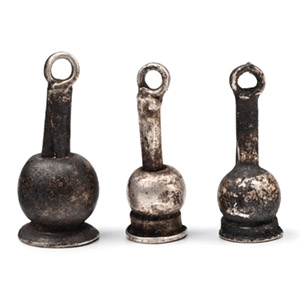
Egyptian Silver Poppy Amulet Group
Late-Ptolemaic Period, 664-30 B.C.Sold for (Inc. bp): £124
Three pendants each with poppy-head and loop at the apex. 3.68 grams total, 17-19 mm
Ex London, UK, gentleman 1980-1990s. This lot is accompanied by an illustrated lot declaration signed by the Head of the Antiquities Department, Dr Raffaele D'Amato.
Amulets in the form of poppies were used to heal and alleviate pain and to ward off death. These types of amulets were also linked to Osiris, the Egyptian deity of agriculture, death, and the afterlife. -
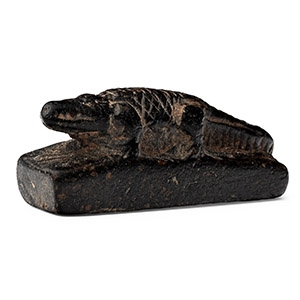
Egyptian Stone Crocodile Amulet
Late Period, 664-332 B.C.Sold for (Inc. bp): £221
Gently trapezoidal plinth with the finely detailed figure of a crocodile on top. 17.8 grams, 46 mm
From a UK dealer since the 1970s. From an old London, UK, collection since circa 1985. This lot is accompanied by an illustrated lot declaration signed by the Head of the Antiquities Department, Dr Raffaele D'Amato.
Crocodile amulets represent the god Sobek - a complex Egyptian god embodying both destructive and creative forces. As the god of the Nile, fertility, and water, he played a vital role in agriculture and the land's prosperity. Sobek was revered for his dual nature as a protector and life-giver, particularly in times of war or need. His strength and protective qualities were essential to daily life and the Egyptians’ understanding of the cosmos, leaving a lasting impact on their culture. -
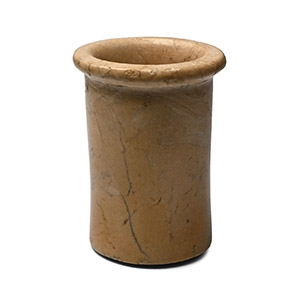
Egyptian Cylindrical Breccia Vase
Early Dynastic Period-Old Kingdom, 3050-2181 B.C.Sold for (Inc. bp): £338
Columnar in form with thick everted rim, slightly domed underside. 534 grams, 10.7 cm
From the private collection of a Canadian gentleman living in Essex, UK, formed since the 1920s-circa 1990. Property of an Essex lady until the late 1990s; thence by descent. From the private collection of an Essex gentleman since the late 1990s. This lot is accompanied by an illustrated lot declaration signed by the Head of the Antiquities Department, Dr Raffaele D'Amato. -
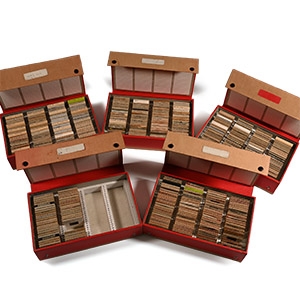
Historic Collection of 867 Slides of Archaeological Sites and Artefacts Including Other Sites in Egypt
1960s-1980s A.D.Sold for (Inc. bp): £1,430
Housed in five linen-covered boxes, covering Unas Teti, Memphis, Tombs of the Nobles, Meruruka, Saqqara, general Egyptian sites, jewellery, and architecture etc. 4.4 kg total, 26.5 x 16.5 x 6.5 cm each box
Property of archaeologist Stephanie Gee, N.W. London, UK, 1960s-1980s. This lot is accompanied by an illustrated lot declaration signed by the Head of the Antiquities Department, Dr Raffaele D'Amato.
Stephanie Gee was a prominent archaeologist who took part in several expeditions in Egypt. She was a trusted assistant to the British-Australian archaeologist Veronica Seton-Williams, who excavated in Egypt, Britain, and the Near East. Stephanie also took part in the Tell El-Farâ'în expeditions of 1965-1968, and assisted Seton-Williams with preparing the 1966 expedition report. Their collaboration continued and Stephanie helped with the manuscript of Seton-Williams’ book ‘The Road to El-Aguzein’, a narrative account of her life that was first published in 1988. -
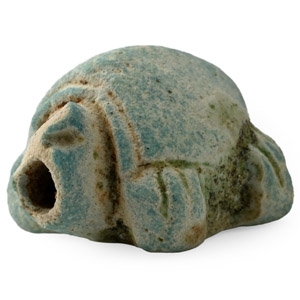
Egyptian Faience Turtle Amulet
Late Period, 664-332 B.C.Sold for (Inc. bp): £143
Blue glazed turtle amulet or bead with flat base and incised lines to each leg, pierced for suspension. 0.76 grams, 11 mm
From an early 20th century collection. This lot is accompanied by an illustrated lot declaration signed by the Head of the Antiquities Department, Dr Raffaele D'Amato.
Turtle amulets have a rich history in ancient Egypt. The turtle was considered to possess a dual character. On one hand, it lived in the dark depths, embodying cosmic danger and was ritually annihilated. On the other hand, its power could be harnessed to ward off evil and work to the advantage of people, making turtle amulets a potent symbol of protection. -
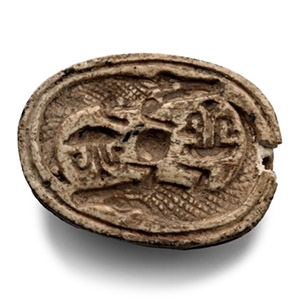
Large Egyptian Steatite Scarab
Late Period, 664-332 B.C.Sold for (Inc. bp): £520
Modelled body of a beetle with detailed carapace and legs; underside with two crocodiles enclosing a central sun disc flanked by two papyrus clumps atop neb signs. 19.8 grams, 38 mm
From the collection of a gentleman, acquired on the London art market in the 1990s. This lot is accompanied by an illustrated lot declaration signed by the Head of the Antiquities Department, Dr Raffaele D'Amato.
The design could be interpreted as ‘Sobek-Ra, lord of the Delta’. Sobek was mainly associated with water, fertility, and the Nile, as well as strength and military prowess. His worship spans much of ancient Egyptian history, from at least the Old Kingdom to the Roman period, and he was honoured not only as a force of nature but also as a god of healing, protection, and royal authority. He was associated with various other deities, most often with the sun god in the form of Sobek-Ra. His primary cult centres were situated in the Faiyum region, especially in the city of Crocodilopolis, and also at Kom Ombo in Upper Egypt. -
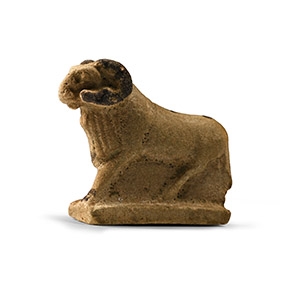
Egyptian Faience Ram Statuette
Late Period, 664-332 B.C.Sold for (Inc. bp): £468
Modelled in a dynamic pose on a rectangular base, muscular body and striated dewlap, curving horns decorated with black glaze framing the face, three large black dots on the back with further black detailing to the front hooves and tail. 44.2 grams, 64 mm
Private collection of Mr K.A., acquired in the 1990s-early 2000s. Accompanied by a copy of an Art Loss Register certificate no.2922.WW, dated 5 June 2007. This lot is accompanied by an illustrated lot declaration signed by the Head of the Antiquities Department, Dr Raffaele D'Amato.
Various gods were depicted as rams. The downturned horns on this amulet indicate that the ram represents Amun. The ram was symbolically linked to ideas of revival and fertility, which, over time, became associated with Osiris and was also viewed as the god's soul or ba. -
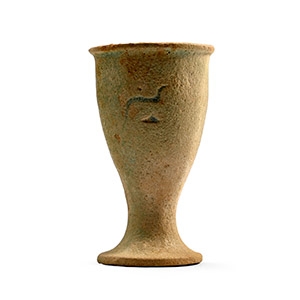
Egyptian Faience Offering Cup with Inscription
Ptolemaic Period, 332-30 B.C.Sold for (Inc. bp): £338
Piriform body, stemmed foot, and thick rim; one side inscribed with the hieroglyphs ḏt ('eternally'). 32 grams, 56 mm
Private collection of Mr K.A., acquired in the 1990s-early 2000s. This lot is accompanied by an illustrated lot declaration signed by the Head of the Antiquities Department, Dr Raffaele D'Amato. -
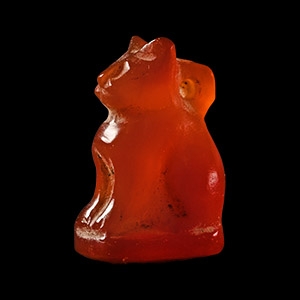
Egyptian Carnelian Cat Amulet
Ptolemaic Period, 332-30 B.C. or laterSold for (Inc. bp): £286
Amuletic pendant of the cat goddess Bastet, sitting on a rectangular base, suspension loop behind the shoulders. 1.82 grams, 16 mm
Acquired 1990s. Property of a Staffordshire lady collector. Ex Quercus of Quonians, Lichfield, UK, 2018. Property of a Sussex, UK, teacher. Private collection, London. This lot is accompanied by an illustrated lot declaration signed by the Head of the Antiquities Department, Dr Raffaele D'Amato.
The cat was sacred to Bastet, a protective mother goddess and the daughter of the sun god Re. Amulets provided the wearer with the goddess's protection. Her name means ‘she of the bast [ointment jar],’ which may have contained a substance favoured by or exclusive to royalty. Originally, Bastet was depicted as a woman with the head of a lioness, but by the late New Kingdom, she was typically depicted with a cat's head. She is sometimes shown with kittens, emphasising her maternal role as a fierce protector of offspring. -
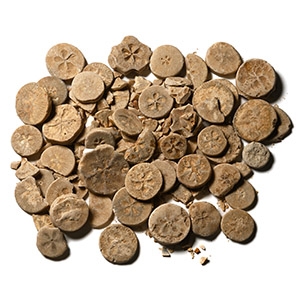
Egyptian Limestone Floral Inlay Group
Roman Period, 30 B.C.-323 A.D. or earlierSold for (Inc. bp): £33
Group of discoid inlay plaques or gaming counters, crinoids with cinquefoil motif; some fragmentary. 60 grams total, 1-21 mm
From a central London ADA dealership, 1980-1990. This lot is accompanied by an illustrated lot declaration signed by the Head of the Antiquities Department, Dr Raffaele D'Amato.
Flowers were symbolic of rebirth due to the daily reopening of their petals after nightfall. As a result, they were widely used in domestic settings, religious and funerary contexts, and as adornments. Similar rosette discs, like those recovered from the Ramesside Period palace at Qantir, were used as decorative elements in royal palaces.

