-
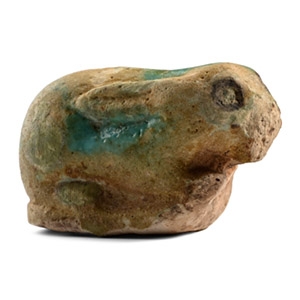
Egyptian Faience Hare Statuette
Ptolemaic Period, 332-30 B.C.Sold for (Inc. bp): £130
Modelled in the round in crouching position with its ears pulled back and resting along the body, black detailing to the eyes. 25 grams, 44 mm
Private collection of Mr K.A., acquired in the 1990s-early 2000s. This lot is accompanied by an illustrated lot declaration signed by the Head of the Antiquities Department, Dr Raffaele D'Amato.
The desert hare was one of the most common wild animals in Egypt. The female hare was sacred to Wenut, goddess of the 15th Upper Egyptian nome, though no specific hare cults are known. The purpose of hare figurines remains uncertain. According to Plutarch, Egyptians regarded the hare’s speed and keen senses—reflected in its open eyes—as divine. -
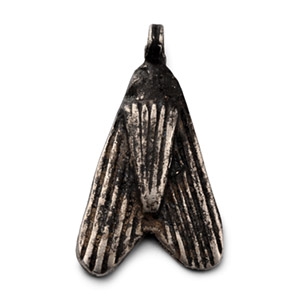
Egyptian Silver Fly Amulet
Late-Ptolemaic Period, 664-30 B.C.Sold for (Inc. bp): £91
With detailing to wings and eyes, loop for suspension above the head. 2 grams, 24 mm
Ex London, UK, gentleman 1980-1990s. This lot is accompanied by an illustrated lot declaration signed by the Head of the Antiquities Department, Dr Raffaele D'Amato.
Considering that Egyptian artists often depicted fly whisks in the hands of pharaohs and high officials, one might assume that flies were merely a nuisance. However, the Egyptians held flies in high regard for their speed, quick reactions, and persistence. Small fly amulets first appeared in burials during the Naqada II Period, around 3200 B.C. These amulets gained popularity, and the materials used to make them varied during the New Kingdom. They were crafted from various materials such as gold, silver, lapis lazuli, carnelian, amethyst, faience, and bone. These amulets were believed to protect against insect bites and to ward off troublesome flying creatures through apotropaic magic. Some believe they may have even symbolised the fly’s fecundity. Additionally, pharaohs would bestow gold fly-shaped pendants as military awards to honour the bravery and persistence of soldiers in battle. -
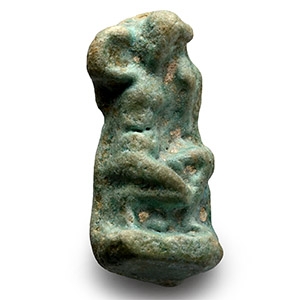
Egyptian Faience Crouching Goddess Amulet
Ptolemaic Period, 332-30 B.C.Sold for (Inc. bp): £65
Formed as a nude Aphrodite crouching on a square base, her hands raised to dress her hair; socket to reverse. 9.25 grams, 42 mm
Acquired on the UK art market during the late 20th century. From the private collection of David King (1940-2024), Hoddesdon, Hertfordshire, UK. This lot is accompanied by an illustrated lot declaration signed by the Head of the Antiquities Department, Dr Raffaele D'Amato. -
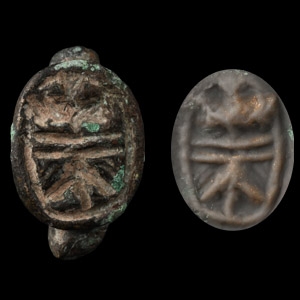
Phoenician Bronze Scaraboid Stamp Seal
6th-4th century B.C.Sold for (Inc. bp): £20
With wire carrier loop and intaglio geometric motif to underside. 4.67 grams, 16 mm
Ex London, UK, gentleman 1980-1990s. This lot is accompanied by an illustrated lot declaration signed by the Head of the Antiquities Department, Dr Raffaele D'Amato. -
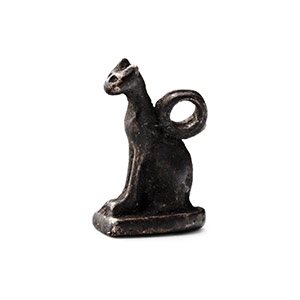
Egyptian Silver Bastet as Seated Cat Amulet
Late-Ptolemaic Period, 664-30 B.C.Sold for (Inc. bp): £715
Seated figure of a cat with pointed ears mounted on a rectangular base with a rounded end; suspension loop on the back. 0.325 grams, 7 mm
Ex London, UK, art market, 1990s. This lot is accompanied by an illustrated lot declaration signed by the Head of the Antiquities Department, Dr Raffaele D'Amato.
The cat was sacred to Bastet, a protective mother goddess and the daughter of the sun god Re. Amulets offered the wearer the goddess's protection. Her name means ‘she of the bast [ointment jar],’ which may have contained a substance favoured by or exclusive to royalty. Originally, Bastet was depicted as a woman with the head of a lioness, but by the late New Kingdom, she was usually shown with a cat's head. She is sometimes portrayed with kittens, emphasising her maternal role as a fierce protector of offspring. -
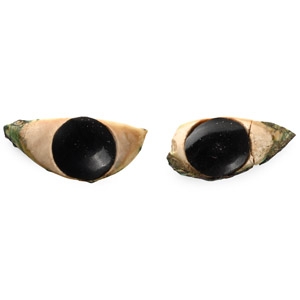
Egyptian Stone Eye Inlay Pair
Ptolemaic Period, 332-30 B.C.Sold for (Inc. bp): £208
White stone sclera with black stone iris, green stains visible on edges from copper rims. 10.5 grams total, 30-32 mm
Acquired on the UK art market, 1977-1979. Private collection, London. This lot is accompanied by an illustrated lot declaration signed by the Head of the Antiquities Department, Dr Raffaele D'Amato.
Egyptian coffin eye inlays were both decorative and symbolic, intended to make the coffin appear lifelike and assist the deceased in the afterlife. Typically, they featured a white sclera (glass, alabaster or quartz), a dark iris (glass or often obsidian), and sometimes red paint at the inner corner. The eyes were often set in bronze or copper frames, occasionally with faience or bronze eyebrows. -
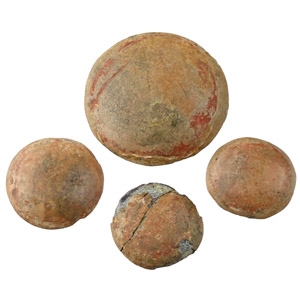
Egyptian Red-Glass Disc Collection
Ptolemaic Period, 332-30 B.C.Sold for (Inc. bp): £39
All four gently domed on one side and flat backed; three are of similar diameter, with one larger. 45.3 grams total, 25-41 mm
Acquired on the UK art market, 1977-1979. Private collection, London. This lot is accompanied by an illustrated lot declaration signed by the Head of the Antiquities Department, Dr Raffaele D'Amato. -
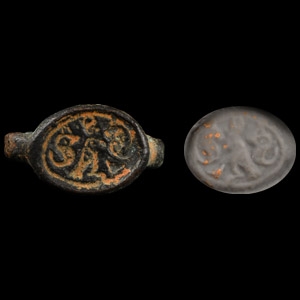
Phoenician Scarab in Bronze Pendant
6th-4th century B.C.Sold for (Inc. bp): £293
With loop and intaglio design to underside featuring depictions of a falcon deity (Ra or Ra-Horakhty) flanked by two uraei; with museum-quality impression. 5.73 grams, 19 mm
Ex London, UK, gentleman 1980-2000s. This lot is accompanied by an illustrated lot declaration signed by the Head of the Antiquities Department, Dr Raffaele D'Amato. -
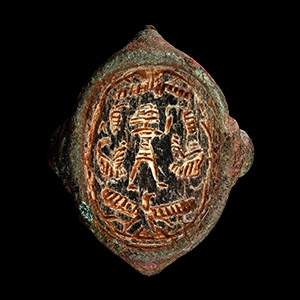
Phoenician Scarab in Bronze Pendant
6th-4th century B.C.Sold for (Inc. bp): £351
With integral loop and flanking uraei, underside features reserved depictions of a winged sun disc, with central human or divine figure below flanked by uraei and quadrupeds, and a vulture with outspread wings beneath; accompanied by a museum-quality impression. 9.06 grams, 22 mm
Ex London, UK, gentleman 1980-2000s. This lot is accompanied by an illustrated lot declaration signed by the Head of the Antiquities Department, Dr Raffaele D'Amato. -
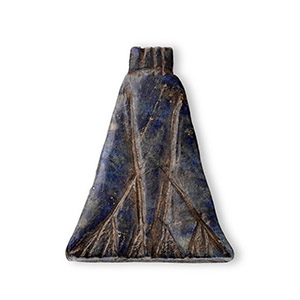
Egyptian Hardstone Amulet of Lotus Flower
New Kingdom, 1550-1070 B.C.Sold for (Inc. bp): £104
Bifacial with ribbed suspension loop and carved petals. 2.23 grams, 22 mm
From an early 20th century collection. This lot is accompanied by an illustrated lot declaration signed by the Head of the Antiquities Department, Dr Raffaele D'Amato. -
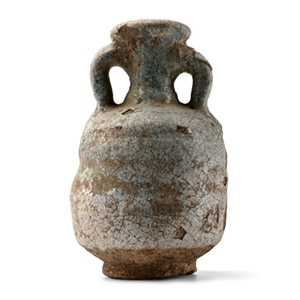
Lead-Glazed Ribbed Glass Amphora
Parthian, 3rd-1st century B.C.Sold for (Inc. bp): £117
Squat in profile with ribbed sidewall and scooped foot, trumpet-shaped neck and mouth flanked by two thick loop handles. 104 grams, 95 mm
Ex London, UK, collection, 1990s. This lot is accompanied by an illustrated lot declaration signed by the Head of the Antiquities Department, Dr Raffaele D'Amato. -
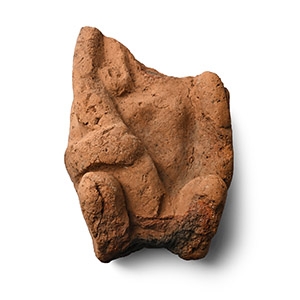
Egyptian Terracotta Fragment of Man Holding Elongated Phallus
Ptolemaic Period, 323-30 B.C.Sold for (Inc. bp): £59
Plano-convex in section with lateral folded legs, lower end of the sidelock at the shoulder, phallus extended across the body. 383 grams, 13 cm
Acquired in London, UK, 1980. From the collection of G.M.R.H., London, UK. This lot is accompanied by an illustrated lot declaration signed by the Head of the Antiquities Department, Dr Raffaele D'Amato.

