-
.jpg)
Large Amethyst Geode with Calcite Formation
Sold for (Inc. bp): £1,430
Cut geode lined with richly-coloured dark purple and lavender coloured amethyst crystals; to the centre of the geode, large cream-coloured calcite crystals bordered by green celadonite and white quartz, typical of Uruguayan crystal formations. 17.65 kg, 35 cm
From Artigas, Uruguay. Property of a London lady. -
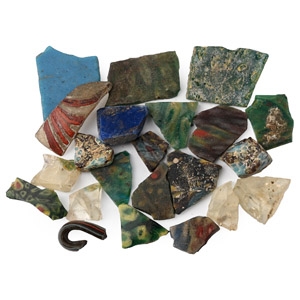
Roman and Egyptian Glass Fragment Collection
2nd century B.C.-1st century A.D.Sold for (Inc. bp): £312
Comprising a mixed group of mosaic and other glass fragments. 26 grams total, 12-29 mm
Ex Gallery Mikazuki prior to 1984. Property of a London, UK, gentleman. This lot is accompanied by an illustrated lot declaration signed by the Head of the Antiquities Department, Dr Raffaele D'Amato. -
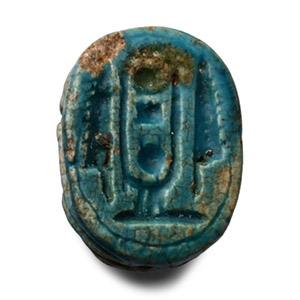
Egyptian Blue Glazed Royal Scarab for Tuthmoses III
New Kingdom, 18th Dynasty, 1479-1425 B.C.Sold for (Inc. bp): £169
With gusset and leg detailing to the sidewall, incuse design to the underside of royal cartouche flanked by feathers. 3.35 grams, 17 mm
From a Post War collection, a deceased estate. Acquired from a UK provincial auction. From the collection of G.M.R.H., London, UK. This lot is accompanied by an illustrated lot declaration signed by the Head of the Antiquities Department, Dr Raffaele D'Amato. -
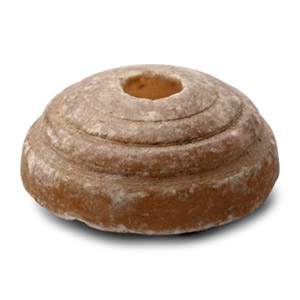
Phoenician Alabaster Spindle Whorl
1st millennium B.C.Sold for (Inc. bp): £52
Plano-convex in section with stepped profile to dome and underside. 16.52 grams, 32 mm
Found in Lebanon before 1980. From the private collection of Kenneth Machin (1936-2020), Buckinghamshire, UK; his collection of antiquities and natural history was formed since 1948; thence by descent. This lot is accompanied by an illustrated lot declaration signed by the Head of the Antiquities Department, Dr Raffaele D'Amato. -
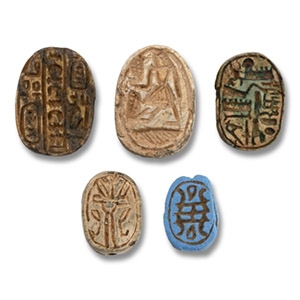
Egyptian Steatite Scarab Group
Mainly Second Intermediate Period–New Kingdom, circa 1660-1069 B.C.Sold for (Inc. bp): £286
Designs include: a tripartite design with ankh, water, nwb, and men signs, with indistinct cartouches possibly of Thutmose III, and signs spelling the phrase 'powerful is the justice of Re' (user-Maat-Re); a line border enclosing the stylised depiction of a striding figure grasping a crocodile, with a neb sign below; a line border enclosing a multitude of signs, including Thutmose III’s throne name (men-kheper-Re), and that of Amun; A line border enclosing central Hathoric sistrum; a line border enclosing a symmetrical motif in contrasting black glaze. 10.6 grams total, 13-19 mm
Acquired on the European art market in the early 2000s. with Galerie Rhéa, Zurich, Switzerland. This lot is accompanied by an illustrated lot declaration signed by the Head of the Antiquities Department, Dr Raffaele D'Amato. -
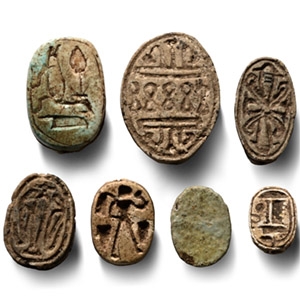
Egyptian Mixed Scarab and Scaraboid Collection
2nd-1st millennium B.C.Sold for (Inc. bp): £468
Comprising (from left to right, top to bottom): 1) a scarab with an oval border containing a goose, nefer(?), and a reed leaf; 2) a scarab with an oval border featuring a triple lotus flower motif at the top and bottom, with a middle row of floral bundles; 3) a scaraboid with a long oval border containing a cross pattern incorporating scrolls, coiled cords, and floral elements; 4) a scarab with an oval border featuring a hes-jar flanked by two cobras; 5) a scarab with a standing male figure holding a sceptre/mace and a flail, flanked by two highly stylised rearing cobras; 6) a plain scarab; 7) and a scarab with an oval border containing the name Amun-Re, a neb symbol, and a lotus flower. 13 grams total, 11-23 mm
From the collection of a gentleman, acquired on the London art market in the 1990s. This lot is accompanied by an illustrated lot declaration signed by the Head of the Antiquities Department, Dr Raffaele D'Amato. -
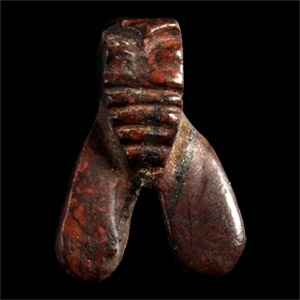
Egyptian Carnelian Fly Amulet
Late Period, 664-332 B.C.Sold for (Inc. bp): £104
Carved with ribbed body and eye detailing; drilled through the body for suspension. 0.34 grams, 10 mm
Ex London, UK, 1990s. This lot is accompanied by an illustrated lot declaration signed by the Head of the Antiquities Department, Dr Raffaele D'Amato.
Small fly amulets first appeared in burials during the Naqada II Period, c. 3200 B.C. These amulets grew in popularity and the materials used to make them expanded during the New Kingdom. They are crafted from a variety of materials such as gold, silver, lapis lazuli, carnelian, amethyst, faience, and bone. These amulets were thought to protect against insect bites and to ward off troublesome flying creatures through apotropaic magic. Some believe they may have even been intended to symbolise the fly’s fecundity. Additionally, pharaohs would bestow gold fly-shaped pendants as military awards to honour the bravery and fly-like persistence of soldiers in battle. -
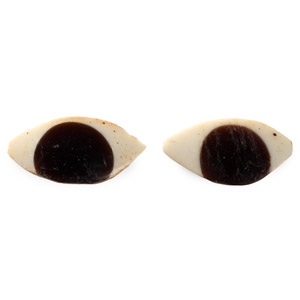
Egyptian Glass Eye Inlay Pair
Ptolemaic Period, 332-30 B.C.Sold for (Inc. bp): £208
The sclera white and the iris black. 4.12 grams total, 27-29 mm
Acquired on the UK art market, 1977-1979. Private collection, London. This lot is accompanied by an illustrated lot declaration signed by the Head of the Antiquities Department, Dr Raffaele D'Amato.
Egyptian coffin eye inlays were both decorative and symbolic, intended to make the coffin appear lifelike and assist the deceased in the afterlife. Typically, they featured a white sclera (glass, travertine, alabaster or quartz), a dark iris (glass or often obsidian), and sometimes red paint at the inner corner. The eyes were often set in bronze or copper frames, occasionally with faience or bronze eyebrows. -
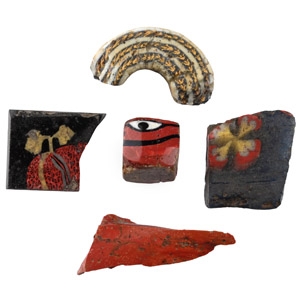
Egyptian Glass Inlay Collection
Ptolemaic Period, 332-30 B.C.Sold for (Inc. bp): £442
Various fragments, most featuring floral motifs, and a rectangular red, black lined block with an eye at each narrow end. 14.1 grams total, 14-29 mm
Acquired on the UK art market, 1977-1979. Private collection, London. This lot is accompanied by an illustrated lot declaration signed by the Head of the Antiquities Department, Dr Raffaele D'Amato. -
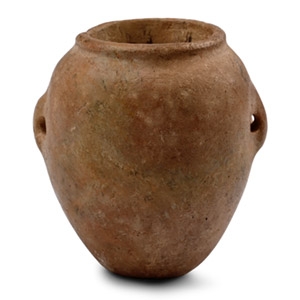
Egyptian Stone Two-Handled Cosmetic Jar
Late Predynastic-early Dynastic Period, 3100-2850 B.C.Sold for (Inc. bp): £572
Barrel-shaped in profile with low rim and two lateral pierced lug handles. 103 grams, 53 mm
From the private collection of a Canadian gentleman living in Essex, UK, formed since the 1920s-circa 1990. Property of an Essex lady until the late 1990s; thence by descent. From the private collection of an Essex gentleman since the late 1990s. This lot is accompanied by an illustrated lot declaration signed by the Head of the Antiquities Department, Dr Raffaele D'Amato. -
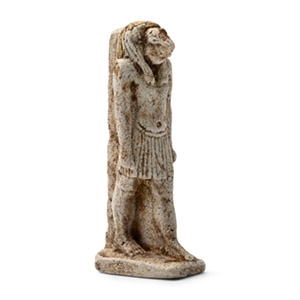
Egyptian Faience Amulet Representing Thoth
664-332 B.C.Sold for (Inc. bp): £143
Comprising a rectangular base and dorsal pillar pierced behind the shoulders, the god with ibis head, tripartite wig, knee-length kilt. 2.33 grams, 37 mm
Private collection, Carouge, Switzerland, assembled in the 1980s-1990s. Thence by descent to the collection of Mr S.P., since 2020. This lot is accompanied by an illustrated lot declaration signed by the Head of the Antiquities Department, Dr Raffaele D'Amato. -
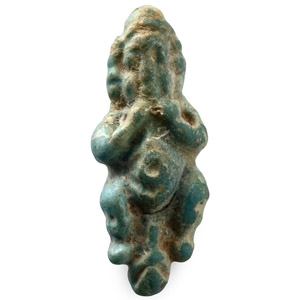
Egyptian Faience Phallic Figure Amulet
Ptolemaic Period, 332-30 B.C.Sold for (Inc. bp): £130
Blue glazed figure of a chubby dwarf with bent legs seated on emphasised phallus, both hands touching the chin, suspension loop to the reverse. 2.43 grams, 29 mm
From an early 20th century collection. This lot is accompanied by an illustrated lot declaration signed by the Head of the Antiquities Department, Dr Raffaele D'Amato.

