-
.jpg)
Phoenician Amethyst Scarab
8th century B.C.Sold for (Inc. bp): £2,600
Plano-convex in section with carved carapace to upper face; two lines of Phoenician script to underside. 3.21 grams, 18 mm
Acquired in 1992. Private collection, Switzerland, thence by descent. Private collection, since the late 1990s. This lot has been checked against the Interpol Database of stolen works of art and is accompanied by a search certificate number no.12851-241685. This lot has been cleared against the Art Loss Register database, and is accompanied by an illustrated lot declaration signed by the Head of the Antiquities Department, Dr Raffaele D'Amato. -
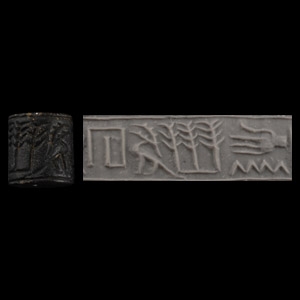
Egyptian Black Stone Cylinder Seal Inscribed with Hieroglyphs for the Name Deneh
Circa 2900 B.C.Sold for (Inc. bp): £2,470
With hieroglyphic inscription, restrung pair of red stone beads, old handwritten label '1633'; accompanied by a copy of an old scholarly note, typed and signed by W.G. Lambert, late Professor of Assyriology, University of Birmingham, 1970-1993, which states: 'Cylinder Seal of Soft Black Stone, 15 x 13.5 mm. Between upper and lower rules five Egyptian hieroglyphs are engraved skillfully. The bird is 'akh', "soul", the following house, hand and wavey line, are probably a personal name Deneh or Dehen, and the remaining sign consisting of three trees or plants may be a title. This is an old Egyptian cylinder seal from the Second Dynasty, c. 2900 B.C., and the inscriptions are still in the process of being deciphered. The occurrence of "soul" suggests mortuary use, but the Egyptians made preparations for such things during life, so the owner may well have had this object during his life. It is in fine state of preservation.'; accompanied by a museum-quality impression. 6.5 grams, 14 mm
UK private collection, acquired 1980-1983. Accompanied by a copy of a scholarly note, typed and signed by Professor Wilfrid George Lambert in 1992. This lot is accompanied by an illustrated lot declaration signed by the Head of the Antiquities Department, Dr Raffaele D'Amato.
Cylinder seals are typically engraved, cylindrical stone objects designed to be rolled over clay, leaving impressions of images and often text carved in reverse. In Egypt, they appeared early in the historical record, likely due to Mesopotamian influence, with the more familiar button and stamp seals becoming prevalent later, particularly during the First Intermediate Period. -
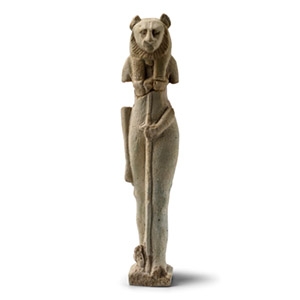
Large Egyptian Faience Figure of Sekhmet
1st millennium B.C.Sold for (Inc. bp): £3,380
Modelled in the round standing, holding an ankh in her right hand, the other holding a slender staff, lion-headed, wearing an ankle-length skirt; loop behind her neck. 79 grams, 14 cm
Acquired in the late 1980s. Private collection, thence by descent. Private collection, since the late 1990s. This lot has been checked against the Interpol Database of stolen works of art and is accompanied by a search certificate number no.12852-241726. This lot has been cleared against the Art Loss Register database, and is accompanied by an illustrated lot declaration signed by the Head of the Antiquities Department, Dr Raffaele D'Amato. -
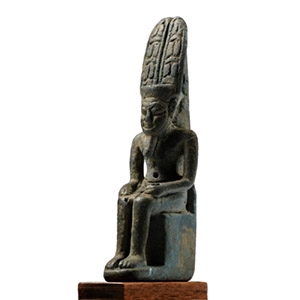
Egyptian Blue Amulet of Amun
Late Period, 26th Dynasty, circa 664-525 B.C.Sold for (Inc. bp): £1,690
The god modelled seated on a throne with a dorsal pillar, hands resting on his knees, wearing a short kilt and a two-plume feather crown; mounted on a wooden stand. 15.75 grams total, 71 mm including stand
with Charles Ede Ltd, London, UK. Private collection, London, UK, acquired from the above on 12 July 1994. Accompanied by a copy of the Charles Ede invoice. This lot has been checked against the Interpol Database of stolen works of art and is accompanied by a search certificate number no.12632-235078. This lot has been cleared against the Art Loss Register database, and is accompanied by an illustrated lot declaration signed by the Head of the Antiquities Department, Dr Raffaele D'Amato.
The amulet of the god Amun served both religious and protective purposes in ancient Egypt. Amun was a major deity associated with creation, kingship, and hidden power. Wearing an amulet bearing his image or name was believed to invoke his divine protection, grant strength, and confer favour or legitimacy. Such amulets were also placed among burial goods to ensure the deceased was protected and guided in the afterlife. -
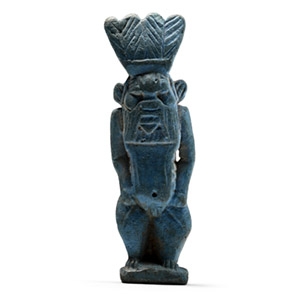
Egyptian Blue Amulet of Bes
Third Intermediate Period, circa 1069-735 B.C.Sold for (Inc. bp): £520
Modelled in the round, Bes standing nude with a lion's tail, wearing a feathered headdress. 4.13 grams, 44 mm
Archéologie; François de Ricqlès, Paris, 30 September-1 October 1996, no.322 (part). Private collection, London, UK, acquired from the above sale. Accompanied by a copy of a French cultural passport, dated 30 September 1996. Accompanied by a copy of the François de Ricqlès invoice. This lot has been checked against the Interpol Database of stolen works of art and is accompanied by a search certificate number no.12630-235074. This lot is accompanied by an illustrated lot declaration signed by the Head of the Antiquities Department, Dr Raffaele D'Amato.
From the New Kingdom onwards, Bes became one of ancient Egypt's most popular apotropaic deities. Despite his somewhat fearsome appearance, Bes served as the patron and protector of pregnant women and children, and was also believed to shield them from snakes. -
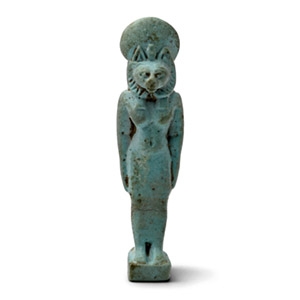
Egyptian Faience Amulet Representing Sekhmet
Late Period, 664-332 B.C.Sold for (Inc. bp): £650
With rectangular base and dorsal pillar pierced behind the shoulders, standing figure of the goddess in lioness-headed form with tripartite wig and solar disc, human body. 9.98 grams, 60 mm
Private collection, Carouge, Switzerland, assembled in the 1980s-1990s. Thence by descent to the collection of Mr S.P., since 2020. This lot is accompanied by an illustrated lot declaration signed by the Head of the Antiquities Department, Dr Raffaele D'Amato. -
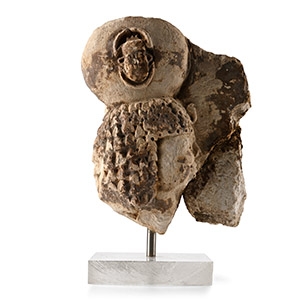
Egyptian Limestone Relief
Late-Ptolemaic Period, 664-30 B.C.Sold for (Inc. bp): £910
Relief fragment comprising: a sun disc with high-relief scarab motif to the centre; below this, a head in profile wearing a tiered wig with uraeus to the brow; mounted on a custom-made stand. 1.61 kg total, 22.2 cm including stand
Collection of Mr C., Geneva, Switzerland (1936-2016), assembled between 1985 and 2010. This lot is accompanied by an illustrated lot declaration signed by the Head of the Antiquities Department, Dr Raffaele D'Amato. -
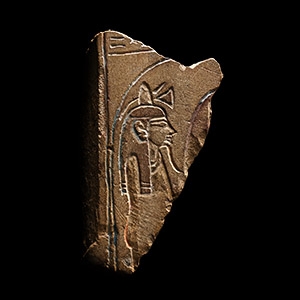
Egyptian Limestone Fragment
New Kingdom, 1550-1295 B.C.Sold for (Inc. bp): £1,690
Architectural fragment with two dressed faces; incised design comprising: vertical border to the left; a band of hieroglyphic text at the top; an arch enclosing a seated figure in profile wearing a tripartite wig and collar with curved beard, head cone and frond above; curved linear element meeting the end of the beard; traces of white, blue, red-brown and other pigments; chamfered edge pierced in modern times for mounting. 190 grams, 10.8 cm
From the estate of a deceased American, acquired between 1970-1989. with Bonham's, London, Knightsbridge, 28 October 2009, no.23 [part]. This lot has been cleared against the Art Loss Register database, and is accompanied by an illustrated lot declaration signed by the Head of the Antiquities Department, Dr Raffaele D'Amato. -
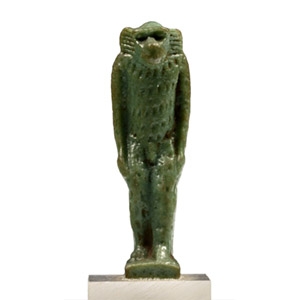
Egyptian Green Glazed Faience Amulet of a Monkey
Third Intermediate Period, circa 1069-735 B.C.Sold for (Inc. bp): £520
Modelled in the round with dorsal pillar and loop, small base. 6.1 grams total, 43 mm including stand
Collection of Monsieur M.; Etude Tajan, Paris, 26 February 1996, no.101. Private collection, London, UK, acquired from the above sale. Accompanied by a copy of a French cultural passport, dated 21 March 1996. This lot is accompanied by an illustrated lot declaration signed by the Head of the Antiquities Department, Dr Raffaele D'Amato.
The vervet monkey was a symbol of love and sexual fulfilment. -
.jpg)
Egyptian Amarna Sandstone Relief Fragment
New Kingdom, 18th Dynasty, 14th century B.C.Sold for (Inc. bp): £15,600
Rectangular in plan with irregular left and lower edge; carved in low-relief in two registers with narrow border; lower register - plain with cream-white pigment; upper register – a combat or possibly post battle or tribute scene depicting two profile male heads with stern features, lentoid eye, strong mouth and chin, wearing brow-bands, probably Western Asiatics; with the leg of a kneeling(?) figure to the right; the reverse dressed but undecorated; two modern mounting holes to the long edge. 5.11 kg, 33 cm
Private collection, 1980s. Private European collection, 2008. This lot has been checked against the Interpol Database of stolen works of art and is accompanied by a search certificate number no.12853-241665. This lot has been cleared against the Art Loss Register database, and is accompanied by an illustrated lot declaration signed by the Head of the Antiquities Department, Dr Raffaele D'Amato.
Scenes of captured enemies and especially foreign envoys in audience with the pharaoh depict figures in various humiliating, supplicatory poses, including prostration and kneeling. -
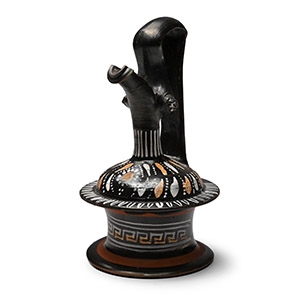
Greek Apulian Blackware Epichysis
South Italic, circa 4th century B.C.Sold for (Inc. bp): £546
With spool base, domed upper face, tall neck with spout and strap handle to the rear; the spool with meander band in cream and white, the upper face with frond pattern in cream and white, parallel vertical strokes to the base of the spout. 183 grams, 14.5 cm
From the private collection of a Canadian gentleman living in Essex, UK, formed since the 1920s-circa 1990. Property of an Essex lady until the late 1990s; thence by descent. From the private collection of an Essex gentleman since the late 1990s. This lot is accompanied by an illustrated lot declaration signed by the Head of the Antiquities Department, Dr Raffaele D'Amato. -
.jpg)
Greek Apulian Black-Glazed Epichysis with Eros
South Italic, circa 325-300 B.C.Sold for (Inc. bp): £975
Blackware with spool base, domed upper face, tall neck with spout and strap handle to the rear; the spool with laurel-leaf band in white, the upper face with tendrils in cream and ochre, winged Eros crouching holding up a mirror; repaired with some repainting. 255 grams, 17 cm
From the private collection of a Canadian gentleman living in Essex, UK, formed since the 1920s-circa 1990. Property of an Essex lady until the late 1990s; thence by descent. From the private collection of an Essex gentleman since the late 1990s. This lot is accompanied by an illustrated lot declaration signed by the Head of the Antiquities Department, Dr Raffaele D'Amato.

