-
.jpg)
Cut and Polished Agate Geode End Group
Sold for (Inc. bp): £20
A group of three cut and polished agate geode sections, one with bands of blue and brown; one with blue, grey and red bands; one with a variegated mottled surface. 774 grams total, 11-14cm
Very fine condition.
From the historic ‘Victorian Museum’ or later collection of Gregory, Bottley & Lloyd (Gregory's); formerly Gregory, Bottley & Co. (1932-1981) and previously J. R. Gregory & Co. (1898-1932); originally James Reynolds Gregory (1858-1898). v
The firm Gregory, Bottley and Lloyd (Gregory's), was acquired by TimeLine Auctions in 2016. London-born James Reynolds Gregory (1832-1899) founded the company, which is the second longest-running gem and fossil dealership in the world. James was educated at Archbishop Tenison's School, and afterward found employment in a jewellery company on Regent Street. In 1858 he established his own business in King William Street. A few years later he moved to ‘very extensive premises’ in Golden Square, Covent Garden. He was one of the best known dealers in London, exhibiting at major commercial shows throughout the world and winning awards for excellence in Paris in 1867, Sydney in 1879 and London in 1862, 1883 and 1884. James primarily bought his stock at auction, from collectors and other dealers, and supplied many major collectors and scientists of his day. He built superb personal collections, a selection going to the British Museum. He wrote many papers and was a member of several learned societies including the Society of Arts. The business became known as J.R. Gregory & Company in 1896, still under James' management with the assistance of his son Albert Gregory (b.1864). When James died three years later, the business passed to Albert. At the end of the 19th century most London dealers had folded or retired, many selling out to J.R. Gregory & Co. Albert continued by acquiring Russell and Shaw (Est. 1848) in 1925 and Francis H. Butler (Est. 1884) in 1927. Percy Bottley (1904-1980) took over the company in 1931, renaming it Gregory, Bottley & Company with respect to his predecessors. Percy’s company survived the 2nd World War by buying out all of its competitors, including the supplier to Pitt-Rivers, Samuel Henson (Est. 1840) and G.H. Richards (Est. 1897) in 1936. Percy also added many important collections to his stock including those of Rev. F. Holmes in 1940, and the Graves collection in 1943. Following Percy's death in 1981, the business was sold to Brian Lloyd, whereupon it became Gregory, Bottley & Lloyd. Brian had been Sotheby’s main Natural History expert in the 1960s and 1970s, and subsequently traded from Pall Mall. The business continued to thrive, and Brian purchased the Joseph Neeld (1789-1856) collection in 1974 and the historic gold collection of H.S. Gordon, first exhibited at the Empire Exhibition, South Africa in 1936. Brian moved the business to 12-13 Rickett Street in 1982, and to 13 Seagrave Road in 1993. He carried on the company's specialization in historic collections, most recently acquiring that of Robert Ferguson (1767-1840) in 2000. The business moved to Walmer in Kent in 2008, and was acquired by TimeLine in April 2016. Trading History Est. 1858 (59 Frith Street, Soho) 1859 - 1861 (3 King William Street, Strand) 1862 - 1866 (25 Golden Square, Covent Garden) 1866 - 1874 (15 Russell Street, Covent Garden) 1874 - 1895 (88 Charlotte Street, Fitzroy Square) 1896 - 1906 (1 Kelso Place, Kensington) 1907 - 1926 (139 Fulham Road, Chelsea) 1926 - 1981 (30 (Old) Church Street, Chelsea) 1982 - 1993 (12-13 Rickett Street, Fulham) 1993 - 2007 (13 Seagrave Road, Fulham) 2008 - 2016 (59 Liverpool Road, Walmer, Kent) 2016 - (363 Main Road, Harwich, Essex) -
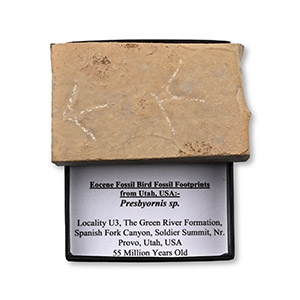
Fossil Presbyornis Bird Footprints
Eocene Period, circa 58-36 million years B.P.Sold for (Inc. bp): £59
A rectangular matrix containing two footprints, emphasised with white chalk; rare. 108 grams, 76 mm
From Locality 3, The Green River Formation, Spanish Fork Canyon, Soldier Summit, near Provo, Utah, USA. From the private collection of Kenneth Machin (1936-2020), Buckinghamshire, UK; his collection of antiquities and natural history was formed since 1948; thence by descent. -
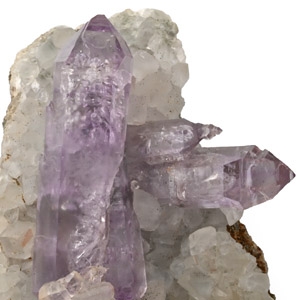
Amethyst Crystal Mineral Display Specimen
Sold for (Inc. bp): £20
Lavender-coloured translucent amethyst crystals on calcite matrix. 15.3 grams, 34 mm
Property of a North West London, UK, lady. -
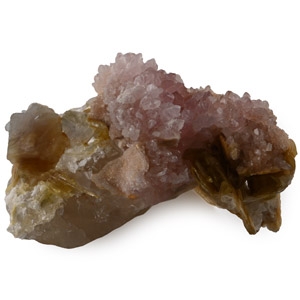
Rose Quartz and Mica Crystal Mineral Display Specimen
Sold for (Inc. bp): £59
Quartz matrix containing clusters of small rose quartz crystals and vitreous mica crystals. 60 grams, 61 mm
Property of a North West London, UK, lady. -
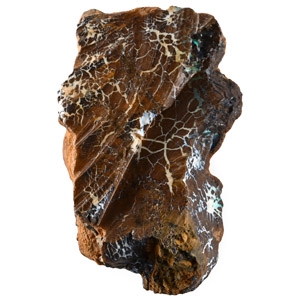
Boulder Opal Mineral Display Specimen
Sold for (Inc. bp): £39
A cut and polished boulder opal displaying blue, white and green colours. 169 grams, 81 mm
Property of a North West London, UK, lady. -
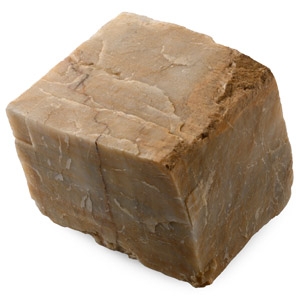
Calcite Crystal Mineral Display Specimen
Sold for (Inc. bp): £13
A large specimen of calcite. 1.81 kg, 94 mm
Property of a North West London, UK, lady. -
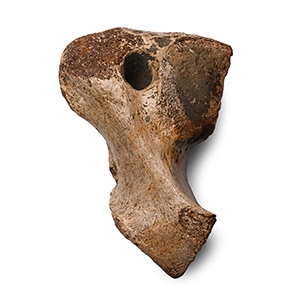
Fossil Woolly Mammoth Bone
Pleistocene Epoch, circa 2.6 million-11,700 years B.P.Sold for (Inc. bp): £65
A partial first cervical vertebra from a mammoth, mammuthus primigenius. 1 kg, 19 cm
Said to be from the Isle of Wight, Hampshire, UK. From a Leicestershire, UK, collection; acquired on the UK art market. Property of a Cheshire, UK, gentleman. -
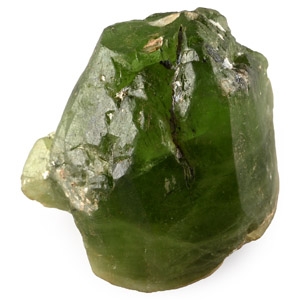
Green Peridot Crystal Mineral Display Specimen
Sold for (Inc. bp): £98
A rich green peridot crystal. 72.8 grams, 46 mm
Property of a North West London, UK, lady. -
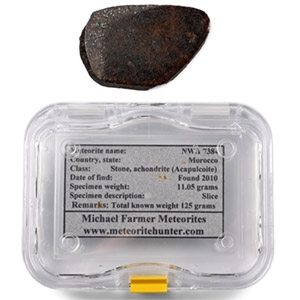
NWA 7384 Acapulcoite Achondrite Meteorite Slice
Sold for (Inc. bp): £85
A polished slice showing small metal grains set in a dark-brown, fine-grained groundmass. 15.4 grams, 54 mm
Found Morocco, North West Africa in 2010. Ex Michael Farmer Meteorites, Tucson, Arizona, USA. From the private collection of a Leicestershire, UK, gentleman. Accompanied by a Michael Farmer dealer card and a Swiss membrane box. -
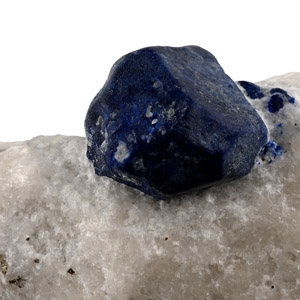
Lazurite Mineral Display Specimen
Sold for (Inc. bp): £46
Dark blue lazurite on matrix. 129 grams, 74 mm
Property of a North West London, UK, lady. -
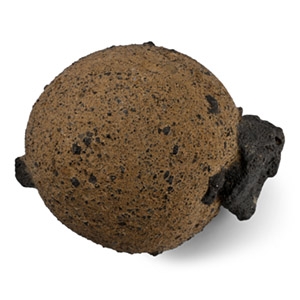
Spherical Sedimentary Concretion
Sold for (Inc. bp): £20
Naturally formed from hardened sediment with projecting porous, black stone nodules. 647 grams, 10.2 cm
Acquired on the UK art market in the 1990s. From the Dr Ince collection, N.W. London, UK.
A concretion is a compact mass of mineral matter, usually spherical or disc-shaped, and they vary greatly in size. They usually form early in the burial history of sediment, before the rest of the sediment has hardened into solid rock. Concretions occur when a considerable amount of cementing material collects locally around a nucleus, often organic (a leaf, tooth, a section of fossil or shell or dead matter) and commonly a marine invertebrate. -
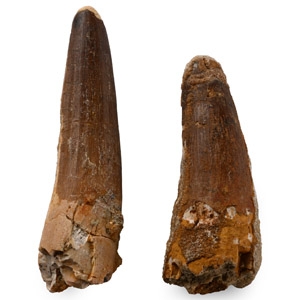
Spinosaurus Fossil Dinosaur Tooth Group
Cretaceous Period, circa 125-113 million years B.P.Sold for (Inc. bp): £85
Comprising two Spinosaurus maroccanus teeth with some root; repaired. 37.3 grams total, 57-68 mm
Acquired on the UK art market before 2000. Property of an Essex, UK, gentleman.
The Spinosaurus was both a beachcomber type scavenger and an active hunter taking small stranded Plesiosaurs, Pterosaurs, turtles and large fish.

