-
.jpg)
Caucasian Axehead with Engraved Dragon Heads
Koban Culture, 12th-8th century B.C.Sold for (Inc. bp): £11,050
Comprising a swept curved edge, slender neck with faceting, bulb socket and small striking face to the butt; frieze of hatched serpentine necks and heads to each face of the blade, with reserved triangles; band of hatched chevrons to the neck, horizontal fluting to the socket; mounted on a custom-made stand. 806 grams total including stand, axehead: 18.8 cm
Franz Heger (1853-1931), Austrian traveller and ethnographer, acquired in the Caucasus during his 1890 expedition. Believed to have been gifted circa 1930 to Franz Hancar (1893-1968), noted scholar and expert in ancient Caucasian cultures. Thence by descent, acquired in the 1950s by Mr R.D., Vienna, Austria. Acquired from the above in 1998 by N.M., former Israeli Ambassador to Austria (1998-2000). Accompanied by an academic report by Dr Raffaele D'Amato. This lot has been checked against the Interpol Database of stolen works of art and is accompanied by a search certificate number no.12840-240720. This lot has been cleared against the Art Loss Register database, and is accompanied by an illustrated lot declaration signed by the Head of the Antiquities Department, Dr Raffaele D'Amato.
During the latter half of the 2nd millennium B.C., one type of axe head dominated in the region of the Eastern European steppes. It had a narrow horizontal blade, a short blade and a tube-shaped handle. Examples have been found across the steppes of Eastern Europe from Transcaucasia. From the middle of the second millennium B.C., the spread of the type in the Eastern Steppes was connected with the movement of Iranian-speaking nomads, maybe the Tocharo-speaking tribes, who used two-wheeled horse-drawn war chariots. -
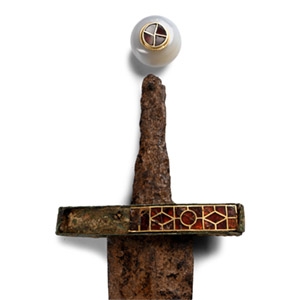
Late Roman Iron Sword with Decorated Guard
5th-6th century A.D.Sold for (Inc. bp): £2,340
A two-edged spatha type with a lentoid parallel-sided blade, sloped shoulders and short tang pierced by an attachment rivet for the grip; the bronze lower guard rectangular in plan and scaphoid in section with inset garnet cloisonné in gold cells with rhomboid patterns alternating with circles; the upper top roundel of the pommel or insertion of the hanging stone divided into four gold cells in garnet cloisonné; accompanied by a barrel-shaped polished hilt stone. 696 grams, 74 cm
From the private collection of a London gentleman, from his grandfather's collection formed before the early 1970s. Accompanied by an academic report by Dr Raffaele D’Amato. This lot has been checked against the Interpol Database of stolen works of art and is accompanied by search certificate no. 12586-240319. This lot has been cleared against the Art Loss Register database, and is accompanied by an illustrated lot declaration signed by the Head of the Antiquities Department, Dr Raffaele D'Amato.
The sword is a Migration Period sword which usually had stones hanging from the pommel or hilt, like the one preserved here, which finds a parallel with the sword of Lord of Morken (Strassmeir, 2019, p.55, lett.G). This typology was widespread in Central Europe by the Huns and there are also specimens attested in Gaul and Spain in the 5th century. -
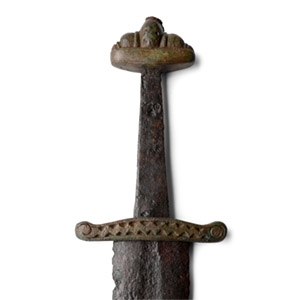
Viking Age Iron Sword Decorated Hilt
11th-13h century A.D.Sold for (Inc. bp): £5,720
Double-edged cutting sword of Couronian type with tapering fullers, bronze cross-guard with Jellinge Style type decoration; five-lobed bronze pommel rivetted at the top. 814 grams, 88 cm
From the private collection of a London gentleman, from his grandfather's collection formed before the early 1970s. Accompanied by an academic report by Dr Raffaele D’Amato. This lot has been checked against the Interpol Database of stolen works of art and is accompanied by search certificate number no.12784-240320. This lot has been cleared against the Art Loss Register database, and is accompanied by an illustrated lot declaration signed by the Head of the Antiquities Department, Dr Raffaele D'Amato.
The Couronian swords of this type with animal head decoration were widespread and used in the Eastern Baltic lands from 10th to 13th century. -
.jpg)
Viking Battle Axe Head with Silver Inlays
Northern Europe, 9th-11th century A.D.Sold for (Inc. bp): £8,450
With short, cylindrical socket to rear, narrow neck, flared blade with curved cutting edge; underside of the blade swept in a gentle curve; short flanges above and below the rear of the socket; decorated overall with finely engraved silver inlays forming two dragons and interlace patterns (probably not original); provided with a display stand. 390 grams, 15.7 cm (813 grams total, 26.2 cm high including stand)
Acquired 1982 in Kaliningrad and transported to Riga in 1986, moved to East Berlin in 1988, and again to Germany in 2000, then UK in 2014. Ex West London collection. Accompanied by a copy of an Art Loss Register certificate no.S00141022. Accompanied by an academic report by Dr Raffaele D'Amato. This lot has been checked against the Interpol Database of stolen works of art and is accompanied by search certificate number no.12476-228759. This lot has been cleared against the Art Loss Register database, and is accompanied by an illustrated lot declaration signed by the Head of the Antiquities Department, Dr Raffaele D'Amato. -
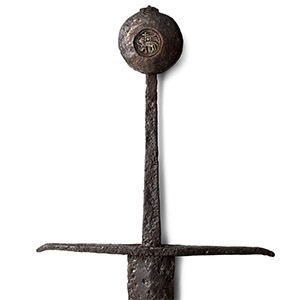
Massive Medieval Iron Hand-and-a-Half Knight's Sword with Lamb of God Pommel
Western Europe, 14th-15th century A.D.Sold for (Inc. bp): £8,450
Of Oakeshott's Type XV or XVIII, cross style 8, pommel style J (recessed) with a strongly tapering, pointed blade of 'flattened diamond'-section; tapering lower-guard with downturned finials; long, slightly tapering grip and a large disc pommel with chamfered edges, inlay to both sides with a low-relief image of Lamb of God, possibly a later addition; some contemporary repairs. 1.6 kg, 1.19 m
From the private family collection of a lady, UK; acquired in Germany mid 20th century. Accompanied by an academic report by Dr Raffaele D’Amato. This lot has been checked against the Interpol Database of stolen works of art and is accompanied by search certificate number no.12787-240329. This lot has been cleared against the Art Loss Register database, and is accompanied by an illustrated lot declaration signed by the Head of the Antiquities Department, Dr Raffaele D'Amato.
Many swords of this type have long grips, like the war-swords of Type XIII. After about 1350, nine swords out of ten seem to have such grips, and are today variously referred to as 'Hand-and-a-half' or 'Bastard' swords. The latter term was used in the 15th century, but it is not certain that it was applied to this particular kind of weapon. 'Hand-and-a-half'', though modern, is a far more fitting name; these swords were single-handed weapons, but by being furnished with long grips, could at need be wielded easily in both. -
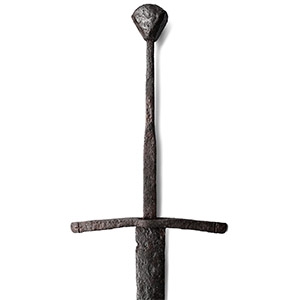
Massive Medieval Iron Two-Handed Knight's Sword with Crosses on Guard
Germany, circa 14th century A.D.Sold for (Inc. bp): £3,380
Tapering blade with a shallow fuller, long and narrow tang with a pear-shaped pommel and a curved cross-guard of Oakeshott Style 6 with incised crosses; professionally conserved. 1.94 kg, 1.42 m
From the private family collection of a lady, UK; acquired in Germany mid 20th century. Accompanied by an academic report by Dr Raffaele D’Amato. This lot has been checked against the Interpol Database of stolen works of art and is accompanied by search certificate number no.12788-240330. This lot has been cleared against the Art Loss Register database, and is accompanied by an illustrated lot declaration signed by the Head of the Antiquities Department, Dr Raffaele D'Amato.
The noteworthy element of this sword is its guard with the engraved crosses. The presence of the cross suggests that the sword once belonged to person belonging to a military order of chivalry. Considering that the Templars were already destroyed when the sword was made, the main candidates could be the Hospitallers or, most probably, the Teutonic Knights. -
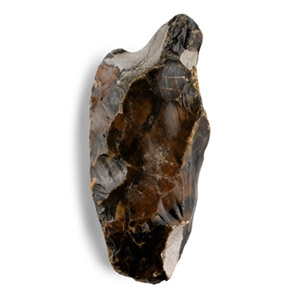
Stone Age Happisburgh Type Flint Handaxe
Lower Palaeolithic, circa 600,000-250,000 B.P.Sold for (Inc. bp): £975
Of brown, buff and black patinated flint, the butt (Type A) fairly cortical with two 'horned' projections of the nodule, one much longer than the other, another patch of cortex remains towards the point to the dorsal face. 293 grams, 13 cm
Discovered by P Macro at Happisburgh, Norfolk, UK, between Tuesday 1st October 2019 and Saturday 30th November 2019. Ex collection of P James, South England. Acquired directly from the finder. From the private collection of an East Anglian, UK, specialist collector. Accompanied by a copy of the British Museum's Portable Antiquities Scheme (PAS) report no.NMS-3A3691. This lot is accompanied by an illustrated lot declaration signed by the Head of the Antiquities Department, Dr Raffaele D'Amato.
The site of Happisburgh in Norfolk has helped to push the history of inhabitation of the British Isles back by 200,000 years, making it a site of special importance. -
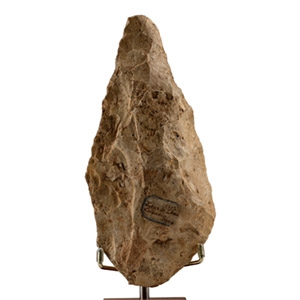
Large Stone Age Acheulean Flint Handaxe
Lower Palaeolithic Period, circa 500,000-350,000 B.P.Sold for (Inc. bp): £520
Piriform in profile with broad butt; old collector's label '1899 / Eaux de l'Avre / Colombin / De[...]'; mounted on a custom-made display stand. 404 grams total including stand, axe: 15 cm
Found Eure et Loire, Eaux de L’Avre, Columbies, France, in 1892. Ex famous UK musician and amateur archaeologist, Victor Brox (1941-2023). Acquired on the UK art market. From the private collection of an East Anglian, UK, specialist collector. This lot is accompanied by an illustrated lot declaration signed by the Head of the Antiquities Department, Dr Raffaele D'Amato.
Attributed to Homo Heidelbergensis. -
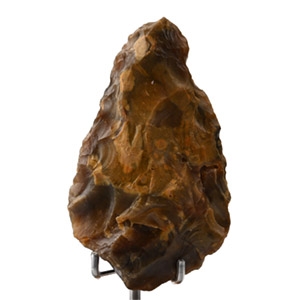
Stone Age Classic-Shaped Flint Handaxe
Palaeolithic Period, circa 500,000-300,000 B.P.Sold for (Inc. bp): £1,170
Cordiform with mottled autumnal patina and glassy flint; traces of fossil marine creatures within the flint, now turned to quartz; mounted on a custom-made display stand. 443 grams total including stand, axe: 13 cm
Found Thames gravels, Kent, UK. Acquired on the UK art market. From the private collection of an East Anglian, UK, specialist collector. This lot is accompanied by an illustrated lot declaration signed by the Head of the Antiquities Department, Dr Raffaele D'Amato.
Attributed to Homo Heidelbergensis. -
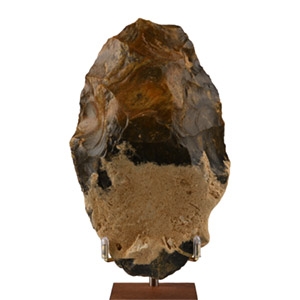
Large Stone Age Acheulean Flint Handaxe
Lower Palaeolithic Period, circa 500,000-350,000 B.P.Sold for (Inc. bp): £390
Substantial leaf-shaped type with some cortex to the butt; inked findspot 'St Même / Charente / Car Audouin (FR)'; mounted on a custom-made display stand. 669 grams total including stand, axe: 15.6 cm
From the well regarded long closed quarry site of St Meme, Charente, France. From an old large Belgian collection. Acquired on the European art market. From the private collection of an East Anglian, UK, specialist collector. This lot is accompanied by an illustrated lot declaration signed by the Head of the Antiquities Department, Dr Raffaele D'Amato.
Attributed to Homo Heidelbergensis. -
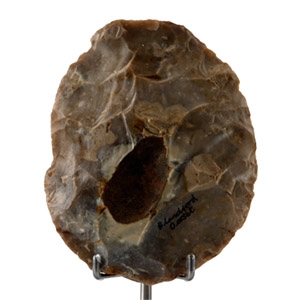
Large Stone Age Flint Ovate Handaxe
Palaeolithic Period, circa 450,000-300,000 B.P.Sold for (Inc. bp): £1,040
With silky cream and pale blue patina; small oval darker area forming part of the original cortex, potentially left to aid grip; inked notation 'Blandford / Dorset'; mounted on a custom-made display stand. 535 grams total including stand, axe: 13.3 cm
Found Blanford, Dorset, UK. From the collection of John Sharp, former well known archaeologist. Acquired on the UK art market. From the private collection of an East Anglian, UK, specialist collector. This lot is accompanied by an illustrated lot declaration signed by the Head of the Antiquities Department, Dr Raffaele D'Amato.
The Ovate form is uncommon. Attributed to Homo Heidelbergensis. -
.jpg)
Large Stone Age Knapped Axe Blade
Neolithic Period, circa 5500-2200 B.P.Sold for (Inc. bp): £2,080
Worked on all sides into an almost symmetrical shape; lanceolate cross-section; beige flint (silex) with cream-coloured spots and dots; waxy surface sheen. 1.29 kg, 34.5 cm
Findspot 'Reuilly sur C.1927', France. Ex M.M., Paris. French art market, 2019. This lot has been checked against the Interpol Database of stolen works of art and is accompanied by search certificate number no.12473-228700. This lot has been cleared against the Art Loss Register database, and is accompanied by an illustrated lot declaration signed by the Head of the Antiquities Department, Dr Raffaele D'Amato.

