-
.jpg)
Sumerian Alabaster Plaque with Seated Man
Circa 2800-2600 B.C.Sold for (Inc. bp): £1,170
Rectangular fragment with border to right and bottom edges; scene with reserved figure in profile sitting on a framed chair wearing a flounced garment and taking or holding a drinking horn in one hand, the other resting on his leg. 108 grams, 94 mm
Private collection, Contessa L.J., since the 1980s. Private collection, Switzerland, 2001. This lot has been cleared against the Art Loss Register database, and is accompanied by an illustrated lot declaration signed by the Head of the Antiquities Department, Dr Raffaele D'Amato. -
.jpg)
Achaemenid Heavy Gold Earring Pair
Circa 6th-4th century B.C.Sold for (Inc. bp): £2,340
A matched pair of large earrings decorated with pomegranates on the outer edge, the crescentic body divided in transversal grooves representing the abdomen of a bee, with granulation on the inner and outer edge, a horizontal gold wire with circlets to the centre. 23.78 grams total, 38 mm each
From a private family collection formed since the early 19th century, thence by descent. Property of a New Zealand legal professional. Accompanied by an academic report by Dr Raffaele D’Amato. This lot has been checked against the Interpol Database of stolen works of art and is accompanied by search certificate number no.12326-223715. This lot has been cleared against the Art Loss Register database, and is accompanied by an illustrated lot declaration signed by the Head of the Antiquities Department, Dr Raffaele D'Amato.
Fruit were generally considered to be a symbol of sensuality, temptation and fertility; the giving and accepting of fruit may be regarded as a symbolic sexual act, or at least a prelude to marriage. It follows naturally that the pomegranate, with its innumerable fleshy seeds symbolising life and fecundity, was an attribute of Aphrodite. -
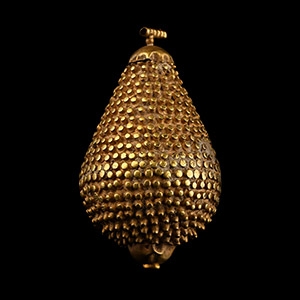
Bactrian Gold Pendant
3rd millennium B.C.Sold for (Inc. bp): £1,560
Biconvex in profile with ribbed suspension bar above, rows of regularly applied granules to the sidewall, domed end with granule finial. 14.53 grams, 41 mm
Ex private European collection, 1980s. Private collection, Switzerland, acquired in 1998. This lot has been cleared against the Art Loss Register database, and is accompanied by an illustrated lot declaration signed by the Head of the Antiquities Department, Dr Raffaele D'Amato. -
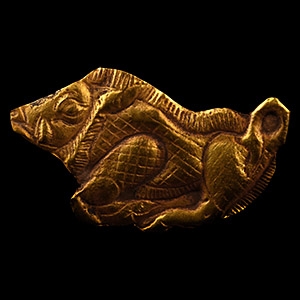
Achaemenid Gold Repousse Boar Mount
6th-4th century B.C.Sold for (Inc. bp): £1,872
Sheet gold appliqué with repoussé detailing of a running boar in profile with hatching to the body; to the reverse, two applied mounting strips; mounted on a custom-made stand. 2.07 grams, 48 mm (449 grams total, 15 cm including stand)
UK private collection before 2000. Acquired on the UK art market. Private collection, London, UK. This lot has been cleared against the Art Loss Register database, and is accompanied by an illustrated lot declaration signed by the Head of the Antiquities Department, Dr Raffaele D'Amato. -
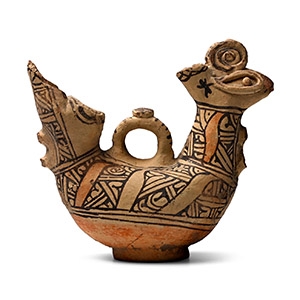
Western Asiatic Terracotta Bichrome Bird Vessel
8th-9th century A.D.Sold for (Inc. bp): £468
Lentoid in plan with central loop handle, spout formed as a bird-head with coiled crest, rear a broad vent with openwork strainer; painted foliage and reserved bands. 387 grams, 17 cm
UK collection, 1990s. Acquired on the UK art market, before 2000. Private collection, Mr M.V., a London-based businessman. This lot has been cleared against the Art Loss Register database, and is accompanied by an illustrated lot declaration signed by the Head of the Antiquities Department, Dr Raffaele D'Amato. -
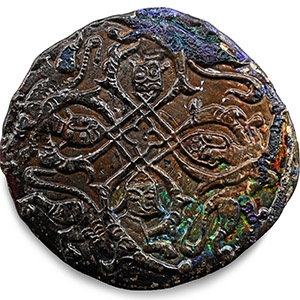
Western Asiatic Roundel for Administrative Purposes or a Weight Unit
9th-11th century A.D.Sold for (Inc. bp): £624
Iridescent blue glass disc with low-relief central quatrefoil, four advancing felines with heater-shaped heads; clay mould for the production of a very similar design, plano-convex in section with knop handle; both in a custom-made lined presentation case with hinged lid. 280 grams total, 9-10.3 cm
Acquired in the 1960s-1970s. Kept in the UK since 1981. This lot has been cleared against the Art Loss Register database, and is accompanied by an illustrated lot declaration signed by the Head of the Antiquities Department, Dr Raffaele D'Amato. -
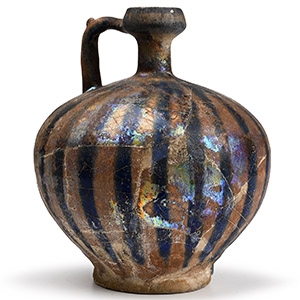
Kashan Glazed Handled Jug
12th-13th century A.D.Sold for (Inc. bp): £845
Spherical body on short ring foot, thin tubular neck, flared spout with D-section handle, blue and white glazed vertical stripes with iridescence; an old label to the underside; repaired. 445 grams, 15.8 cm
From the private family collection of Ersula Barter-Hemmerich, the longest serving member of staff working at the United Nations, her private collection formed in the 1950s and 1960s; thence by descent to her grandson. This lot has been cleared against the Art Loss Register database, and is accompanied by an illustrated lot declaration signed by the Head of the Antiquities Department, Dr Raffaele D'Amato. -
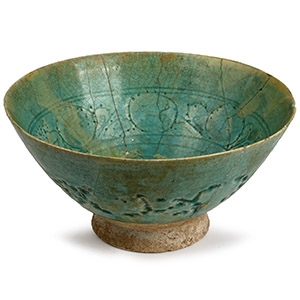
Kashan Turquoise Glazed Bowl
13th century A.D.Sold for (Inc. bp): £247
Glazed hemispherical bowl with deep basal ring, painted scroll and dot decoration to the inner face, punched decoration to the outer face, old inked label 'XIII cnt, 750'; repaired. 203 grams, 15.3 cm wide
From the private family collection of Ersula Barter-Hemmerich, the longest serving member of staff working at the United Nations, her private collection formed in the 1950s and 1960s; thence by descent to her grandson. This lot has been cleared against the Art Loss Register database, and is accompanied by an illustrated lot declaration signed by the Head of the Antiquities Department, Dr Raffaele D'Amato. -
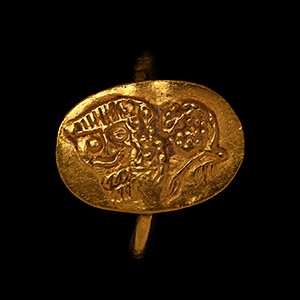
Western Asiatic Gold Ring with Lion
12th-13th century A.D.Sold for (Inc. bp): £1,300
Slender hoop with ellipsoid plaque, die-struck image of a couchant lion with pelletted detailing. 4.19 grams, 20.66 mm overall, 16.79 mm internal diameter (approximate size British M, USA 6, Europe 12.46, Japan 12)
UK private collection before 2000. Acquired on the UK art market. Private collection, London, UK. This lot has been cleared against the Art Loss Register database, and is accompanied by an illustrated lot declaration signed by the Head of the Antiquities Department, Dr Raffaele D'Amato. -
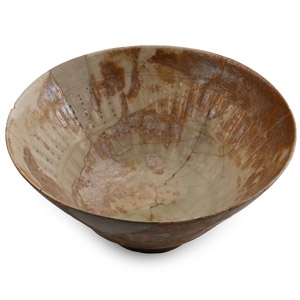
Ayyubid Glazed Bowl
12th-13th century A.D.Sold for (Inc. bp): £78
Conical profile with wide foot, white glaze and ribbed decoration to the inner face; some restoration. 249 grams, 17.8 cm wide
From the private family collection of Ersula Barter-Hemmerich, the longest serving member of staff working at the United Nations, her private collection formed in the 1950s and 1960s; thence by descent to her grandson. This lot has been cleared against the Art Loss Register database, and is accompanied by an illustrated lot declaration signed by the Head of the Antiquities Department, Dr Raffaele D'Amato. -
.jpg)
Greek Pontic Tinned Bronze Chalcidian Helmet
5th-3rd century B.C.Sold for (Inc. bp): £16,250
The bowl forged from a single piece and fitted with removable cheek-pieces; the dome divided into two halves by a carinated ridge, the peaked crown separated from the lower helmet wall by an indented ridge; cut-outs for ears and eyes with raised edges; short, angular neck-guard and short nose-guard extending to the eyebrows; the cheek-pieces with contoured front edge, holes for a chin-strap; remains of textile on the left side of the bowl; accompanied by a display stand. 2.15 kg total, 43 cm high including stand
From the collection of T.K., Germany, 1970s. Acquired in 1992 by Mr R.K. Acquired by the present owner on the UK art market. Accompanied by an academic report by Dr Raffaele D'Amato. This lot has been checked against the Interpol Database of stolen works of art and is accompanied by search certificate number no.12782-240166. This lot has been cleared against the Art Loss Register database, and is accompanied by an illustrated lot declaration signed by the Head of the Antiquities Department, Dr Raffaele D'Amato.
Hinged cheek-pieces, like in our specimen, appeared in Thracia during the 4th century, but prototypes from the Pontic area and wider Greece show them already in use in the 5th century B.C. The traces of textile on the left part of our helmet show that it was stored inside a protective item -perhaps a case or bag – guarding it against atmospheric agents or possible damage when not in use. -
.jpg)
Roman Imperial Bronze Legionary Helmet
Late 1st century B.C.-early 1st century A.D.Sold for (Inc. bp): £39,000
A relatively heavy legionary helmet (cassis) of ‘Imperial Gallic Type’ with deep rounded bowl, simple C-shaped cut-outs for the ears, integral flared horizontal neck-guard extending some way along the sides, two corrugated ribs to the occipital area at the rear, intermitted by two bronze rivets, and four corrugated embossed 'wings' or prominent curved eyebrows flanking three riveted bosses arranged vertically; three studs on the rear of the neck-guard for attaching suspension loops to the preserved clasps of the cheek-guards (bucculae); hinged bracket at each temple once attaching the cheek-guard; embossed beaded brow band running from one ear opening to the other; mounted on a custom-made stand. 1.03 kg, 26.5 cm front to back
Ex John Moore, York, UK, 1997. Property of a North London, UK, gentleman. Accompanied by an academic report by Dr Raffaele D'Amato. This lot has been checked against the Interpol Database of stolen works of art and is accompanied by search certificate number no. 12789-240372. This lot has been cleared against the Art Loss Register database, and is accompanied by an illustrated lot declaration signed by the Head of the Antiquities Department, Dr Raffaele D'Amato.
This early category of helmets was characterised by a hemispherical calotte and a slightly sloping neck guard. They were fitted with a pair of prominent curved eyebrows (symbolising the wings of Jupiter's thunderbolts) flanking rivetted bosses.

