-
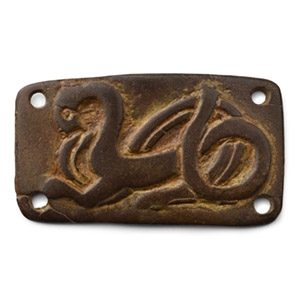
Anglo-Scandinavian Viking Bronze Belt Mount with Entwined Beast
10th-11th century A.D.Sold for (Inc. bp): £286
Rectangular panel pierced at each corner for attachment; low-relief 'hippocamp' zoomorphic figure with arched neck, curved beak, coiled rear body. 6.1 grams, 36 mm
Found East Anglia, UK. This lot is accompanied by an illustrated lot declaration signed by the Head of the Antiquities Department, Dr Raffaele D'Amato.
The design shows elements of Irish influence. -
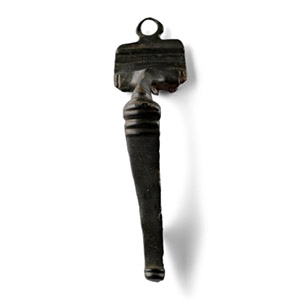
Anglo-Saxon Bronze Looped Square-Headed Bow Brooch
Late 5th century A.D.Sold for (Inc. bp): £91
With rectangular headplate and carinated bow; transverse ribbing with tremolier detailing; with remains of the iron pin, loop to chain together the pair. 19.9 grams, 94 mm
Found East Stoke, Nottinghamshire, UK. This lot is accompanied by an illustrated lot declaration signed by the Head of the Antiquities Department, Dr Raffaele D'Amato. -
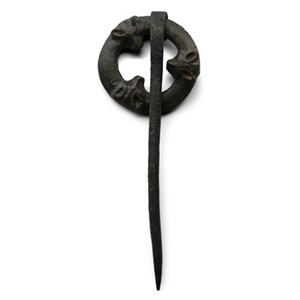
Viking Age Bronze Annular Brooch with Bear's Masks
10th century A.D.Sold for (Inc. bp): £234
Annular in form, D-shaped in section with three inward-facing bear-masks, sturdy pin with loop finial on the shank. 16.7 grams, 88 mm
From the private collection of a London gentleman, from his grandfather's collection formed before the early 1970s. This lot is accompanied by an illustrated lot declaration signed by the Head of the Antiquities Department, Dr Raffaele D'Amato. -
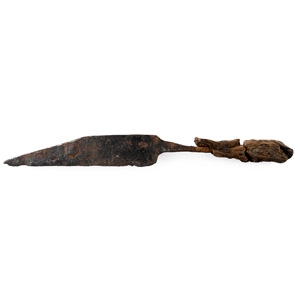
Saxon Iron Knife with Wooden Handle
6th-8th century A.D.Sold for (Inc. bp): £221
Single-edged blade with drooping point, whittle-tang hilt with original wood adhering. 22.9 grams, 17.2 cm
Acquired on the UK art market before 2000. Property of an Essex, UK, gentleman. This lot is accompanied by an illustrated lot declaration signed by the Head of the Antiquities Department, Dr Raffaele D'Amato. -
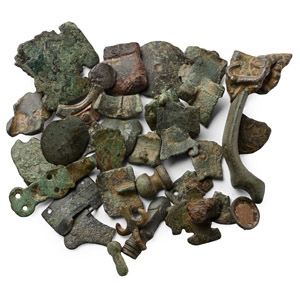
Anglo-Saxon Bronze Artefact Fragments
6th century A.D.Sold for (Inc. bp): £46
Including: cruciform brooch, button brooch, disc brooch, wrist clasp, belt mounts and other items, some with traces of gilding. 217 grams total, 15-53 mm
Found East Anglia, UK. This lot is accompanied by an illustrated lot declaration signed by the Head of the Antiquities Department, Dr Raffaele D'Amato. -
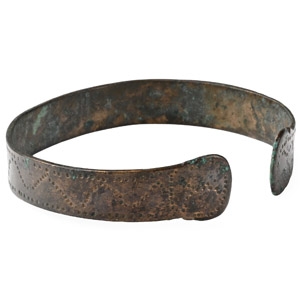
Viking Period Bronze Decorated Bracelet
9th-11th century A.D. or earlierSold for (Inc. bp): £208
Flat-section penannular body with slightly flared terminals, upper face with punched dot decoration. 14.6 grams, 55 mm
UK private collection before 2000. Acquired on the UK art market. Private collection, London, UK. This lot is accompanied by an illustrated lot declaration signed by the Head of the Antiquities Department, Dr Raffaele D'Amato. -
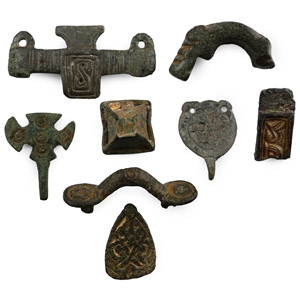
Anglo-Saxon Bronze Artefact Collection
6th century A.D. and laterSold for (Inc. bp): £130
Including: ansate brooch, wrist clasp, hooked tags, pyramid mount and other items, some with gilding. 41 grams total, 15-43 mm
Found East Anglia, UK. This lot is accompanied by an illustrated lot declaration signed by the Head of the Antiquities Department, Dr Raffaele D'Amato. -

Viking Gilt Bronze Drum Brooch with Oseberg Beast Panels
9th century A.D.Sold for (Inc. bp): £598
A hollow drum-shape with ornament to the obverse and sidewall; lozenge shaped cross with bosses to centre, high-relief designs comprising four discoid panels of Oseberg Style 'gripping-beast' motifs with a larger dome to the centre and four smaller ones within a hatched border with raised trefoils; the slightly sloping sidewall with four panels of S-shaped animals with interlaced tendrils, separated by hatched borders; small hole near the outer edge of the upper plate; to the reverse, the perimeter flange with remains of the pin-hinge. 35 grams, 51 mm
From a private UK collection formed since the 1980s. Ex property of a UK gallery, early 2000s. This lot is accompanied by an illustrated lot declaration signed by the Head of the Antiquities Department, Dr Raffaele D'Amato.
Drum brooches (also called ‘box brooches’, Swedish Dosspännen) were a Scandinavian fashion of the Viking period, beginning in the late 8th century AD and mainly featuring Oseberg style gripping-beast motifs. They remained popular throughout the period into the 11th century AD. They are especially associated with the island of Gotland, the crossroads of trade and traffic in the Baltic where a variety of cultural influences were felt. Occasional examples occur elsewhere in the area of Scandinavian power, plausibly associated with the movement of brides from Gotland to foreign homelands. The earliest (8th century) examples are high-quality multi-part castings with lavish use of gold, parcel-gilding and silver; by the later Viking age they appear in bronze and gilt-bronze. The original artistic motifs also evolve into more geometric forms with increased use of knotwork. As a type, these brooches are characterised by their discoid upper face divided into symmetrical sectors, often with openwork detail; cords and faux-ropework to the edges are a consistent feature of the later designs; some feature a separate cast upper plate while on others it is the baseplate which is separate, occasionally the central knop is also a separate casting. It has been suggested that drum brooches were used to hold small valuables, although this seems improbable – these were normally suspended from the girdle or necklace for display. They were most probably used to fasten the triangular shawl or mantle which covered the upper body, in the dress fashion which included the heavy hängerok dress which was worn outside the undershift; the hängerok was often of rich fabric with embroidered borders, and the metal jewellery and glass beads were used to add richness to the costume. It may be this type of brooch (or the tortoise form) which was referred to by the Arab traveller Ibn Fadlan when he mentioned that Rus women wore on their chests drum-shaped brooches of iron, copper, silver or gold, whose decoration indicated the wealth of their husbands. The present example with Salin's Style III ornament is among the very earliest known, dating from the 8th century before the onset of the Viking period. It does not feature the customary separate baseplate. -

Viking Period Bronze Twisted Neck Torc
9th-11th century A.D. or earlierSold for (Inc. bp): £234
Round-section penannular body with decorative twist, coiled flattened finials. 46 grams, 13.6 cm
UK private collection before 2000. Acquired on the UK art market. Private collection, London, UK. This lot is accompanied by an illustrated lot declaration signed by the Head of the Antiquities Department, Dr Raffaele D'Amato. -
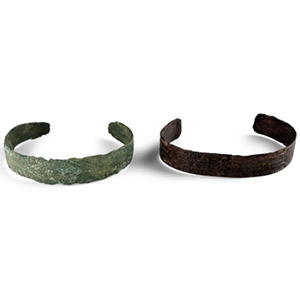
Viking Period Bronze Bracelet Group
Circa 8th-10th century A.D.Sold for (Inc. bp): £104
Each a flat-section penannular strip with low-relief geometric ornament to the outer face. 29 grams, 65-68 mm
Previously in a collection formed in the 1970s on the UK art market. From the property of L.F. Property of a Cheshire, UK, gentleman. This lot is accompanied by an illustrated lot declaration signed by the Head of the Antiquities Department, Dr Raffaele D'Amato. -
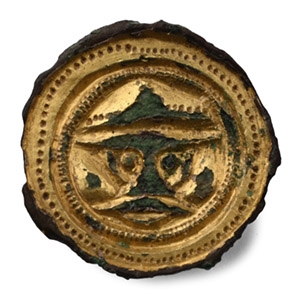
Anglo-Saxon Gilt Bronze Button Brooch
5th-6th century A.D.Sold for (Inc. bp): £156
Of Avent's Class A(ii) with flange to the rim, inner collar, central helmetted mask with scaphoid mouth; remains of pin lug and catchplate to reverse. 2.34 grams, 17 mm
Found East Anglia, UK. This lot is accompanied by an illustrated lot declaration signed by the Head of the Antiquities Department, Dr Raffaele D'Amato. -
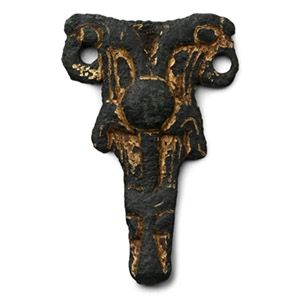
Anglo-Saxon Gilt Bronze Gusset Plate with Ravens
6th century A.D.Sold for (Inc. bp): £33
Formed as a slender triangle with slightly concave sides terminating in a stylised beast's head with roundel eyes and a square muzzle; raised median band with dome and scrolled ends forming avian heads. 8.41 grams, 43 mm
Found Weston Colville, Cambridgeshire, UK. This lot is accompanied by an illustrated lot declaration signed by the Head of the Antiquities Department, Dr Raffaele D'Amato.

