-

Turco-Mongol 'Greek Fire' Ceramic Fire Bomb or Hand Grenade
13th-15th century A.D.Sold for (Inc. bp): £117
Piriform in profile with domed mouth and stepped neck, raised vertical lugs on the body, stamped rosettes and linear decoration; intended to be filled with explosive liquid and wick, used as a hand grenade. 838 grams, 19.5 cm
From an important specialist collection, London, UK, 1990s onwards. Accompanied by an academic paper by military specialist Dr Raffaele D'Amato, dated 15 July 2019 and titled 'Eastern Roman Empire - Greek Fire Bomb or Hand Grenade (μεσαίον kακάβιον) 9th-11th century AD'. This lot is accompanied by an illustrated lot declaration signed by the Head of the Antiquities Department, Dr Raffaele D'Amato.
Apart from the use of siphons or manual flame-throwers called cheirosiphona, special corps of Roman soldiers employed terracotta grenades, in the form of small jars, abundantly evidenced in archaeological excavations. They were called μεσαία kακαβιά or κυτροκακάβια where the former had a bulbous shape and the latter a more cylindrical form. -
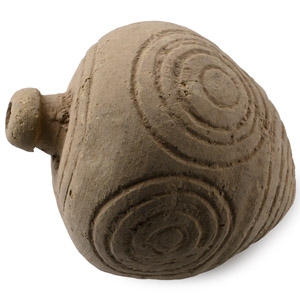
Byzantine 'Greek Fire' Ceramic Fire Bomb or Hand Grenade
9th-11th century A.D.Sold for (Inc. bp): £91
Bulbous body with pointed tip and domed mouth, concentric circle motifs to the body and circumferential banding to the upper and lower body; intended to be filled with explosive liquid and a wick, and used as a hand grenade. 684 grams, 12 cm
From an important specialist collection, London, UK, 1990s onwards. Accompanied by an academic paper by military specialist Dr Raffaele D'Amato, dated 15 July 2019 and titled 'Eastern Roman Empire - Greek Fire Bomb or Hand Grenade (μεσαίον kακάβιον) 9th-11th century AD'. This lot is accompanied by an illustrated lot declaration signed by the Head of the Antiquities Department, Dr Raffaele D'Amato.
Apart from the use of siphons or manual flame-throwers called cheirosiphona, special corps of Roman soldiers employed terracotta grenades, in the form of small jars, abundantly evidenced in archaeological excavations. They were called μεσαία kακαβιά or κυτροκακάβια where the former had a bulbous shape and the latter a more cylindrical form. -
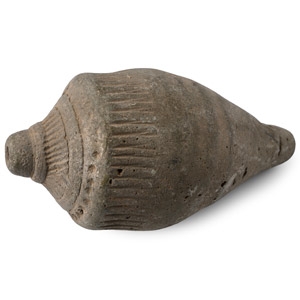
Turco-Mongol 'Greek Fire' Ceramic Fire Bomb or Hand Grenade
13th-15th century A.D.Sold for (Inc. bp): £85
Piriform in profile with domed mouth, impressed line and dot decoration on the upper body; intended to be filled with explosive liquid and wick, used as a hand grenade. 54 grams, 16.5 cm
From an important specialist collection, London, UK, 1990s onwards. Accompanied by an academic paper by military specialist Dr Raffaele D'Amato, dated 15 July 2019 and titled 'Eastern Roman Empire - Greek Fire Bomb or Hand Grenade (μεσαίον kακάβιον) 9th-11th century AD'. This lot is accompanied by an illustrated lot declaration signed by the Head of the Antiquities Department, Dr Raffaele D'Amato.
Apart from the use of siphons or manual flame-throwers called cheirosiphona, special corps of Roman soldiers employed terracotta grenades, in the form of small jars, abundantly evidenced in archaeological excavations. They were called μεσαία kακαβιά or κυτροκακάβια where the former had a bulbous shape and the latter a more cylindrical form. -
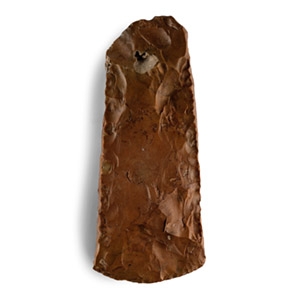
Large Scandinavian Stone Age Trechter Beyer Type Flaked Axehead
Neolithic Period, circa 5500 B.P.Sold for (Inc. bp): £130
Worked and unpolished on all surfaces and edges, trapezoidal in plan with rectangular cross-section and slightly convex broad sides, straight narrow sides; thin butt rounded and with reduced thickness; rounded cutting edge; dark beige 'marbled' flint with inclusions. 467 grams, 18.5 cm
From the South of Denmark. Acquired on the UK art market. From the private collection of an East Anglian, UK, specialist collector. This lot is accompanied by an illustrated lot declaration signed by the Head of the Antiquities Department, Dr Raffaele D'Amato. -
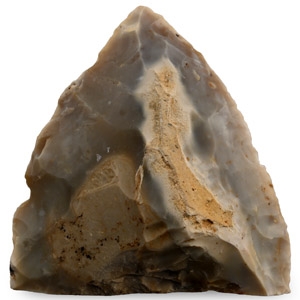
Stone Age Neanderthal Mousterian Flint Knife
Middle Palaeolithic Period, circa 150,000- 60,000 B.P.Sold for (Inc. bp): £85
Slightly curved triangular point with plano-convex profile, cream and orange patina. 89 grams, 84 mm
Found Yonne, Bourgogne Franche-Compte Region, France. From a large French collection built up in the early 1900s. Acquired on the European art market. From the private collection of an East Anglian, UK, specialist collector. This lot is accompanied by an illustrated lot declaration signed by the Head of the Antiquities Department, Dr Raffaele D'Amato. -
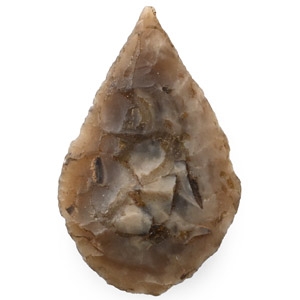
Stone Age Flint Ovate Arrowhead
Neolithic Period, circa 5000 B.P.Sold for (Inc. bp): £104
A nicely knapped leaf-shaped arrowhead in light brown flint, with old collector's number to verso: '24'. 1.87 grams, 30 mm
Found Thames Valley in the 19th century. From an antiquarian Palaeolithic study collection, Shropshire, UK. This lot is accompanied by an illustrated lot declaration signed by the Head of the Antiquities Department, Dr Raffaele D'Amato. -
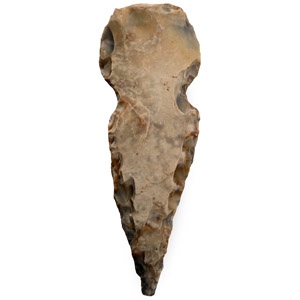
British Stone Age Knapped Flint Waisted Point
Middle Palaeolithic Period, Mousterian circa 150,000-60,000 B.P.Sold for (Inc. bp): £111
Leaf-shaped in plan and triangular in section; remains of old early 20th century label to verso. 49.7 grams, 10.2 cm
From an old West Country, UK, collection, sold at auction. From the private collection of a West Midlands lady collector. This lot is accompanied by an illustrated lot declaration signed by the Head of the Antiquities Department, Dr Raffaele D'Amato. -
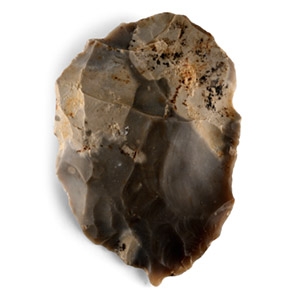
Very Large Stone Age Mousterian Levelious Flint Knife
Middle Palaeolithic Period, circa 150,000- 60,000 B.P.Sold for (Inc. bp): £130
Broadly ovate knapped from buff to light grey flint, made by Neanderthal man. 215 grams, 12 cm
Found Bourgogne Franche-Compte Region, France. From a large French collection built up in the early 1900s. Acquired on the European art market. From the private collection of an East Anglian, UK, specialist collector. This lot is accompanied by an illustrated lot declaration signed by the Head of the Antiquities Department, Dr Raffaele D'Amato. -
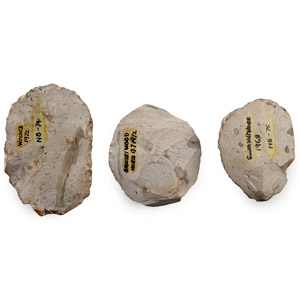
Stone Age Flint Scraper Group
Neolithic Period, 6th-4th millennium B.P.Sold for (Inc. bp): £39
Comprising: discoid in plan with inked label 'Bricketwood Herts 17.7.1972'; ovate in plan with inked label 'South Wiltshire 1968', 'N8-75', (1) and (3); ovate in plan with cortex to reverse, inked label 'Wessex 1972 N*-74' and '4a' to reverse. 141 grams total, 55-70 mm
Found South Wiltshire 1968, Wessex 1972, and Bricketwood, Herts 17 July 1972. From the private collection of Kenneth Machin (1936-2020), Buckinghamshire, UK; his collection of antiquities and natural history was formed since 1948; thence by descent. This lot is accompanied by an illustrated lot declaration signed by the Head of the Antiquities Department, Dr Raffaele D'Amato. -
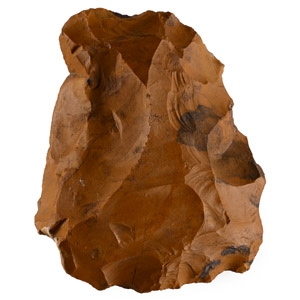
Stone Age Mousterian 'Fontmaure' Jasper Neanderthal Handaxe
Middle Palaeolithic Period, circa 150,000- 60,000 B.P.Sold for (Inc. bp): £156
Bifacially worked tool group, the jasper with vibrant colours and traces of chalcedony running though it. 124 grams, 77 mm
Found Fontmaure, Vienne, France. Ex famous UK musician and amateur archaeologist, Victor Brox (1941-2023). Acquired on the UK art market. From the private collection of an East Anglian, UK, specialist collector. This lot is accompanied by an illustrated lot declaration signed by the Head of the Antiquities Department, Dr Raffaele D'Amato. -
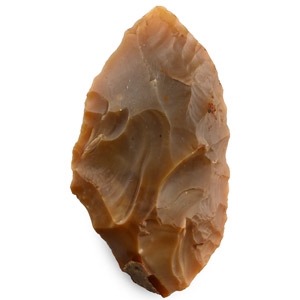
Stone Age Mousterian Bifacial Neanderthal Flint Knife
Middle Palaeolithic Period, circa 150,000-60,000 B.P.Sold for (Inc. bp): £247
A knapped leaf-shaped bifacial knife; inked legend 'Alligny . Cosne - 26 Jui 24'. 29.3 grams, 68 mm
Found Alligny, Cosne, France. Ex M Alias collection, France. Acquired on the European art market. From the private collection of an East Anglian, UK, specialist collector. This lot is accompanied by an illustrated lot declaration signed by the Head of the Antiquities Department, Dr Raffaele D'Amato. -
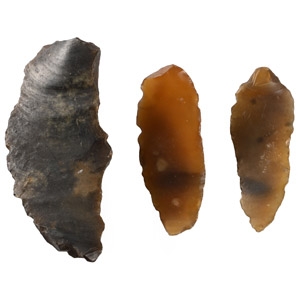
Stone Age Flint Single-Faced Knife Group
Mesolithic Period, circa 6000 B.P.Sold for (Inc. bp): £33
Three knapped knife blades, one in dark grey flint with some cortex, two pale brown. 22.05 grams total, 43-61 mm
Found Thames Valley in the 19th century. From an antiquarian Palaeolithic study collection, Shropshire, UK. This lot is accompanied by an illustrated lot declaration signed by the Head of the Antiquities Department, Dr Raffaele D'Amato.

