-
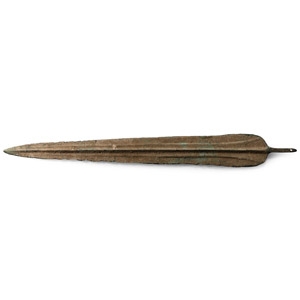
Luristan Bronze Blade with Blood Channels
2nd-1st millennium B.C.Sold for (Inc. bp): £169
A substantial leaf-shaped blade with raised midrib extending to a short tang with attachment rivet, ribbed fullers with curved ends extending to the shoulders. 417 grams, 49.5 cm
Acquired in the 1990s. Ex Abelita family collection. This lot is accompanied by an illustrated lot declaration signed by the Head of the Antiquities Department, Dr Raffaele D'Amato. -
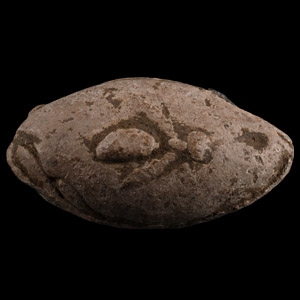
Greek Slingshot with Ephesus Bee
4th-1st century B.C.Sold for (Inc. bp): £234
Lentoid in form with raised legend 'APAIδ[.]' and to reverse, a raised bee motif. 30.9 grams, 30 mm
Private collection, Austria. Private collection, Europe. This lot is accompanied by an illustrated lot declaration signed by the Head of the Antiquities Department, Dr Raffaele D'Amato. -
.jpg)
Post Medieval Iron Dagger with Bronze Hilt
17th century A.D.Sold for (Inc. bp): £247
Comprising a triangular two-edged blade with median chamfer, ricasso at the rear, quillons formed as two vertical rings on short arms, wooden grip with most of the hatched mounting ring, rectangular pommel with raised panel to each face. 276 grams, 42.2 cm
Previously acquired at a UK auction in the 1990s. Acquired from an Oxfordshire antiques centre. Property of a Berkshire, UK, collector. This lot is accompanied by an illustrated lot declaration signed by the Head of the Antiquities Department, Dr Raffaele D'Amato.
Swords and daggers with a square pommel became fashionable in the early 16th century, a Central European fashion. The edges of the present weapon do not ever appear to have been sharpened, so this may have been a parade-piece. -
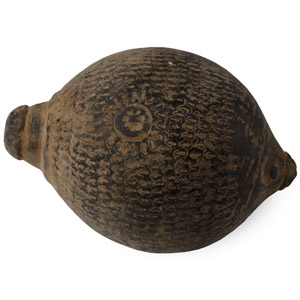
Byzantine 'Greek Fire' Ceramic Fire Bomb or Hand Grenade
9th-11th century A.D.Sold for (Inc. bp): £182
Rounded body with tiered neck and domed mouth, body decorated with tightly arranged teardrop-shaped motifs with large rosettes on the shoulder; intended to be filled with explosive liquid and a wick, and used as a hand grenade. 757 grams, 14.1 cm
From an important specialist collection, London, UK, 1990s onwards. Accompanied by an academic paper by military specialist Dr Raffaele D'Amato, dated 15 July 2019 and titled 'Eastern Roman Empire - Greek Fire Bomb or Hand Grenade (μεσαίον kακάβιον) 9th-11th century AD'. This lot is accompanied by an illustrated lot declaration signed by the Head of the Antiquities Department, Dr Raffaele D'Amato.
Apart from the use of siphons or manual flame-throwers called cheirosiphona, special corps of Roman soldiers employed terracotta grenades, in the form of small jars, abundantly evidenced in archaeological excavations. They were called μεσαία kακαβιά or κυτροκακάβια where the former had a bulbous shape and the latter a more cylindrical form. -
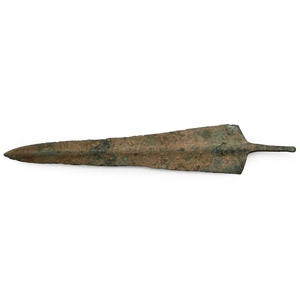
Luristan Bronze Leaf-Shaped Dagger
2nd-1st millennium B.C.Sold for (Inc. bp): £130
Triangular double-edged blade with flat midrib and short tang with flattened end. 211 grams, 32.5 cm
Acquired in the 1990s. Ex Abelita family collection. This lot is accompanied by an illustrated lot declaration signed by the Head of the Antiquities Department, Dr Raffaele D'Amato. -
.jpg)
Byzantine 'Greek Fire' Ceramic Fire Bomb or Hand Grenade
9th-11th century A.D.Sold for (Inc. bp): £78
A piriform missile with domed filler-hole, intended to be filled with explosive liquid and wick, used as a hand grenade. 281 grams, 92 mm
From an important specialist collection, London, UK, 1990s onwards. Accompanied by an academic paper by military specialist Dr Raffaele D'Amato, dated 15 July 2019 and titled 'Eastern Roman Empire - Greek Fire Bomb or Hand Grenade (μεσαίον kακάβιον) 9th-11th century AD'. This lot is accompanied by an illustrated lot declaration signed by the Head of the Antiquities Department, Dr Raffaele D’Amato. This lot is accompanied by an illustrated lot declaration signed by the Head of the Antiquities Department, Dr Raffaele D'Amato. -
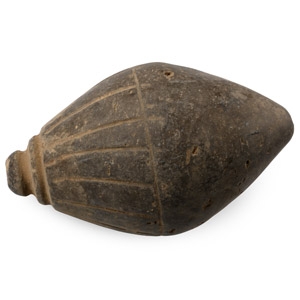
Byzantine 'Greek Fire' Ceramic Fire Bomb or Hand Grenade
9th-11th century A.D.Sold for (Inc. bp): £91
Piriform body with domed mouth, impressed linear decoration on the upper body; intended to be filled with explosive liquid and a wick, and used as a hand grenade. 564 grams, 14.1 cm
From an important specialist collection, London, UK, 1990s onwards. Accompanied by an academic paper by military specialist Dr Raffaele D'Amato, dated 15 July 2019 and titled 'Eastern Roman Empire - Greek Fire Bomb or Hand Grenade (μεσαίον kακάβιον) 9th-11th century AD'. This lot is accompanied by an illustrated lot declaration signed by the Head of the Antiquities Department, Dr Raffaele D'Amato.
Apart from the use of siphons or manual flame-throwers called cheirosiphona, special corps of Roman soldiers employed terracotta grenades, in the form of small jars, abundantly evidenced in archaeological excavations. They were called μεσαία kακαβιά or κυτροκακάβια where the former had a bulbous shape and the latter a more cylindrical form. -
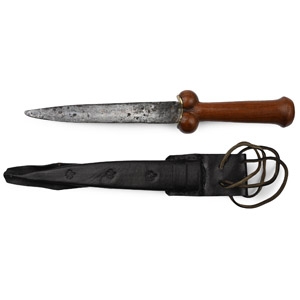
Medieval Iron Ballock Dagger with Reproduction Hilt and Sheath
15th century A.D. and laterSold for (Inc. bp): £247
The tapering blade with a single cutting edge; modern replica leather scabbard decorated with 'fleur de lys' and wooden handle with bulbous guard and pommel. 222 grams, 36.5 cm
From the collection of the famous author, writer and speaker, Gordon Bailey, Essex, UK; formed since 1968. From the private collection of a Kent, UK, gentleman. This lot is accompanied by an illustrated lot declaration signed by the Head of the Antiquities Department, Dr Raffaele D'Amato.
The term 'ballock dagger' was used in medieval times to describe a dagger with a grip bearing a considerable resemblance to a phallic symbol. It was also called 'kidney dagger' during the Victorian times. The constant characteristic is the presence of two roundish and symmetrical bulbs at the guard, with the grip itself emerging upward between them and flaring slightly towards the top, sometimes being surmounted by a cap. -
.jpg)
Post Medieval Cased 'Manchester Area' Militaria and Other Artefact Collection
18th-20th century A.D.Sold for (Inc. bp): £33
Including cap badges, cartwheel pennies, snake-buckle, buttons and other items, mounted in a glazed wooden frame. 1.1 kg, 29.5 x 35 cm
From the private collection of a Manchester, UK, detectorist, 1990s. This lot is accompanied by an illustrated lot declaration signed by the Head of the Antiquities Department, Dr Raffaele D’Amato. This lot is accompanied by an illustrated lot declaration signed by the Head of the Antiquities Department, Dr Raffaele D'Amato. -
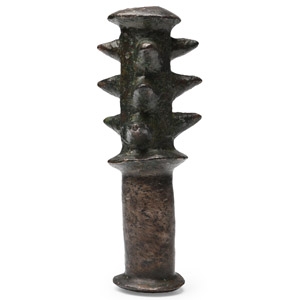
Luristan Bronze Socketted Macehead
2nd-1st millennium B.C.Sold for (Inc. bp): £286
Cylindrical in plan, the upper section with vertical columns of three prominent spikes, short cylindrical shaft, flange rim to each end. 359 grams, 12.5 cm
Acquired in the 1990s. Ex Abelita family collection. This lot is accompanied by an illustrated lot declaration signed by the Head of the Antiquities Department, Dr Raffaele D'Amato. -
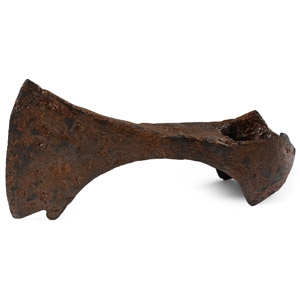
Viking Age Iron Shallow Bearded Axehead
9th century A.D.Sold for (Inc. bp): £260
A hand-forged axehead with triangular-section narrow blade widening to a broad bevelled edge with square chin, socket with lateral flanges and rounded panel to the rear. 579 grams, 18 cm
From the private collection of a London gentleman, from his grandfather's collection formed before the early 1970s. This lot is accompanied by an illustrated lot declaration signed by the Head of the Antiquities Department, Dr Raffaele D'Amato.
The axe seems to belong to the typology of Viking side axes of Wheeler type B (Wheeler III / Rygh 559). Usually these bearded axeheads (skeggöks) had a longer edge, designed to split tree trunks into planks and beams, or heads in two parts. Some of the bearded axes were known as halfÞynna öx, the neck on such 'half thin axe' was thinly forged, to make it lighter. -
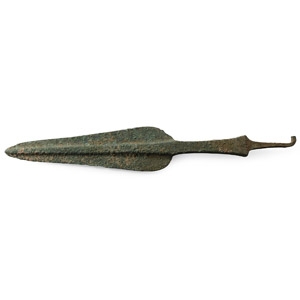
Large Amlash Bronze Spearhead
1200-1100 B.C.Sold for (Inc. bp): £117
Tapering leaf-shaped blade with raised midrib developing to a sturdy V-shaped shank, tapering rectangular-section tang. 280 grams, 32.5 cm
Acquired in the 1990s. Ex Abelita family collection. This lot is accompanied by an illustrated lot declaration signed by the Head of the Antiquities Department, Dr Raffaele D'Amato.
The weapon belongs to the type 1 of the spear-head classification of Khorasani, mainly from Marlik or Amlash areas. Similar pieces have been dated by Stutzinger to 1200-1100 B.C.

