-
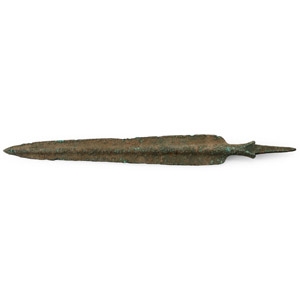
Large Luristan Bronze Spearhead
2nd-1st millennium B.C.Sold for (Inc. bp): £117
Triangular in profile with rounded shoulders and square-section mid-rib running to the tip; short flared neck and square-section tang. 464 grams, 42 cm
Acquired in the 1990s. Ex Abelita family collection. This lot is accompanied by an illustrated lot declaration signed by the Head of the Antiquities Department, Dr Raffaele D'Amato. -
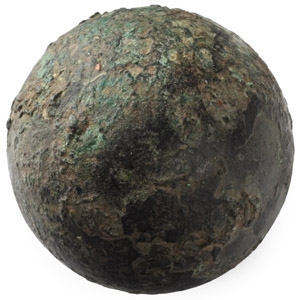
Tudor Hand Cannon Bronze Shot
16th century A.D.Sold for (Inc. bp): £72
Spherical shot from a large hand gun or a small cannon. 90.6 grams, 27 mm
Acquired on the UK art market in the early 2000s. This lot is accompanied by an illustrated lot declaration signed by the Head of the Antiquities Department, Dr Raffaele D'Amato. -
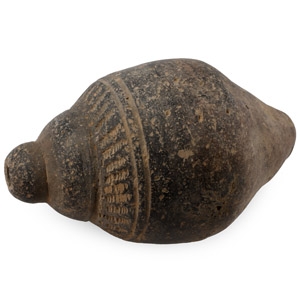
Turco-Mongol 'Greek Fire' Ceramic Fire Bomb or Hand Grenade
13th-15th century A.D.Sold for (Inc. bp): £78
Cylindrical body with pointed tip, tiered mouth and hatched linear decoration on the upper body; intended to be filled with explosive liquid and a wick, and used as a hand grenade. 523 grams, 13.4 cm
From an important specialist collection, London, UK, 1990s onwards. Accompanied by an academic paper by military specialist Dr Raffaele D'Amato, dated 15 July 2019 and titled 'Eastern Roman Empire - Greek Fire Bomb or Hand Grenade (μεσαίον kακάβιον) 9th-11th century AD'. This lot is accompanied by an illustrated lot declaration signed by the Head of the Antiquities Department, Dr Raffaele D'Amato.
Apart from the use of siphons or manual flame-throwers called cheirosiphona, special corps of Roman soldiers employed terracotta grenades, in the form of small jars, abundantly evidenced in archaeological excavations. They were called μεσαία kακαβιά or κυτροκακάβια where the former had a bulbous shape and the latter a more cylindrical form. -
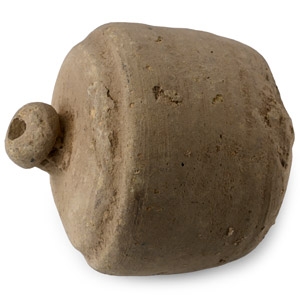
Byzantine 'Greek Fire' Ceramic Fire Bomb or Hand Grenade
9th-11th century A.D.Sold for (Inc. bp): £46
Cylindrical body with pointed tip and domed mouth; intended to be filled with explosive liquid and a wick, and used as a hand grenade. 726 grams, 12 cm
From an important specialist collection, London, UK, 1990s onwards. Accompanied by an academic paper by military specialist Dr Raffaele D'Amato, dated 15 July 2019 and titled 'Eastern Roman Empire - Greek Fire Bomb or Hand Grenade (μεσαίον kακάβιον) 9th-11th century AD'. This lot is accompanied by an illustrated lot declaration signed by the Head of the Antiquities Department, Dr Raffaele D'Amato.
Apart from the use of siphons or manual flame-throwers called cheirosiphona, special corps of Roman soldiers employed terracotta grenades, in the form of small jars, abundantly evidenced in archaeological excavations. They were called μεσαία kακαβιά or κυτροκακάβια where the former had a bulbous shape and the latter a more cylindrical form. -
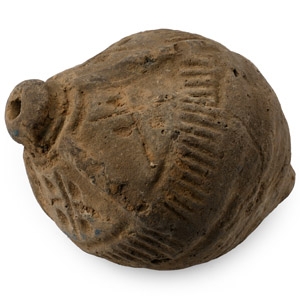
Byzantine 'Greek Fire' Ceramic Fire Bomb or Hand Grenade
9th-11th century A.D.Sold for (Inc. bp): £78
Piriform body with domed mouth, four raised lugs to the upper body with a hatched band beneath, the field decorated with X-motifs with impressed dots between the arms; intended to be filled with explosive liquid and a wick, and used as a hand grenade. 387 grams, 11.5 cm
From an important specialist collection, London, UK, 1990s onwards. Accompanied by an academic paper by military specialist Dr Raffaele D'Amato, dated 15 July 2019 and titled 'Eastern Roman Empire - Greek Fire Bomb or Hand Grenade (μεσαίον kακάβιον) 9th-11th century AD'. This lot is accompanied by an illustrated lot declaration signed by the Head of the Antiquities Department, Dr Raffaele D'Amato.
Apart from the use of siphons or manual flame-throwers called cheirosiphona, special corps of Roman soldiers employed terracotta grenades, in the form of small jars, abundantly evidenced in archaeological excavations. They were called μεσαία kακαβιά or κυτροκακάβια where the former had a bulbous shape and the latter a more cylindrical form. -
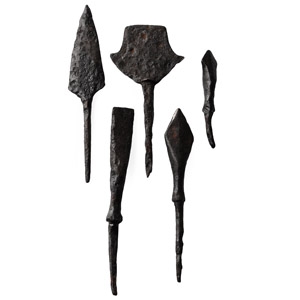
Medieval Iron Mixed Arrowhead Collection
Circa 12th-14th century A.D.Sold for (Inc. bp): £39
Comprising tanged arrowheads of various types. 40.3 grams total, 43-80 mm
From the private collection of a London gentleman, from his grandfather's collection formed before the early 1970s. This lot is accompanied by an illustrated lot declaration signed by the Head of the Antiquities Department, Dr Raffaele D'Amato. -
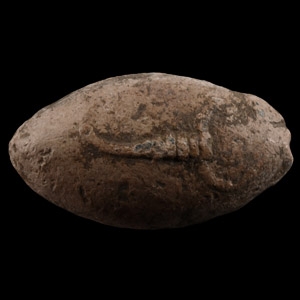
Greek Slingshot with Scorpion
4th-1st century B.C.Sold for (Inc. bp): £338
Lentoid in form with raised motif of a scorpion. 30.3 grams, 29 mm
Private collection, Austria. Private collection, Europe. This lot is accompanied by an illustrated lot declaration signed by the Head of the Antiquities Department, Dr Raffaele D'Amato. -
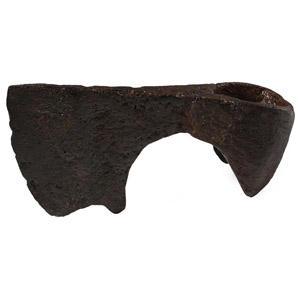
Viking Age Iron Bearded Axehead
11th-12th century A.D.Sold for (Inc. bp): £130
A hand-forged axehead with rectangular-section narrow blade widening to a broad bevelled edge with square chin, socket with rounded extensions to the rear. 531 grams, 15.5 cm
From the private collection of a London gentleman, from his grandfather's collection formed before the early 1970s. This lot is accompanied by an illustrated lot declaration signed by the Head of the Antiquities Department, Dr Raffaele D'Amato.
The more commonly used weapons of the Finno-Ugrian people were axes, commonly found in all Finnic areas, as well as spears. Iron axeheads of this typology show a sub-trapezoidal asymmetrical blade, sometimes perforated through the centre. -
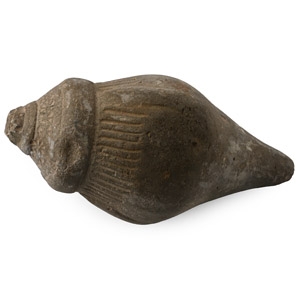
Turco-Mongol 'Greek Fire' Ceramic Fire Bomb or Hand Grenade
9th-11th century A.D.Sold for (Inc. bp): £72
Hollow vessel with piriform body, raised lugs on the shoulder with hatched banding in between the lugs, decorative band of rosettes beneath the domed mouth; intended to be filled with explosive liquid and a wick, and used as a hand grenade. 452 grams, 16 cm
From an important specialist collection, London, UK, 1990s onwards. This lot is accompanied by an illustrated lot declaration signed by the Head of the Antiquities Department, Dr Raffaele D'Amato. -
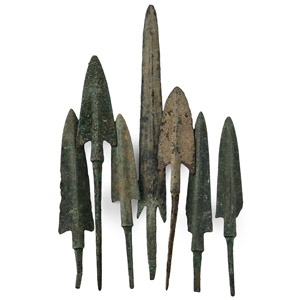
Luristan Bronze Arrowhead Collection
2nd-1st millennium B.C.Sold for (Inc. bp): £195
Comprising mainly barbed-and-tanged types. 225 grams total, 12.6-20.5 cm
From a London collection, 1990s-2000. This lot is accompanied by an illustrated lot declaration signed by the Head of the Antiquities Department, Dr Raffaele D'Amato. -
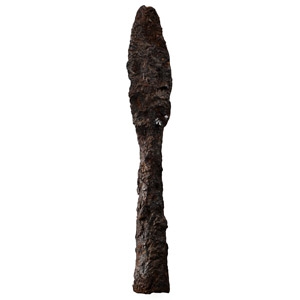
Viking Socketted Iron Spearhead
9th-11th century A.D.Sold for (Inc. bp): £39
A short, leaf-shaped blade and tapering, round-section socket, pierced for attachment to a shaft. 102 grams, 18 cm
Fair condition.
UK gallery, acquired in the 2000s. Property of an English gentleman. This lot is accompanied by an illustrated lot declaration signed by the Head of the Antiquities Department, Dr Raffaele D'Amato. -
.jpg)
Luristan Barbed Bronze Arrowhead
13th-6th century B.C.Sold for (Inc. bp): £59
Comprising a paddle-shaped blade with long barbs, circular-section socket and a tapering square-section tang. 16.2 grams, 12.9 cm
Acquired 1980-2015. Ex Abelita family collection. This lot is accompanied by an illustrated lot declaration signed by the Head of the Antiquities Department, Dr Raffaele D’Amato. This lot is accompanied by an illustrated lot declaration signed by the Head of the Antiquities Department, Dr Raffaele D'Amato.

