-
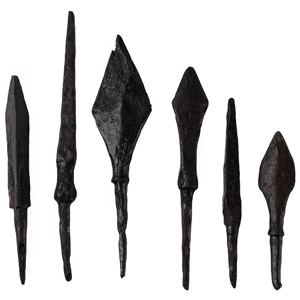
Medieval Iron Arrowhead Group
Circa 12th-14th century A.D.Sold for (Inc. bp): £78
Comprising tanged arrowheads of various types. 49.8 grams total, 53-90 mm
From the private collection of a London gentleman, from his grandfather's collection formed before the early 1970s. This lot is accompanied by an illustrated lot declaration signed by the Head of the Antiquities Department, Dr Raffaele D'Amato. -
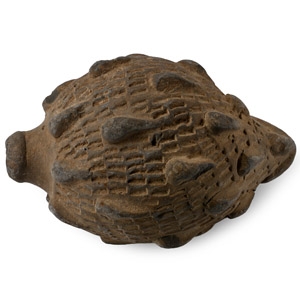
Byzantine 'Greek Fire' Ceramic Fire Bomb or Hand Grenade
9th-11th century A.D.Sold for (Inc. bp): £130
Piriform in profile with domed mouth, raised teardrop-shaped lugs on a stamped background covering the body; intended to be filled with explosive liquid and wick, used as a hand grenade. 518 grams, 13.2 cm
From an important specialist collection, London, UK, 1990s onwards. Accompanied by an academic paper by military specialist Dr Raffaele D'Amato, dated 15 July 2019 and titled 'Eastern Roman Empire - Greek Fire Bomb or Hand Grenade (μεσαίον kακάβιον) 9th-11th century AD'. This lot is accompanied by an illustrated lot declaration signed by the Head of the Antiquities Department, Dr Raffaele D'Amato.
Apart from the use of siphons or manual flame-throwers called cheirosiphona, special corps of Roman soldiers employed terracotta grenades, in the form of small jars, abundantly evidenced in archaeological excavations. They were called μεσαία kακαβιά or κυτροκακάβια where the former had a bulbous shape and the latter a more cylindrical form. -
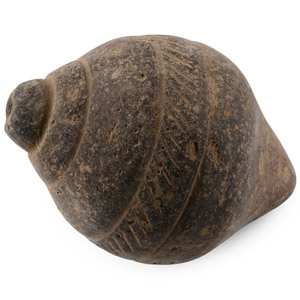
Byzantine 'Greek Fire' Ceramic Fire Bomb or Hand Grenade
9th-11th century A.D.Sold for (Inc. bp): £91
Piriform body with a domed mouth, a circumferential hatched band on the shoulder; intended to be filled with explosive liquid and a wick, and used as a hand grenade. 594 grams, 12.5 cm
From an important specialist collection, London, UK, 1990s onwards. Accompanied by an academic paper by military specialist Dr Raffaele D'Amato, dated 15 July 2019 and titled 'Eastern Roman Empire - Greek Fire Bomb or Hand Grenade (μεσαίον kακάβιον) 9th-11th century AD'. This lot is accompanied by an illustrated lot declaration signed by the Head of the Antiquities Department, Dr Raffaele D'Amato.
Apart from the use of siphons or manual flame-throwers called cheirosiphona, special corps of Roman soldiers employed terracotta grenades, in the form of small jars, abundantly evidenced in archaeological excavations. They were called μεσαία kακαβιά or κυτροκακάβια where the former had a bulbous shape and the latter a more cylindrical form. -
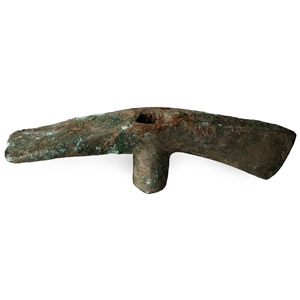
Heavy Luristan Bronze Dolabra
2nd-1st millennium B.C.Sold for (Inc. bp): £117
A combined adze- and axe-head with central shaft hole and curved blades. 1.42 kg, 23.5 cm
Acquired in the 1990s. Ex Abelita family collection. This lot is accompanied by an illustrated lot declaration signed by the Head of the Antiquities Department, Dr Raffaele D'Amato. -
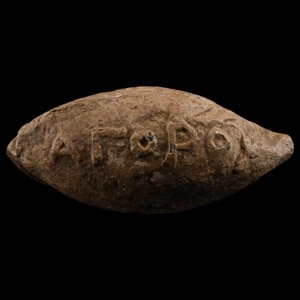
Greek Slingshot with Inscription
4th-1st century B.C.Sold for (Inc. bp): £338
Lentoid in form with raised legend 'AΓOPOY' beneath casting seam. 36.2 grams, 32 mm
Private collection, Austria. Private collection, Europe. This lot is accompanied by an illustrated lot declaration signed by the Head of the Antiquities Department, Dr Raffaele D'Amato. -
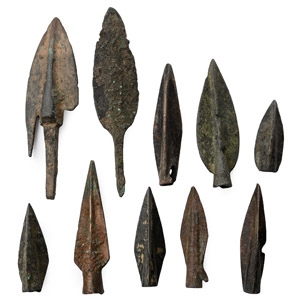
Greek Period High Quality Bronze Arrowhead Collection
5th-3rd century B.C.Sold for (Inc. bp): £130
Mainly triangular-section and socketted leaf types. 51 grams total, 24-66 mm
From an English collection formed before 2000. This lot is accompanied by an illustrated lot declaration signed by the Head of the Antiquities Department, Dr Raffaele D'Amato. -
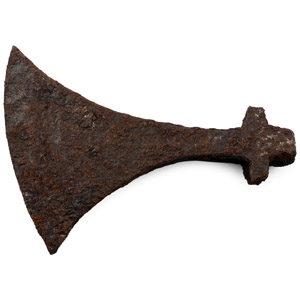
Viking Age Danish Iron Broad Axehead
Late 10th-early 11th century A.D.Sold for (Inc. bp): £572
With rectangular spurs above and below the curved socket, medium-broad flaring triangular-section blade extending to a curved edge, hammer extension to the rear. 245 grams, 13.6 cm
Fair condition.
Private collection, York, UK, 1990s. Property of a Sussex, UK, teacher. This lot is accompanied by an illustrated lot declaration signed by the Head of the Antiquities Department, Dr Raffaele D'Amato.
The first specialised battle-axes which appeared in the second half of the 10th century A.D. were light, narrow, usually thinly forged but with broad-edged blades, sometimes decorated with precious metals. -
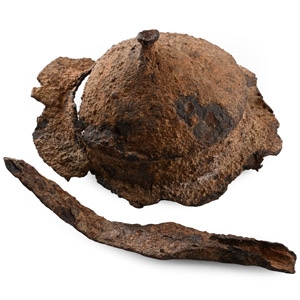
Anglo-Saxon Iron 'Battle Damaged' Shield Boss and Spear
Circa 6th century A.D.Sold for (Inc. bp): £221
Comprising: ferrous shield boss of Härke & Dickinson's Type 3 with broad flange, deep sidewall with carination and domed cone; flared apex stud; traces of fixing rivets in underside of flange; spearhead of Swanton's Type E2, lenticular in section with elongated lozengiform profile, split socket. 437 grams total, 17-17.5 cm
Found East Anglia, UK. This lot is accompanied by an illustrated lot declaration signed by the Head of the Antiquities Department, Dr Raffaele D'Amato.
The distortion to the shield boss appears to have been produced by an impact blow from a sturdy, wedge-section blade, probably an axe. -
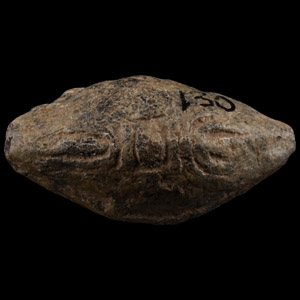
Romano-British 'Verulanium' Lead Slingshot
2nd century A.D.Sold for (Inc. bp): £169
Biconical in profile with reserved 'thunderbolt' motif to two faces; old inked collector's reference '130'. 59 grams, 37 mm
Found near St Albans (Verulamium), UK. From the private collection of Kenneth Machin (1936-2020), Buckinghamshire, UK; his collection of antiquities and natural history was formed since 1948; thence by descent. This lot is accompanied by an illustrated lot declaration signed by the Head of the Antiquities Department, Dr Raffaele D'Amato.
The missiles of ovoid shape belong to type Ia of the Völling classification. The sling (funda) with its lead missiles (plumbea pondera or glandae) and stone (lapides) was used by special funditores, illustrated on Trajan’s Column where they are simply dressed in broad tunics with no armour, but carry a shield. A fold in their cloak, or sagulum, acted as an ammunition bag. The effectiveness of the slingers was unquestionable and much appreciated, especially against elephants. Celsus, writing towards the end of the 2nd century A.D., described how a slingshot wound was more dangerous and harder to treat than one inflicted by an arrow. -
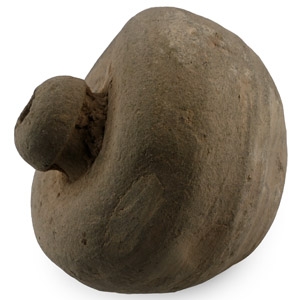
Byzantine 'Greek Fire' Ceramic Fire Bomb or Hand Grenade
9th-11th century A.D.Sold for (Inc. bp): £72
Squat body with domed mouth, misshapen during manufacturing process; intended to be filled with explosive liquid and a wick, and used as a hand grenade. 365 grams, 88 mm
From an important specialist collection, London, UK, 1990s onwards. Accompanied by an academic paper by military specialist Dr Raffaele D'Amato, dated 15 July 2019 and titled 'Eastern Roman Empire - Greek Fire Bomb or Hand Grenade (μεσαίον kακάβιον) 9th-11th century AD'. This lot is accompanied by an illustrated lot declaration signed by the Head of the Antiquities Department, Dr Raffaele D'Amato.
Apart from the use of siphons or manual flame-throwers called cheirosiphona, special corps of Roman soldiers employed terracotta grenades, in the form of small jars, abundantly evidenced in archaeological excavations. They were called μεσαία kακαβιά or κυτροκακάβια where the former had a bulbous shape and the latter a more cylindrical form. -
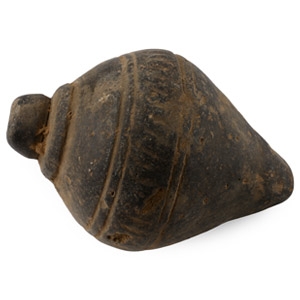
Byzantine 'Greek Fire' Ceramic Fire Bomb or Hand Grenade
9th-11th century A.D.Sold for (Inc. bp): £85
Piriform body with domed mouth, circumferential bands on the shoulder; intended to be filled with explosive liquid and a wick, and used as a hand grenade. 525 grams, 13.1 cm
From an important specialist collection, London, UK, 1990s onwards. Accompanied by an academic paper by military specialist Dr Raffaele D'Amato, dated 15 July 2019 and titled 'Eastern Roman Empire - Greek Fire Bomb or Hand Grenade (μεσαίον kακάβιον) 9th-11th century AD'. This lot is accompanied by an illustrated lot declaration signed by the Head of the Antiquities Department, Dr Raffaele D'Amato.
Apart from the use of siphons or manual flame-throwers called cheirosiphona, special corps of Roman soldiers employed terracotta grenades, in the form of small jars, abundantly evidenced in archaeological excavations. They were called μεσαία kακαβιά or κυτροκακάβια where the former had a bulbous shape and the latter a more cylindrical form. -
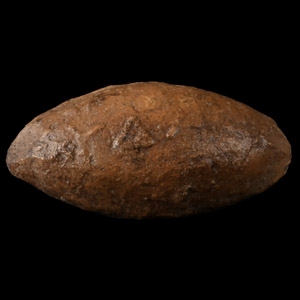
Greek Macedonian Lead Inscribed Slingshot
3rd-1st century B.C.Sold for (Inc. bp): £520
Biconical in profile with casting seam and reserved legend 'ΥΔΑ'. 34.5 grams, 31 mm
Ex German art market, 2000s. Acquired from an EU collector living in London. From the collection of a Surrey, UK, gentleman. This lot is accompanied by an illustrated lot declaration signed by the Head of the Antiquities Department, Dr Raffaele D'Amato.
The leaden bullets, which were thrown from slings, were called in Greek Molivdainai (μολύβδαιναι), and in Latin glandes; the former indicating the material ‘lead’, the latter the shape ‘acorns’. These bullets, were cast in a mould and bore letters or devices, or both, on two sides or on only one. In form they were more like an almond than an acorn, but many are pointed at both ends; in size, they are generally about one inch and a half in maximum length, and under one inch in maximum width.

