-
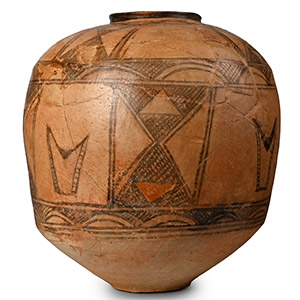
Gigantic Western Asiatic Pottery Jar
Circa 3000 B.C.Sold for (Inc. bp): £2,984
Barrel-shaped in profile with low rim to the mouth; painted dentilled band to the shoulder with eight panels below alternating plain and hatched; similar pattern to the sidewall, the plain panels with swallowtail motif. 11.9 kg, 53 cm high
with Mahboubian Gallery, London, 1974. This lot has been checked against the Interpol Database of stolen works of art and is accompanied by search certificate number no.12811-241409. This lot has been cleared against the Art Loss Register database, and is accompanied by an illustrated lot declaration signed by the Head of the Antiquities Department, Dr Raffaele D'Amato. -
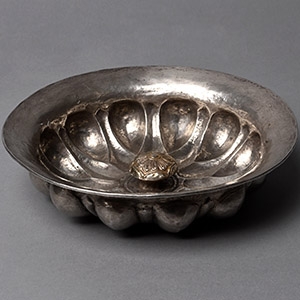
Achaemenid Silver Phiale with Central Rosette
5th century B.C.Sold for (Inc. bp): £4,680
Squat lotiform bowl with wide everted rim, central domed mesomphalos with rosette detailing, traces of gilding. 283 grams, 20.7 cm wide
English private collection, formed 1940s. Private collection, UK. This lot has been checked against the Interpol Database of stolen works of art and is accompanied by a search certificate number no.12795-241325. This lot has been cleared against the Art Loss Register database, and is accompanied by an illustrated lot declaration signed by the Head of the Antiquities Department, Dr Raffaele D'Amato.
This bowl is possibly part of a set of nearly identical vessels, probably used at the table of royal Satrapes. Persian governors used banquets to display their wealth and power by imitating the royal banquets. It was a greater honour for them to receive a drinking vessel such as this as a gift from the King of the Kings – establishing one’s status as a royal dinner guest. No doubt it took practice to drink adeptly from a vessel like this: however the omphalos in the base would have made it easier to hold with one hand, with the middle finger hooked inside the indentation and the thumb stretched out to grip the vessel at or near the rim. -
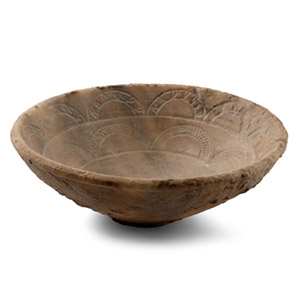
South Arabian Alabaster Bowl with Decorations
5th-3rd century B.C.Sold for (Inc. bp): £260
Shallow in profile with chamfered rim, concentric circles to inner face with arcading in two tiers; marine encrustation to exterior. 217 grams, 12.9 cm
UK private collection before 2000. Acquired on the UK art market. Private collection, London, UK. This lot has been cleared against the Art Loss Register database, and is accompanied by an illustrated lot declaration signed by the Head of the Antiquities Department, Dr Raffaele D'Amato. -
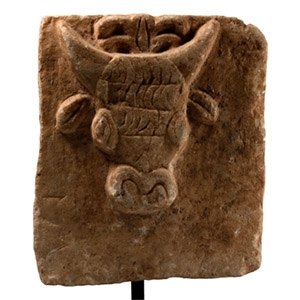
South Arabian Alabaster Plaque with Bull's Head
3rd-1st century B.C.Sold for (Inc. bp): £572
Comprising a square panel with a bull's head in low-relief, striated eyes and flaring nostrils, a thick tuft of hair arranged between the eyes, acanthus leaf between curved horns; mounted on a custom-made display stand. 2.18 kg total, 19.7 cm including stand
UK collection, 1990s. Acquired on the UK art market, before 2000. Private collection, Mr M.V., a London-based businessman. This lot has been cleared against the Art Loss Register database, and is accompanied by an illustrated lot declaration signed by the Head of the Antiquities Department, Dr Raffaele D'Amato.
Along with the ibex, the bull is one of the most frequently represented animals in the sculpture found in the Arabian cemeteries, like Timna. -
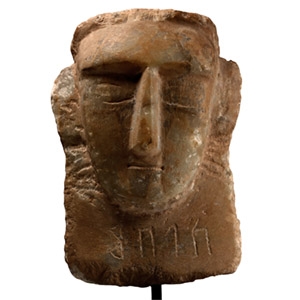
South Arabian Alabaster Sculpture of a Man with Inscription
3rd-1st century B.C.Sold for (Inc. bp): £910
On a rectangular background, shallow sockets and grooved eyebrows, elongated nose and face, mouth faintly indicated by a straight incised line, large, protruding ears; traces of beard under the chin, vertical lines representing hair; name engraved in Arabian letters beneath the chin; mounted on a custom-made display stand. 3.62 kg total, 27.1 cm including stand
UK collection, 1990s. Acquired on the UK art market, before 2000. Private collection, Mr M.V., a London-based businessman. This lot has been cleared against the Art Loss Register database, and is accompanied by an illustrated lot declaration signed by the Head of the Antiquities Department, Dr Raffaele D'Amato.
Within South Arabia, there was a well-developed ancient tradition of carving funerary sculptures from a calcite-alabaster stone. The eyes and eyebrows of the heads were usually inlaid or (like probably here) highlighted with red or black pigment. The figure is inscribed on the base with the name of the dedicant, or with the personal name of the dead person. -
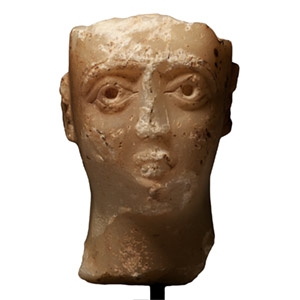
South Arabian Alabaster Head of a Man
3rd-1st century B.C.Sold for (Inc. bp): £715
Small mouth raised sharply in the middle, large nose with angular depressions for the nostrils, deep eye sockets to accept inlay, upper and lower eyelids with rounded ridges, eyebrows tapering towards the outer end; chiselled ears, top of the head cut off flat at the hair line, back of the head left roughly tooled with central vertical insertion pin; mounted on a custom-made display stand. 2.12 kg total, 18.7 cm including stand
UK collection, 1990s. Acquired on the UK art market, before 2000. Private collection, Mr M.V., a London-based businessman. This lot has been cleared against the Art Loss Register database, and is accompanied by an illustrated lot declaration signed by the Head of the Antiquities Department, Dr Raffaele D'Amato.
Usually the heads of this typology are exhibited frontally and in symmetrical manner. Many of the heads have rather angular features. Nearly all the objects in this category were ornamented with inlay- the eyes and the eyebrows, in many cases. The sockets designed to receive the inlaid eyes are usually shaped in a rather naturalistic way. -
.jpg)
Old Anatolian Stone Cylinder Seal
2nd-1st millennium B.C.Sold for (Inc. bp): £1,170
With frieze depicting a facing anthropomorphic figure placed tête-bêche with another; supplied with a museum-quality impression. 72.1 grams, 40 mm
From the collection of the late S, London, UK, 1970-2000. Examined by Professor Wilfrid George Lambert FBA (1926-2011), historian, archaeologist, and specialist in Assyriology and Near Eastern archaeology, in the 1990s. This lot has been cleared against the Art Loss Register database, and is accompanied by an illustrated lot declaration signed by the Head of the Antiquities Department, Dr Raffaele D'Amato. -
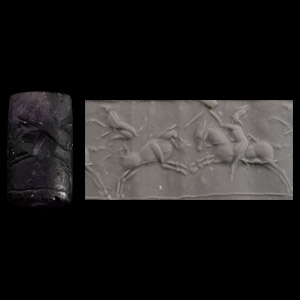
Early Parthian Stone Cylinder Seal
Late 1st millennium B.C.Sold for (Inc. bp): £585
With frieze depicting galloping horseman and fleeing stag, with a second horse confronting the first, repaired; supplied with a museum-quality impression. 8.75 grams, 24 mm
From the collection of the late S., London, UK, 1970-2000. Examined by Professor Wilfrid George Lambert FBA (1926-2011), historian, archaeologist, and specialist in Assyriology and Near Eastern archaeology, in the 1990s. This lot has been cleared against the Art Loss Register database, and is accompanied by an illustrated lot declaration signed by the Head of the Antiquities Department, Dr Raffaele D'Amato. -
.jpg)
Neo-Babylonian Red Stone Cylinder Seal
900-600 B.C. or laterSold for (Inc. bp): £1,235
Frieze in three registers: two crouching gryphons facing each other on a hatched base; below, advancing ox; court scene with a profile figure seated on a dais holding a vessel and facing two advancing figures in robes with open front, one leg exposed; sapling scene-divider; supplied with a museum-quality impression. 3.41 grams, 19 mm
From the 'S' collection, acquired 1970-1990s. The collection was seen and studied by W.G. Lambert, late Professor of Assyriology at the University of Birmingham, 1970-1993. This lot has been cleared against the Art Loss Register database, and is accompanied by an illustrated lot declaration signed by the Head of the Antiquities Department, Dr Raffaele D'Amato. -
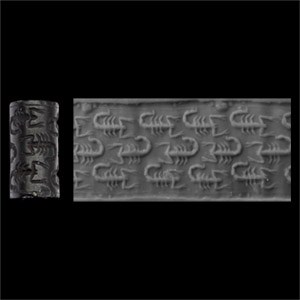
Syrian Hematite Cylinder Seal with Scorpions
1800-1500 B.C.Sold for (Inc. bp): £1,105
With scorpions and restrung pair of red stone beads, old handwritten label '1628'; accompanied by an copy of an old scholarly note, typed and signed by W.G. Lambert, late Professor of Assyriology, University of Birmingham, 1970-1993, which states: 'Cylinder Seal of Hematite, 18x9.5 mm. This seal shows three rows of three scorpions, the middle row facing the opposite direction from the other two. This is a Syrian seal c. 1800-1500 B.C., of an unusual type. It is in fine state of preservation, and the insects are well engraved. The scorpion was a divine symbol ln the Ancient Near East, but in Syria it is not known of which deity it was the symbol. The design is in fact very old, being found in Jemdet Nasr seals c. 3000 B.C., and in Syria artists copied older motifs on many occasions.'; accompanied by a museum-quality impression. 5.4 grams, 18 mm
UK private collection, acquired 1980-1983. Accompanied by a copy of a scholarly note, typed and signed by Professor Wilfrid George Lambert in 1992. This lot has been cleared against the Art Loss Register database, and is accompanied by an illustrated lot declaration signed by the Head of the Antiquities Department, Dr Raffaele D'Amato. -
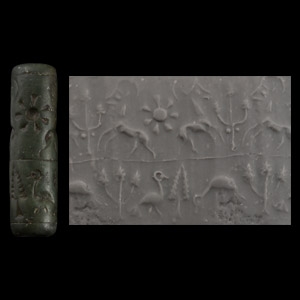
Middle Assyrian Stone Cylinder Seal
1400-900 B.C.Sold for (Inc. bp): £585
With frieze in two registers: above - opposed ibexes with frond between their chests, rosette above their rumps; below - geese in a landscape with vegetation; supplied with a museum-quality impression. 8.81 grams, 39 mm
From the collection of the late S, London, UK, 1970-2000. Examined by Professor Wilfrid George Lambert FBA (1926-2011), historian, archaeologist, and specialist in Assyriology and Near Eastern archaeology, in the 1990s. This lot has been cleared against the Art Loss Register database, and is accompanied by an illustrated lot declaration signed by the Head of the Antiquities Department, Dr Raffaele D'Amato. -
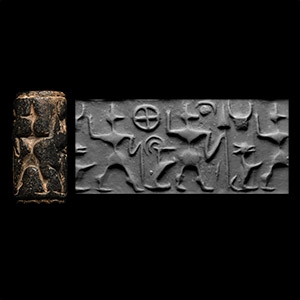
North-Syrian Black Stone Cylinder Seal with Storm God
Circa 2000-1800 B.C.Sold for (Inc. bp): £910
Cylinder with standing figures and animals, restrung pair of red stone beads, old handwritten label '1659'; accompanied by a copy of an old scholarly note, typed and signed by W.G. Lambert, late Professor of Assyriology, University of Birmingham, 1970-1993, which states: 'Cylinder Seal of Black Stone, 40.5 x 19.5 mm. The deeply engraved design shows two warrior gods, standing, wearing short kilts with one hand raised the other holding an object the one holding a spear, the other an unidentified item represented by a vertical line. Before each standing warrior god is a sideways horned animal in one case and a sideways donkey in the other. There is a row of symbols along the top of the area: a circle with cross inside, an inverted crescent and dot, and a bull's head. There are horizontal rulings above and below the scene. This is a North Syrian or Anatolian seal c. 2000-1800 B.C. This is a rare type, and a nice example. The points on the top of the heads of the gods are no doubt spiked helmets, and the short kilt also fits the Anatolian storm god, which was worshipped in a variety of different forms. The style of engraving is deep but uncluttered and has a considerable charm.'; accompanied by a museum-quality impression. 30.8 grams, 40 mm
Armand Trampitsch, Glyptique Archéologie, Paris, Hôtel Drouot, 13-14 May 1992, no.23 [Part]. Accompanied by a copy of a scholarly note, typed and signed by Professor Wilfrid George Lambert in 1992. This lot has been cleared against the Art Loss Register database, and is accompanied by an illustrated lot declaration signed by the Head of the Antiquities Department, Dr Raffaele D'Amato.

