-
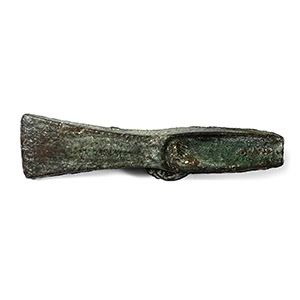
British Bronze Age 'Shelf Type' Looped Palstave Axehead
2nd millennium B.C.Sold for (Inc. bp): £156
With substantial blade and thick triangular sides with lateral loop; unfinished. 405 grams, 16 cm
Found near River Trent, Clifton, Nottinghamshire, UK. From the private collection of John Fox, Nottingham, Nottinghamshire, UK, antiquarian and archaeologist; his collection assembled in the 1950s-1970s. This lot is accompanied by an illustrated lot declaration signed by the Head of the Antiquities Department, Dr Raffaele D'Amato. -
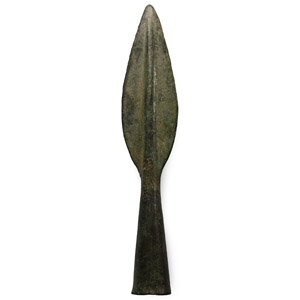
Bronze Age Socketted Spearhead
1st millennium B.C.Sold for (Inc. bp): £169
Leaf-shaped blade with a raised mid-rib extending to a flaring socket with a rivet hole. 204 grams, 19.1 cm
Ex German art market, 2000s. Acquired from an EU collector living in London. From the collection of a Surrey, UK, gentleman. This lot is accompanied by an illustrated lot declaration signed by the Head of the Antiquities Department, Dr Raffaele D'Amato. -
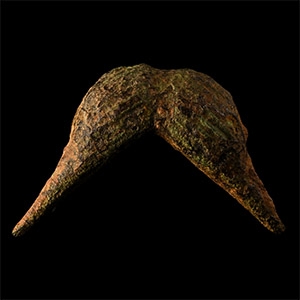
Iron Age Celtic Bronze Moustache Type Dagger Pommel
2nd century B.C.-1st century A.D.Sold for (Inc. bp): £39
Comprising a swollen body tapering towards the pointed terminals; the centre of the body with a circumferential recess; decorated with alternating ridges and grooves. 19.8 grams, 39 mm
Property of a Cambridgeshire, UK, collector. From his private collection since the 1970s; thence by descent circa 2000. Ex private collection of a Bedfordshire gentleman. This lot is accompanied by an illustrated lot declaration signed by the Head of the Antiquities Department, Dr Raffaele D'Amato.
This type of pommel is called a 'moustache pommel', so named because of its shape, a sort of comedic, droopy moustache. -
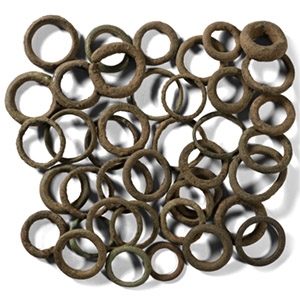
Iron Age Celtic Bronze Proto-Ring Money Collection
Circa 3rd-1st century B.C.Sold for (Inc. bp): £78
A bronze 'proto-money' or harness ring group comprising round-section rings. 100 grams total, 14-23 mm
From an English collection formed before 2000. This lot is accompanied by an illustrated lot declaration signed by the Head of the Antiquities Department, Dr Raffaele D'Amato. -
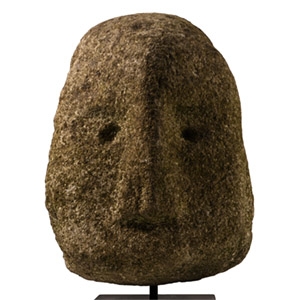
Iron Age Celtic Stone Head
Circa 2nd century B.C.-2nd century A.D. or laterSold for (Inc. bp): £1,040
An iconic Pagan sculpture with rounded forehead and chin, broad nose and recessed eyes; mounted on a custom-made display stand. 17.2 k total, 30.5 cm including stand
From Staffordshire, UK. From a collection acquired on the UK art market. Property of a West Midlands, UK, private collector. This lot is accompanied by an illustrated lot declaration signed by the Head of the Antiquities Department, Dr Raffaele D'Amato. -
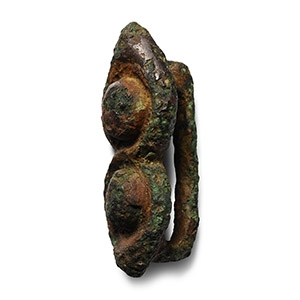
Brigantes Celtic 'Eyes' Strap Slide
1st century B.C.-1st century A.D.Sold for (Inc. bp): £20
Strap fastener or belt-slide with a figure-of-eight plan, domed centre to each of two cells, slider bar to reverse; late Iron Age or early Roman period. 15 grams, 37 mm
Found near York, Yorkshire, UK, in 2007. From an old Yorkshire, UK, collection. This lot is accompanied by an illustrated lot declaration signed by the Head of the Antiquities Department, Dr Raffaele D'Amato. -
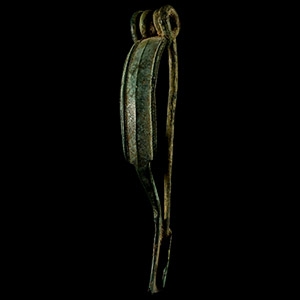
Iron Age Celtic Bronze La Tene Fibula
1st century B.C.-1st century A.D.Sold for (Inc. bp): £85
With integral spring and pin, flat-section bow with raised median rib and edges, wide foot with catch and piercing. 8.78 grams, 68 mm
Acquired on the UK art market before 2000. Property of an Essex, UK, gentleman. This lot is accompanied by an illustrated lot declaration signed by the Head of the Antiquities Department, Dr Raffaele D'Amato. -
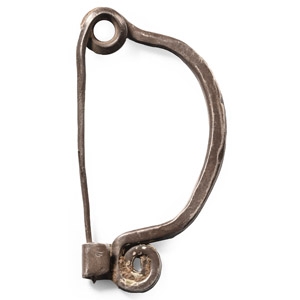
Celtic La Tene Silver Fibula
Iron Age, circa 400-200 B.C.Sold for (Inc. bp): £111
Symmetrical humpback shape, constructed on a single piece of silver with simple loop spring, arched bow, spiral terminal decoration and integral catchplate. 7.65 grams, 51 mm
From the collection of a Suffolk gentleman, early 2000s. Property of a private collector, West London, UK. This lot is accompanied by an illustrated lot declaration signed by the Head of the Antiquities Department, Dr Raffaele D'Amato. -
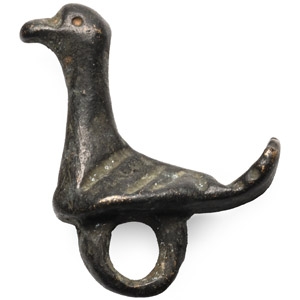
Celtic Bronze Bird Amulet
Iron Age, 1st century B.C.-1st century A.D.Sold for (Inc. bp): £312
With a long neck and folded wings with stylised feather detailing, loop below. 4.94 grams, 26 mm
Ex Manchester, UK, collection, 1990s. This lot is accompanied by an illustrated lot declaration signed by the Head of the Antiquities Department, Dr Raffaele D'Amato. -
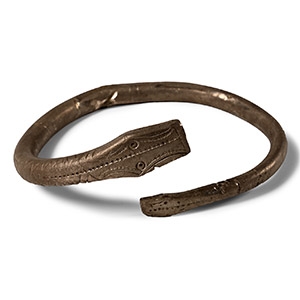
Iron Age Celtic Silver Snake-Headed Bracelet
1st century A.D.Sold for (Inc. bp): £468
Comprising a round-section shank and flattened finials: one with punched annulet detailing and ring-and-dot eyes, the other smaller with punched pellets. 61.5 grams, 81 mm
Acquired on the London art market in the late 1980s-1990s. From the family collection of an East London, UK, gentleman. This lot is accompanied by an illustrated lot declaration signed by the Head of the Antiquities Department, Dr Raffaele D'Amato. -
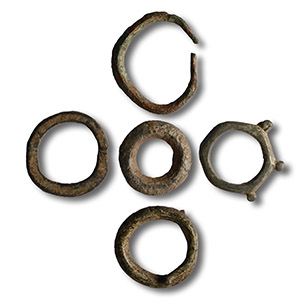
Iron Age Celtic Bronze Proto-Ring Money Collection
Circa 3rd-1st century B.C.Sold for (Inc. bp): £20
A 'proto-money' or harness ring group comprising round-section rings, some with butt-joints, radiating lobes and other features. 25.9 grams total, 22-31 mm
From an English collection formed before 2000. This lot is accompanied by an illustrated lot declaration signed by the Head of the Antiquities Department, Dr Raffaele D'Amato.
From the 3rd to 2nd Century B.C. and even before, Celtic rings in bronze were often used as a medium of exchange, before the actual issue of coinage in the area. The first attestation of rings as proto-money came from the Celtic Moesia, before the Roman conquest. -
.jpg)
Iron Age Celtic Bronze Artefact Collection
1st century B.C.-1st century A.D.Sold for (Inc. bp): £72
Comprising: a fragment of a dragonesque brooch; an openwork dragonesque brooch with a central boss; a small toggle with bulbous finials; an oval strap or belt mount with a rivet to the reverse. 58 grams total including document, 17-40 mm
Found Yorkshire, UK. From the private collection of Robin Sykes, Yorkshire, UK, formed since the late 1990s. Accompanied by record sheets by Jim Halliday. This lot is accompanied by an illustrated lot declaration signed by the Head of the Antiquities Department, Dr Raffaele D'Amato.

