-
.jpg)
Luristan Bronze Dagger
13th-6th century B.C.Sold for (Inc. bp): £468
Double-edged triangular blade, integral hilt with lateral flanges with remains of bone handle. 196 grams, 31 cm
From the estate of a deceased gentleman, Surrey, UK, 1980s. This lot is accompanied by an illustrated lot declaration signed by the Head of the Antiquities Department, Dr Raffaele D'Amato.
The dirk belongs to the type III in the Medvedskaya classification, used in Near East from the 13th to the 6th century B.C. The type is the 32a of the Maxwell-Hyslop study. -
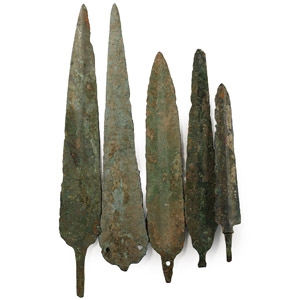
Western Asiatic Bronze Dagger Blade Collection
2200-600 century B.C.Sold for (Inc. bp): £182
Comprising four triangular and leaf-shaped blades, one with pierced tang with rivet hole and one pierced through the shoulders with two rivet holes; an arrowhead with strong mid-rib, short tang and narrow foliate blade. 321 grams total, 15-24.5 cm
Ex London art market, 1980-1990s. This lot is accompanied by an illustrated lot declaration signed by the Head of the Antiquities Department, Dr Raffaele D'Amato.
Some of the daggers represent one of the earliest form of the tangless round-heeled dagger, and the smaller examples were used as knives. Small tanged blades without a rivet, which have sometimes been identified as spearheads, are knives, while the riveted form could be used as a dagger or for domestic purposes. -
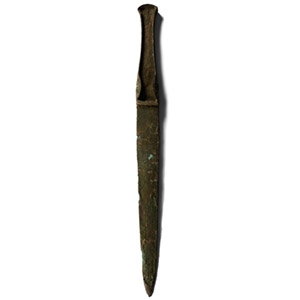
Luristan Bronze Dirk
12th century B.C.Sold for (Inc. bp): £195
With lentoid-section blade, integral tapering hilt with flared finial, lateral flanges to accept a panel of bone or wood to each face forming the grip. 283 grams, 40 cm
Ex London art market, 1980-1990s. This lot is accompanied by an illustrated lot declaration signed by the Head of the Antiquities Department, Dr Raffaele D'Amato.
The dirk belongs to the type IIIa of the Medvedskaya classification. In these specimens handle and blade are cast in one piece. In Luristan, daggers produced up until the second half of the 2nd millennium B.C. were simple bronze or copper blades with the tangs attached by rivets to a handle made of organic material. -
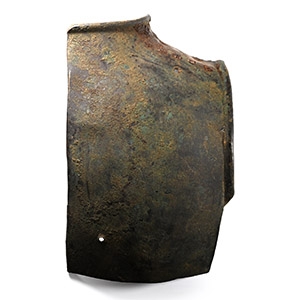
Hellenistic Bronze Cuirass Section
3rd-1st century B.C.Sold for (Inc. bp): £520
Possibly the upper right back element of a composite cuirass for a cataphract (armoured horseman), part of the edge around the neck and shoulders preserved, iron rivets and holes for attaching the shoulder straps still visible. 220 grams, 23 cm
UK private collection, acquired in 1996. This lot is accompanied by an illustrated lot declaration signed by the Head of the Antiquities Department, Dr Raffaele D'Amato.
A near complete armour for cataphract was found in the French excavations in Al-Khanoum, a Hellenistic city in Afghanistan. The cavalry of Seleucid, Ptolemaic and other Hellenistic Kingdoms formed regiments of heavy armoured horsemen, who in the west, employed a combination of lamellar and segmented armour together with muscled armour of Greek type. Cataphract armour in the West had more Greek element, for example more plate armour and less scale and lamellar. -
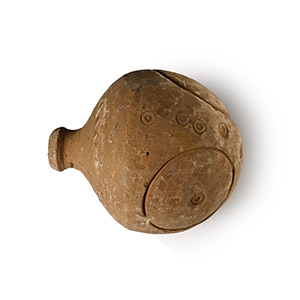
Byzantine 'Greek Fire' Ceramic Fire Bomb or Hand Grenade
9th-11th century A.D.Sold for (Inc. bp): £85
A bulbous missile with domed mouth; the body with three large annulets with ring-and-circle motif to the centre interspersed with vertical rows of ring-and-circle motifs; intended to be filled with explosive liquid and wick, used as a hand grenade. 740 grams, 11.8 cm
From an important specialist collection, London, UK, 1990s onwards. Accompanied by an academic paper by military specialist Dr Raffaele D'Amato, dated 15 July 2019 and titled 'Eastern Roman Empire - Greek Fire Bomb or Hand Grenade (μεσαίον kακάβιον) 9th-11th century AD'. This lot is accompanied by an illustrated lot declaration signed by the Head of the Antiquities Department, Dr Raffaele D'Amato.
Apart from the use of siphons or manual flame-throwers called cheirosiphona, special corps of Roman soldiers employed terracotta grenades, in the form of small jars, abundantly evidenced in archaeological excavations. They were called μεσαία kακαβιά or κυτροκακάβια where the former had a bulbous shape and the latter a more cylindrical form. -
.jpg)
Luristan Bronze Long Arrowhead
2nd-1st millennium B.C.Sold for (Inc. bp): £46
Triangular blade with raised midrib extending to the short socket with rectangular-section tang. 32 grams, 13 cm
From the private collection of John Fox, Nottingham, Nottinghamshire, UK, antiquarian and archaeologist; his collection assembled in the 1950s-1970s. This lot is accompanied by an illustrated lot declaration signed by the Head of the Antiquities Department, Dr Raffaele D'Amato. -
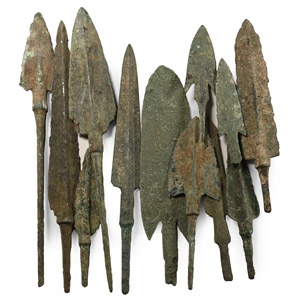
Luristan Bronze Arrowhead Collection
14th-10th century B.C.Sold for (Inc. bp): £182
A group of large tanged arrowheads, mainly of triangular type with some barbed examples. 288 grams total, 6.4-16.9 cm
Ex London art market, 1980-1990s. This lot is accompanied by an illustrated lot declaration signed by the Head of the Antiquities Department, Dr Raffaele D'Amato.
Although some of them are different in shape, these arrowheads are apparently related types of a polythetic group. Two basic deltoid forms are represented: one has a sharp, flat blade, the ends of which extend to form wings or barbs, and a prominent midrib extending into a long tang that often has a stop; the blade shape varies from deltoid to more triangular. The other form has no barbs, but it has a prominent midrib extending to the tang, and a narrow leaf-shaped blade. -
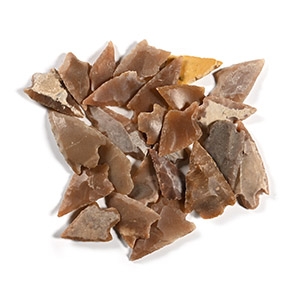
Stone Age Barbed and Tanged Arrowhead Collection
Neolithic Period, 6th-4th millennium B.C.Sold for (Inc. bp): £52
Comprising mostly bifacial and uniface triangular barded and tanged flint and chert arrowheads; probably from the Sahara region of North Africa. 45 grams total, 22-36 mm
UK gallery, early 2000s. This lot is accompanied by an illustrated lot declaration signed by the Head of the Antiquities Department, Dr Raffaele D'Amato.
Similar specimens of arrowheads have been found in the Eastern Sahara Region of Abu Tartur Plateau. Most of the arrowheads came from the El Jarar Neolithic, c. 7700-7300 B.P. (c.6500-6100 B.C.). Other parallels occur in the region of Kharga Oasis. -
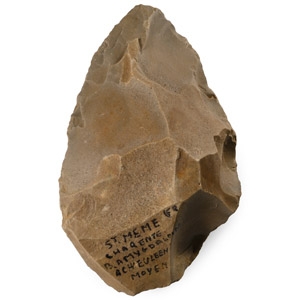
French Stone Age Acheulean Handaxe
Lower Palaeolithic Period, circa 450,000-300,000 B.P.Sold for (Inc. bp): £208
Well made with a drop ovate form; inked legend ' St. Meme (FR / Charente / B. Amygdaloide / Acheuleen / Moyen'. 280 grams, 11.3 cm
From the well regarded long closed quarry site of St Meme, Charente, France. From an old large French collection. Acquired on the European art market. From the private collection of an East Anglian, UK, specialist collector. This lot is accompanied by an illustrated lot declaration signed by the Head of the Antiquities Department, Dr Raffaele D'Amato.
Likely made by Homo Heidelbergensis or the first Neanderthals in to France. -
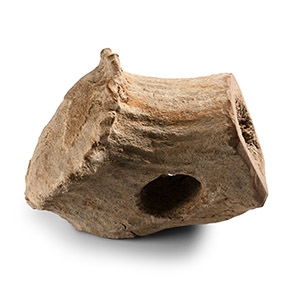
British Stone Age Socketted Bone Mace Head
Neolithic Period, 4000-2300 B.P.Sold for (Inc. bp): £598
Carved from a large bone fragment and drilled through the centre. 227 grams, 10.4 cm
Found Colwick, Nottinghamshire. From the private collection of John Fox, Nottingham, Nottinghamshire, UK, antiquarian and archaeologist; his collection assembled in the 1950s-1970s. This lot is accompanied by an illustrated lot declaration signed by the Head of the Antiquities Department, Dr Raffaele D'Amato. -
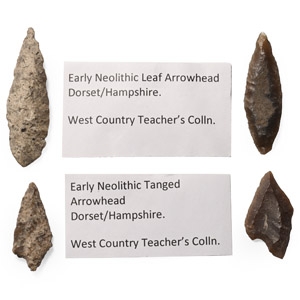
British Stone Age Arrowhead Collection
Neolithic Period, 6000-4500 B.C.Sold for (Inc. bp): £104
Comprising two leaf-shaped and two tanged examples. 7.98 grams total, 28-45 mm
Found in Dorset & Hampshire. Ex N. Thomas collection, 1980s. This lot is accompanied by an illustrated lot declaration signed by the Head of the Antiquities Department, Dr Raffaele D'Amato. -
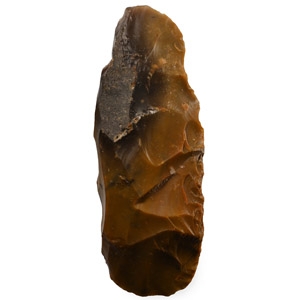
Danish Stone Age Mesolithic Flaked Adze
Mesolithic Period, circa 10,000-6000 B.C .Sold for (Inc. bp): £39
Lentoid in section with rounded butt and broad edge. 268 grams, 13.1 cm
From an old UK collection. Acquired on the UK art market. From the private collection of an East Anglian, UK, specialist collector. This lot is accompanied by an illustrated lot declaration signed by the Head of the Antiquities Department, Dr Raffaele D'Amato.

