-
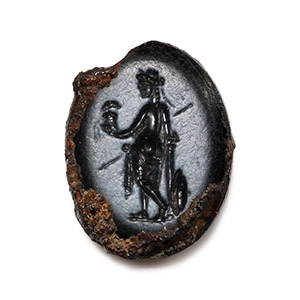
Roman Nicolo Gemstone with Venus
2nd-3rd century A.D.Sold for (Inc. bp): £1,040
With intaglio standing Venus (Greek Aphrodite) with shield and spear; supplied with a museum-quality impression. 0.68 grams, 12 mm
Ex Parisian collection, Mr A., 1990s. Acquired in 2010. This lot is accompanied by an illustrated lot declaration signed by the Head of the Antiquities Department, Dr Raffaele D'Amato. -
.jpg)
Roman Bronze Statue of Venus Anadyomene
1st-2nd century A.D.Sold for (Inc. bp): £2,340
Venus (Greek Aphrodite), the goddess of love, rising from the sea, standing nude and bearing the weight on her left leg; her head turned to the right with slightly downcast eyes and finely worked facial detailing; the bountiful hair arranged on top of her head with two long ringlets falling on her shoulders and her left hand holding the end of one ringlet; mounted on a custom-made display stand. 311 grams total, 14 cm including stand
Swiss private collection, 1970. Private collection, Zurich, Switzerland. This lot has been checked against the Interpol Database of stolen works of art and is accompanied by a search certificate number no.12684-236369. This lot has been cleared against the Art Loss Register database, and is accompanied by an illustrated lot declaration signed by the Head of the Antiquities Department, Dr Raffaele D'Amato.
Like many other nude Venus types, the Anadyomene type was not supposed to conceal the body, but to show her naked and unashamed, arms raised, touching her tresses and exposing the goddess to the viewer. The image of a nude female emerging from the sea with wet tresses was inspired by the stories of the ancient Greek courtesan Phryne swimming nude in the sea during festivals. -
.jpg)
Roman Bronze Statue of Mercury
1st century A.D.Sold for (Inc. bp): £3,380
A youthful and muscular figure of the god Mercury (Greek Hermes) standing nude with his weight resting on his right leg, left leg slightly bent and the heel raised; his hair dressed in short curls, wearing a winged petasos, and a cloak wrapped over his shoulder and left arm, naturalistic anatomical detailing; mounted on a custom-made display base. 298 grams total, 14.3 cm including stand
Swiss private collection, 1970. Private collection, Zurich, Switzerland. This lot has been checked against the Interpol Database of stolen works of art and is accompanied by a search certificate number no.12685-236368. This lot has been cleared against the Art Loss Register database, and is accompanied by an illustrated lot declaration signed by the Head of the Antiquities Department, Dr Raffaele D'Amato. -
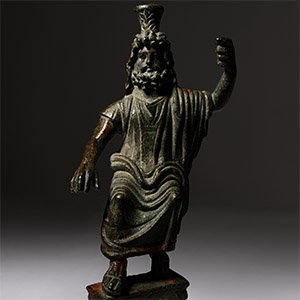
Roman Bronze Figure of Serapis
1st century B.C.-1st century A.D.Sold for (Inc. bp): £5,200
Depicted seated with his feet resting on a low stool, left hand raised and once holding sceptre or a staff; a modius crown resting on his curly hair, decorated with three incised olive sprays; dressed in a chiton and a draped himation, with his sandal-clad feet showing from beneath the folds of his garments; mounted on a custom-made display stand. 233 grams total, 12 cm high excluding stand
Private collection, Florida, USA, 1980s. European private collection, acquired in 2002. Accompanied by a copy of an Art Loss Register certificate, no.S00019356. Accompanied by an academic report by Dr Raffaele D’Amato. This lot has been checked against the Interpol Database of stolen works of art and is accompanied by search certificate number no.12611-234679. This lot has been cleared against the Art Loss Register database, and is accompanied by an illustrated lot declaration signed by the Head of the Antiquities Department, Dr Raffaele D'Amato.
The facial features are of the bearded Hellenistic type, well known by the features of the seated cult statue from the Serapeum in Alexandria and the prototypes of a number of separated heads or busts which also survive in innumerable copies in all the corners of the Roman Empire. A statue made by the Hellenistic sculptor Bryaxis was the model for this statuette and the successive iconography. -
.jpg)
Roman Bronze Figure of Apollo
Circa 1st century A.D.Sold for (Inc. bp): £13,000
Standing nude with a chlamys draped over his left shoulder and fastened on the right shoulder, bearing the weight on his right foot with the left leg bent at the knee with the heel raised; the right arm extended and holding the remains of an attribute, the left arm bent at the elbow; his head turned slightly to the right with long luxurious hair swept back and gathered at the nape of the neck; set on a circular socle base; stripped and repatinated. 700 grams, 19 cm
Acquired at Mythes ét Légendes, 18 Place des Vosges, Paris, 14 May 1980. Private collection, France. Ex Jean Roudillon, Hôtel des Ventes de Belfort SARL, 22 October 2011, no.9. with Christie's, London, 2 April 2014, no.91. Accompanied by copies of the relevant Christie's catalogue pages. Accompanied by a copy of an Art Loss Register certificate no.S0007570. Accompanied by a copy of French passport no.132675 dated 7 December 2011. Accompanied by an academic report by Dr Raffaele D’Amato. This lot has been checked against the Interpol Database of stolen works of art and is accompanied by a search certificate number no.12360-226681. This lot has been cleared against the Art Loss Register database, and is accompanied by an illustrated lot declaration signed by the Head of the Antiquities Department, Dr Raffaele D'Amato.
The figurine is of archaic style; it is probably a provincial work of a Gallo-Roman workshop. The prototype can be seen in the Apollo of Naxos in the Berlin Museum. The style of posture and movement can also be seen in the archaic bronzes of Falterona, the Louvre and Athens. -
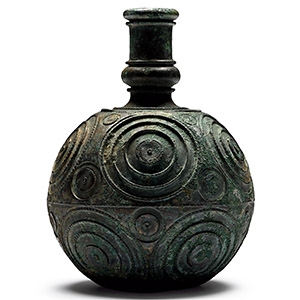
Roman Bronze Bottle with Circular Design
3rd-4th century A.D.Sold for (Inc. bp): £5,200
Spherical in profile with flat base, large raised concentric circles in two bands with smaller similar motifs between; separate balustered neck. 310 grams total, 40-66 mm
Acquired in London in 2002. European private collection. This lot has been checked against the Interpol Database of stolen works of art and is accompanied by a search certificate number no.12686-234678. This lot has been cleared against the Art Loss Register database, and is accompanied by an illustrated lot declaration signed by the Head of the Antiquities Department, Dr Raffaele D'Amato.
This is a rare type of Roman vessel, dated to the late Imperial period, between the late 3rd and 4th century A.D. The closest known parallel is a near-identical example in the Metropolitan Museum of Art, New York, which retains its original chain attachment and suspension holes at the shoulder. Such vessels were likely sealed with a perishable stopper and intended for storing or transporting perfumes or cosmetic oils. -
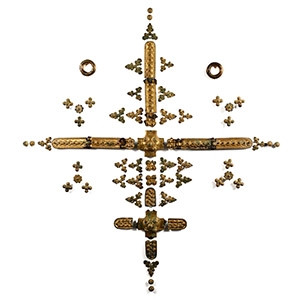
Byzantine Gilt Bronze Horse Harness Decoration Set
8th-10th century A.D.Sold for (Inc. bp): £2,990
Group of tongue-shaped harness plates, rosette and other studs and three-armed distributors. 236 grams total, 0.6-10.9 cm
From the private collection of a London gentleman, from his grandfather's collection formed before the early 1970s. This lot has been checked against the Interpol Database of stolen works of art and is accompanied by a search certificate number no.12689-234700. This lot has been cleared against the Art Loss Register database, and is accompanied by an illustrated lot declaration signed by the Head of the Antiquities Department, Dr Raffaele D'Amato. -
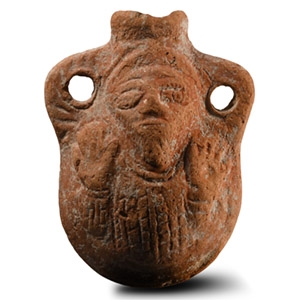
Byzantine Terracotta Pilgrim Flask with a Saint
6th century A.D.Sold for (Inc. bp): £1,170
Piriform in profile with two thick lug handles to the shoulder, obverse with low-relief facing figure holding a large cross and orb, reverse with facing figure with hand held up in the orans posture; with a display stand. 47.2 grams, 77 mm (71.4 grams total, 91 mm including stand)
Ex private collection, Mrs L.S., 1990s. Acquired from the above, 2001. Private European collection. This lot has been checked against the Interpol Database of stolen works of art and is accompanied by a search certificate number no.12110-218216. This lot is accompanied by an illustrated lot declaration signed by the Head of the Antiquities Department, Dr Raffaele D'Amato.
Ampullae like this one were filled with water from holy places, like the lake near the Sanctuary of Saint Menas, famous for its healing properties. In Egypt in the 6th-7th century, and throughout the eastern part of the Roman Empire, these ampullae were an integral part of the equipment of pilgrims visiting holy places and who, like today, carried with them a portion of holy water considered miraculous against ailments of the body and soul. -
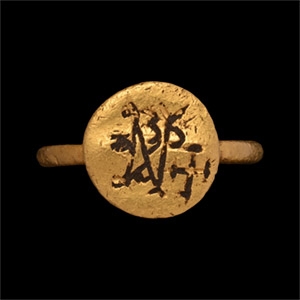
Byzantine Gold Ring with Monogram
6th-7th century A.D.Sold for (Inc. bp): £1,300
Round-section hoop supporting a disc bezel with engraved monogram incorporating a cross potent and the letters N, O, P, E, Z and others. 3.29 grams, 17.57 mm overall, 15.91 mm internal diameter (approximate size British I 1/2, USA 4 1/2, Europe 8.07, Japan 7)
From an early 20th century collection based on the collector's ticket. Property of a Californian, USA, collector. This lot is accompanied by an illustrated lot declaration signed by the Head of the Antiquities Department, Dr Raffaele D'Amato. -
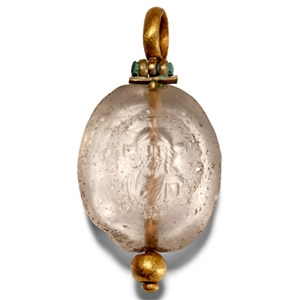
Byzantine Rock Crystal Pendant
Circa 8th-12th century A.D.Sold for (Inc. bp): £3,900
Biconvex crystal bead mounted on a gold rod with bulb below, hinged bale above; obverse with intaglio nimbate bust of Christ, reverse with nimbate bust of Mary. 18.87 grams, 50 mm
Acquired from a London, UK, gallery, 1980s. From a North American gentleman's collection, 1980-1990s. This lot has been checked against the Interpol Database of stolen works of art and is accompanied by a search certificate number no.12692-235761. This lot has been cleared against the Art Loss Register database, and is accompanied by an illustrated lot declaration signed by the Head of the Antiquities Department, Dr Raffaele D'Amato. -
.jpg)
Sumerian Terracotta Foundation Cone From Lagash
Circa 2100 B.C.Sold for (Inc. bp): £1,690
Conical with a domed top, ten-line inscription for Gudea of Lagash, giving a record of the building of Eninnu, the temple of Ningirsu: 'For Ningirsu, the powerful warrior of Enlil, Gudea, ruler of Lagaš, brought about perfection: he built and restored his E-ninnu-anzud-babbar.' 172 grams, 12.2 cm
From an important collection formed before 1988. Examined by Professor Wilfrid George Lambert FBA (1926-2011), historian, archaeologist, and specialist in Assyriology and Near Eastern archaeology, in the late 1980s and 1990s. Accompanied by a copy of a scholarly note by Professor Wilfrid George Lambert. This lot has been cleared against the Art Loss Register database, and is accompanied by an illustrated lot declaration signed by the Head of the Antiquities Department, Dr Raffaele D'Amato.
Votive cones are one type of royal foundation deposit, objects that were buried in the walls and beneath the floors of important buildings during construction to sanctify the site and to create a historical memory of the ruler and his achievements. -
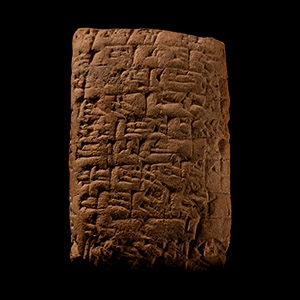
Old Babylonian Terracotta Cuneiform Tablet from 'Warad-Amurru' to 'Ubar-Shamash' Concerning Barley
19th-16th century B.C.Sold for (Inc. bp): £975
Pillow-shaped with impressed bands of cuneiform text to both broad faces, one edge and one end. 70 grams, 60 mm
Specialised collection of cuneiform texts, the property of a London gentleman and housed in London before 1988. Thence by descent to family members. Examined by Professor Wilfrid George Lambert FBA (1926-2011), historian, archaeologist, and specialist in Assyriology and Near Eastern archaeology, in the late 1980s and early 1990s. The collection is exceptional for the variety of types, including some very rare and well preserved examples. This lot has been cleared against the Art Loss Register database, and is accompanied by an illustrated lot declaration signed by the Head of the Antiquities Department, Dr Raffaele D'Amato.

