-
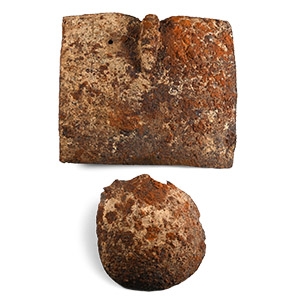
Oriental European Iron Armour Sections
10th-14th century A.D.Sold for (Inc. bp): £33
Consisting of a square dorsal plate and a spherical shoulder protection, the dorsal plate with one of the fixing holes present. 790 grams total, 12.7-20 cm
UK private collection, acquired in 1996. This lot is accompanied by an illustrated lot declaration signed by the Head of the Antiquities Department, Dr Raffaele D'Amato.
Although this is a type of armour that currently has no parallels for its dorsal plate, the spherical shoulder protection finds some comparable items with fragments of armour from the Balkans and could correspond to the melon of Eastern Roman sources of the period. -
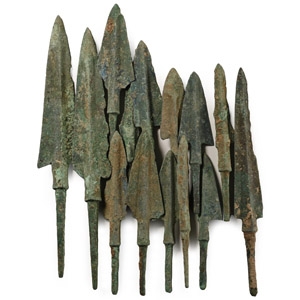
Luristan Bronze Arrowhead Collection
13th-6th century B.C.Sold for (Inc. bp): £169
A group of large tanged arrowheads mainly of triangular type. 319 grams total, 8.7-16.8 cm
Ex London art market, 1980-1990s. This lot is accompanied by an illustrated lot declaration signed by the Head of the Antiquities Department, Dr Raffaele D'Amato.
One category of the represented arrowheads has a sharp, flat blade, the ends of which extend to form wings or barbs, and a prominent midrib extending into a long tang with a stop; the blade shape varies from deltoid to more triangular. Another form has no barbs, but it has a prominent midrib extending to the tang, and a narrow leaf-shaped blade. -
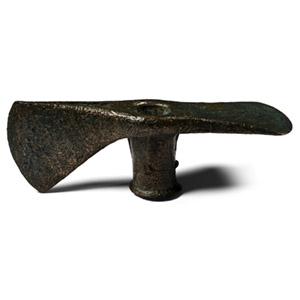
Large Luristan Socketted Bronze Adze
2nd-early 1st millennium B.C.Sold for (Inc. bp): £468
An adze-axe head with central shaft hole and curved blades, flange to socket. 570 grams, 16.5 cm
Acquired in the 1990s. Ex Abelita family collection. This lot is accompanied by an illustrated lot declaration signed by the Head of the Antiquities Department, Dr Raffaele D'Amato.
The adze-axe was a fundamental weapon of many Bronze Age cultures around the world. The form lends itself to dual purposes - for war and peace. As a tool, it functions in fabricating wood and as a weapon, its heavy mass and compact form make it a deadly striking and chopping weapon, even able to defeat light armour. -
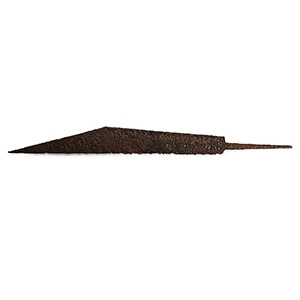
Large Viking Age Iron Broken-Backed Knife 'Seax' Blade
8th-10th century A.D.Sold for (Inc. bp): £117
With scooped forward edge, straight single edge and arched triangular back; transverse mounting tang. 208 grams, 37.5 cm
From a North American collection formed in the 1970s-1990s. This lot is accompanied by an illustrated lot declaration signed by the Head of the Antiquities Department, Dr Raffaele D'Amato.
This knife seems to be of type IV, like the one found in the Thames at Wandsworth. Based on its similarities with a specimen from Canterbury, it could be dated to the 8th century A.D. Underwood classifies these kind of knives under the typology C (angled back-curved cutting edge) dating them from the mid 6th to early 8th century A.D. -
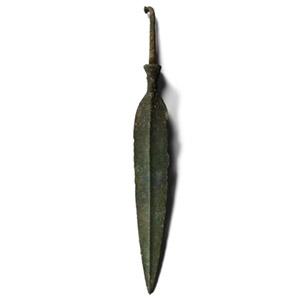
Large Luristan Bronze Spearhead
Late 3rd millennium B.C.Sold for (Inc. bp): £117
Leaf-shaped blade with pronounced midrib and thick neck, flared base, square-section tang with stud. 504 grams, 41cm
Ex London art market, 1980-1990s. This lot is accompanied by an illustrated lot declaration signed by the Head of the Antiquities Department, Dr Raffaele D'Amato.
The type belongs to the category of tripartite lances with long pointed biconvex blade and single bevelled tang. In this typology the blade, of rhomboidal section, is usually well balanced. The stem, medium or short, is widened at its base and forms a fairly clean stop. Elements of shaft of a similar spear found at Tepe Hissar has allowed to reconstruct the length of the spear reaching up to 1.40 m. -
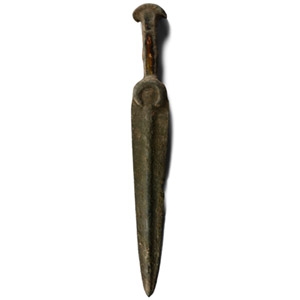
Marlik Type Bronze Dagger with Integral Hilt
14th-10th century B.C.Sold for (Inc. bp): £247
The blade with raised mid-rib and penannular guard, integral flanged hilt with organic inserts for the grip and crescentic pommel. 368 grams, 31.5 cm
Ex London art market, 1980-1990s. This lot is accompanied by an illustrated lot declaration signed by the Head of the Antiquities Department, Dr Raffaele D'Amato.
These daggers were cast in one-piece mould. Some scholars (Negahban) states that blade and grip were cast in one piece mould, and that the penannular guard was later cast onto the blade. However the main characteristic was the hilt and pommel open to accept organic inlays, here preserved. -
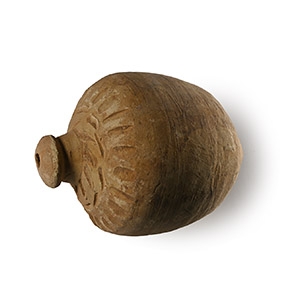
Byzantine 'Greek Fire' Ceramic Fire Bomb or Hand Grenade
9th-11th century A.D.Sold for (Inc. bp): £78
Piriform in profile with narrow point and domed mouth; radiating line decoration to the upper body; intended to be filled with explosive liquid and a wick, and used as a hand grenade. 756 grams, 15.5 cm
From an important specialist collection, London, UK, 1990s onwards. Accompanied by an academic paper by military specialist Dr Raffaele D'Amato, dated 15 July 2019 and titled 'Eastern Roman Empire - Greek Fire Bomb or Hand Grenade (μεσαίον kακάβιον) 9th-11th century AD'. This lot is accompanied by an illustrated lot declaration signed by the Head of the Antiquities Department, Dr Raffaele D'Amato.
Apart from the use of siphons or manual flame-throwers called cheirosiphona, special corps of Roman soldiers employed terracotta grenades, in the form of small jars, abundantly evidenced in archaeological excavations. They were called μεσαία kακαβιά or κυτροκακάβια where the former had a bulbous shape and the latter a more cylindrical form. -
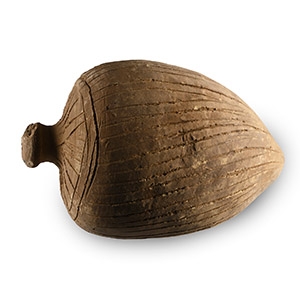
Byzantine 'Greek Fire' Ceramic Fire Bomb or Hand Grenade
9th-11th century A.D.Sold for (Inc. bp): £59
Piriform in profile with narrow point and domed mouth; incised line decoration to the body; intended to be filled with explosive liquid and wick, used as a hand grenade. 996 grams, 16 cm
From an important specialist collection, London, UK, 1990s onwards. Accompanied by an academic paper by military specialist Dr Raffaele D'Amato, dated 15 July 2019 and titled 'Eastern Roman Empire - Greek Fire Bomb or Hand Grenade (μεσαίον kακάβιον) 9th-11th century AD'. This lot is accompanied by an illustrated lot declaration signed by the Head of the Antiquities Department, Dr Raffaele D'Amato.
Apart from the use of siphons or manual flame-throwers called cheirosiphona, special corps of Roman soldiers employed terracotta grenades, in the form of small jars, abundantly evidenced in archaeological excavations. They were called μεσαία kακαβιά or κυτροκακάβια where the former had a bulbous shape and the latter a more cylindrical form. -
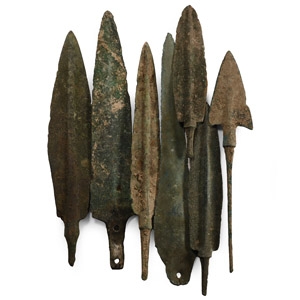
Large Western Asiatic Bronze Arrowhead and Dagger Collection
1800-700 B.C.Sold for (Inc. bp): £156
Including mainly triangular and leaf-shaped types of arrowheads, and two small daggers with pierced tang. 251 grams total, 10.5-17 cm
Ex London art market, 1980-1990s. This lot is accompanied by an illustrated lot declaration signed by the Head of the Antiquities Department, Dr Raffaele D'Amato.
Small tanged blades without a rivet, which have sometimes been identified as spearheads, are knives, while the rivetted form could have been used as a dagger or for domestic purposes. Both forms are characteristic of the Hyksos period in Palestine. A curious blade from Byblos (Level 19) represents the earlier form of this type. -
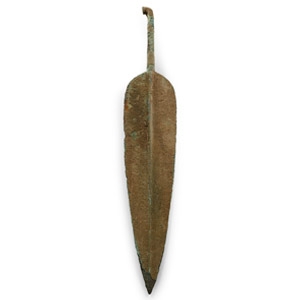
Western Asiatic Bronze Blade
14th-10th century B.C.Sold for (Inc. bp): £104
The leaf-shaped ovate blade with rounded, gently curved shoulders and raised midrib, flat rectangular-sectioned tang tapering to a bent end with the remains of a fastening button. 348 grams, 34 cm
Acquired 1980-2015. Ex Abelita family collection. This lot is accompanied by an illustrated lot declaration signed by the Head of the Antiquities Department, Dr Raffaele D’Amato. This lot is accompanied by an illustrated lot declaration signed by the Head of the Antiquities Department, Dr Raffaele D'Amato.
Similar spearheads were excavated in the Marlik Royal cemetery by Dr Negahban, see for example in tomb 47, Trench XXIIE. They were the evolution of a typology which began much earlier in Mesopotamia and the fertile crescent, the type 4 of the Stronach classification, with straight square-section tang, usually thickened at the base with a button tang. The foliate blade was wide and exaggerated in some specimens excavated at Marlik. -
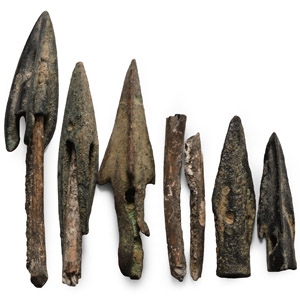
Greek Bronze Arrowheads with Original Shafts
Circa 5th-3rd century B.C.Sold for (Inc. bp): £111
Comprising four triangular tanged types and one leaf-shaped socketted type, four with original wooden shafts; rare. 19.9 grams total, 45-57 mm
Ex Robin Symes Gallery, Mayfair, pre 1999. From a London, UK, collection. This lot is accompanied by an illustrated lot declaration signed by the Head of the Antiquities Department, Dr Raffaele D'Amato.
Missile troops were not neglected in ancient Greece. In the mid-4th century B.C. Athens, inscriptions list boxes of arrows; in 282, a Cretan coach is recorded as being employed to train Athenian archers, and Sparta too had long since employed Cretan archers. Bow and quiver of great value were often the prize of sport competitions. -
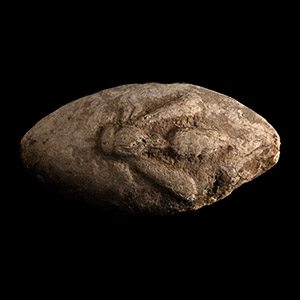
Hellenistic Rhodian Lead Slingshot with Bee
3rd century B.C.Sold for (Inc. bp): £1,430
Lentoid-section and depicting a bee to one side and inscription 'ΚΑΛΑ' on the other. 27.2 grams, 31 mm
From a Manchester, UK, collection, 1990s. This lot is accompanied by an illustrated lot declaration signed by the Head of the Antiquities Department, Dr Raffaele D'Amato.
The slingshots with an inscription ΚΑΛΑ are believed to originate from the Island of Rhodes. On these sling bullets ΚΑΛΑ should be translated as “nice things.” Together with the Balearic slingers, Rhodian slingers were considered to be the best of the Hellenistic world, and they were also used in the Roman army.

