-
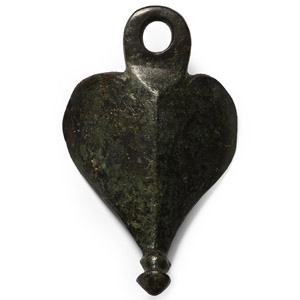
Roman Horse Harness Phalera
1st-4th century A.D.Sold for (Inc. bp): £72
Of carinated profile with pierced lug above and knop finial. 97 grams, 95 mm
Ex German art market, 2000s. Acquired from an EU collector living in London. From the collection of a Surrey, UK, gentleman. This lot is accompanied by an illustrated lot declaration signed by the Head of the Antiquities Department, Dr Raffaele D’Amato. This lot is accompanied by an illustrated lot declaration signed by the Head of the Antiquities Department, Dr Raffaele D'Amato. -
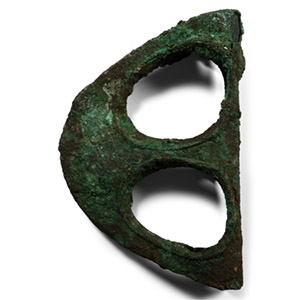
Canaanite 'Window' Bronze Axehead
2100-1800 B.C.Sold for (Inc. bp): £737
Curving blade with two large 'eye-shaped' openings, cylindrical socket. 142 grams, 11 cm
Acquired in the mid 1980s. Private collection, Switzerland, thence by descent. Private collection, since the late 1990s This lot is accompanied by an illustrated lot declaration signed by the Head of the Antiquities Department, Dr Raffaele D'Amato.
The ‘window’ axes have several morphological characteristics. The blade, semi-circular or elongated in shape, always ended in a rounded edge. In this type the blade was flat in section. It included two openings at its base—windows—of varying width, circular or oval. The haft consisted of a collar as wide as the blade. The weapon was threaded into an elongated wooden handle, often curved at its base, of oval section, with a differential width promoting the strength of the haft. It was thus wedged, and a rivet passed through the handle, just above the axe, serving as a stop. -
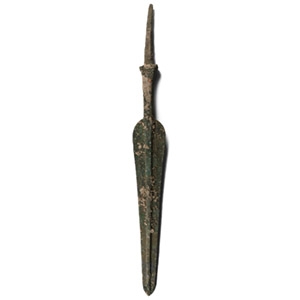
Very Large Amlash Bronze Spear-Head
12th-11th century B.C.Sold for (Inc. bp): £117
Leaf-shaped blade with raised midrib extending to a square-section shank, flared below with a square-section tang. 537 grams, 45.5 cm
Ex London art market, 1980-1990s. This lot is accompanied by an illustrated lot declaration signed by the Head of the Antiquities Department, Dr Raffaele D'Amato.
The weapon belongs to the type 1 of the spear-head classification of Khorasani, mainly from Marlik or Amlash areas. Similar pieces have been dated by Stutzinger to 1200-1100 B.C. -
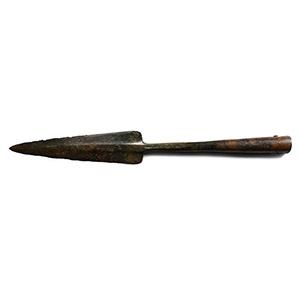
Luristan Bronze Spearhead
13th-7th century B.C.Sold for (Inc. bp): £286
Composed of a leaf-shaped blade with tapering socket. 355 grams, 44 cm
Acquired 1980-2015. Ex Abelita family collection. This lot is accompanied by an illustrated lot declaration signed by the Head of the Antiquities Department, Dr Raffaele D’Amato. This lot is accompanied by an illustrated lot declaration signed by the Head of the Antiquities Department, Dr Raffaele D'Amato. -
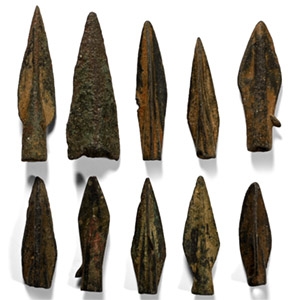
Greek Period High Quality Large Bronze Arrowhead Collection
5th-3rd century B.C.Sold for (Inc. bp): £65
Mostly long leaf-shaped types with short socket. 50 grams total, 30-45 mm
From an English collection formed before 2000. This lot is accompanied by an illustrated lot declaration signed by the Head of the Antiquities Department, Dr Raffaele D'Amato. -
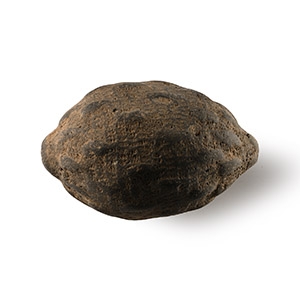
Byzantine 'Greek Fire' Ceramic Fire Bomb or Hand Grenade
9th-11th century A.D.Sold for (Inc. bp): £91
Piriform in profile with narrow point; the body decorated with raised teardrop-shaped bosses and impressed dots; intended to be filled with explosive liquid and a wick, and used as a hand grenade. 630 grams, 13.3 cm
From an important specialist collection, London, UK, 1990s onwards. Accompanied by an academic paper by military specialist Dr Raffaele D'Amato, dated 15 July 2019 and titled 'Eastern Roman Empire - Greek Fire Bomb or Hand Grenade (μεσαίον kακάβιον) 9th-11th century AD'. This lot is accompanied by an illustrated lot declaration signed by the Head of the Antiquities Department, Dr Raffaele D'Amato.
Apart from the use of siphons or manual flame-throwers called cheirosiphona, special corps of Roman soldiers employed terracotta grenades, in the form of small jars, abundantly evidenced in archaeological excavations. They were called μεσαία kακαβιά or κυτροκακάβια where the former had a bulbous shape and the latter a more cylindrical form. -
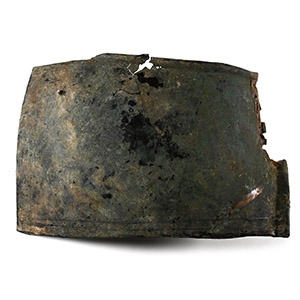
Hellenistic Bronze Cuirass Section
3rd-1st century B.C.Sold for (Inc. bp): £286
Possibly the upper right front element of a composite cuirass for a cataphract (armoured horseman), part of the edge around the neck and shoulders preserved, rivets and clasp for attachment of the back section present. 261 grams, 23 cm
UK private collection, acquired in 1996. This lot is accompanied by an illustrated lot declaration signed by the Head of the Antiquities Department, Dr Raffaele D'Amato.
A near complete armour for cataphract was found in the French excavations in Al-Khanoum, a Hellenistic city in Afghanistan. The cavalry of Seleucid, Ptolemaic and other Hellenistic Kingdoms formed regiments of heavy armoured horsemen, who in the west, employed a combination of lamellar and segmented armour together with muscled armour of Greek type. Cataphract armour in the West had more Greek element, for example more plate armour and less scale and lamellar. -
.jpg)
North-Western Persian Type Bronze Blade
Early 1st millennium B.C.Sold for (Inc. bp): £59
With tapering triangular blade, having straight shoulders, flat midrib and tapering square-sectioned tang ending with a rounded pommel. 99 grams, 33 cm
Acquired 1980-2015. Ex Abelita family collection. This lot is accompanied by an illustrated lot declaration signed by the Head of the Antiquities Department, Dr Raffaele D’Amato. This lot is accompanied by an illustrated lot declaration signed by the Head of the Antiquities Department, Dr Raffaele D'Amato.
Moorey, Gordon and Khorasani created a classification of bladed weapons, according to which daggers are edged weapons not greater than 36cm in length, dirks (short swords) are between 36cm and 50cm in length, and swords are edged weapons greater than 50cm in length. -
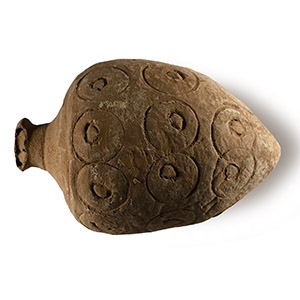
Byzantine 'Greek Fire' Ceramic Fire Bomb or Hand Grenade
9th-11th century A.D.Sold for (Inc. bp): £72
Piriform in profile with narrow point and domed mouth; the body decorated with impressed concentric circles; intended to be filled with explosive liquid and wick, used as a hand grenade. 510 grams, 13.3 cm
From an important specialist collection, London, UK, 1990s onwards. Accompanied by an academic paper by military specialist Dr Raffaele D'Amato, dated 15 July 2019 and titled 'Eastern Roman Empire - Greek Fire Bomb or Hand Grenade (μεσαίον kακάβιον) 9th-11th century AD'. This lot is accompanied by an illustrated lot declaration signed by the Head of the Antiquities Department, Dr Raffaele D'Amato.
Apart from the use of siphons or manual flame-throwers called cheirosiphona, special corps of Roman soldiers employed terracotta grenades, in the form of small jars, abundantly evidenced in archaeological excavations. They were called μεσαία kακαβιά or κυτροκακάβια where the former had a bulbous shape and the latter a more cylindrical form. -
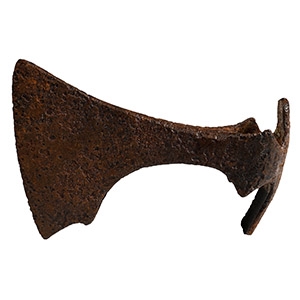
Viking Age Iron Bearded Axehead
9th-11th century A.D.Sold for (Inc. bp): £338
With gently curving blade, long neck with a spur, round socket with vertical flanges. 331 grams, 14 cm
From a North American collection formed in the 1970s-1990s. This lot is accompanied by an illustrated lot declaration signed by the Head of the Antiquities Department, Dr Raffaele D'Amato. -
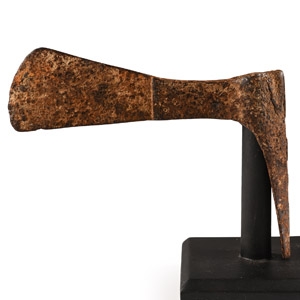
Luristan Iron Socketted Axehead
1st millennium B.C.Sold for (Inc. bp): £52
Narrow blade with rounded cutting edge, rectangular-section neck and round socket with extension below; mounted on a custom-made display stand. 259 grams, 17.5 cm (435 grams total, 20.5 cm wide including stand)
Ex London, UK, gallery, 1990s. This lot is accompanied by an illustrated lot declaration signed by the Head of the Antiquities Department, Dr Raffaele D'Amato. -
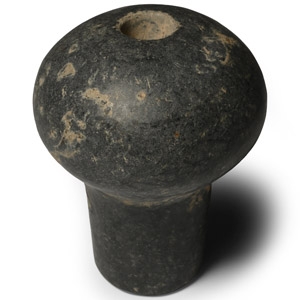
Western Asiatic Stone Macehead
3rd-2nd millennium B.C.Sold for (Inc. bp): £169
With plain globular body, circular short shaft expanding to a circular flat base. 386 grams, 83 mm
From the collection of a London, UK, gentleman, 1990s. This lot is accompanied by an illustrated lot declaration signed by the Head of the Antiquities Department, Dr Raffaele D’Amato. This lot is accompanied by an illustrated lot declaration signed by the Head of the Antiquities Department, Dr Raffaele D'Amato.

