-
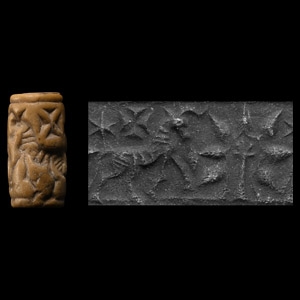
Neo-Assyrian Cream Stone Cylinder Seal with Bull
Circa 800-600 B.C.Sold for (Inc. bp): £286
Accompanied by a copy of an old scholarly note, typed and signed by W.G. Lambert, late Professor of Assyriology, University of Birmingham, 1970-1993, which states: ' Cylinder Seal of Cream Stone. 24 x 12 mm. The design, which is put between upper and lower rulings, shows a walking bull facing a stylized sacred tree: a straight trunk with five-branch crown, surrounded by scalloped line supporting seven leaves. There is a rhomb between bull and tree, and a star and Maltese cross above the bull's back. This is a Neo-Assyrian seal, c.800-600 B.C. It is one of the rarer types, deeply cut, and in good condition. The bull and the tree are both symbols of the storm god Adad, who had an important place in the Neo-Assyrian pantheon. The star is the symbol of Ishtar/Venus, also an important Assyrian deity, but the Maltese cross is so far not certainly identified.'; supplied with a museum-quality impression. 5.78 grams, 24 mm
From the private collection of a North American lady, formed 1970s-early 1990s, with collection reference no.590/2. Accompanied by a copy of a scholarly note, typed and signed by Professor Wilfrid George Lambert. This lot has been cleared against the Art Loss Register database, and is accompanied by an illustrated lot declaration signed by the Head of the Antiquities Department, Dr Raffaele D'Amato. -
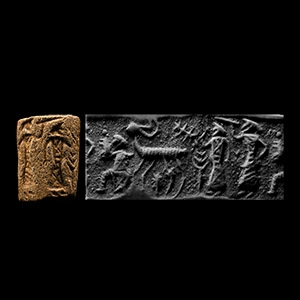
Anatolian Yellow Stone Cylinder Seal with Horned Quadruped
2nd millennium B.C.Sold for (Inc. bp): £98
Cylinder with cord and bead handles; accompanied by a copy of an old scholarly note, typed and signed by W.G. Lambert, late Professor of Assyriology, University of Birmingham, 1970-1993, which states: 'Description of Cylinder Seal of Yellow Stone (?), 31 x 23.5 mm. Standing horned quadruped with plant(?) between splayed legs, before it three figure of human form, the first seated, the other two standing, the first of them holding up a weapon(?), the other a branch(?) ; all three face away from the horned animal , and there is a tree in front of the last of the three. This is a very unusual piece, and the cylinder is irregular as though an existing piece of material had been used without trimming to a regular shape. Most probably second millennium and from Syria or Anatolia. Condition very good.'; supplied with a museum-quality impression. 24.8 grams, 31 mm
UK private collection, acquired 1980-1983. Accompanied by a copy of a scholarly note, typed and signed by Professor Wilfrid George Lambert in November 1987. This lot has been cleared against the Art Loss Register database, and is accompanied by an illustrated lot declaration signed by the Head of the Antiquities Department, Dr Raffaele D'Amato. -
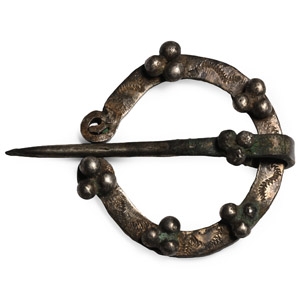
Sasanian Silver Penannular Brooch
3rd-4th century A.D.Sold for (Inc. bp): £169
Comprising a flat-section penannular bow with scrolled finials, granule-clusters to the upper face, tremolier ornament and thick pin. 10.5 grams, 44 mm
Acquired before 1983. Ex London gallery, 1990s. This lot has been cleared against the Art Loss Register database, and is accompanied by an illustrated lot declaration signed by the Head of the Antiquities Department, Dr Raffaele D'Amato. -
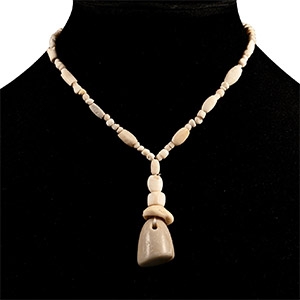
Western Asiatic Bead Necklace String
1st millennium B.C. and laterSold for (Inc. bp): £33
Restrung group of oblate, fusiform, drum-shaped and other beads in stone and shell. 28.2 grams, 28.5 cm
Ex London, UK, collection, 1990s. This lot has been cleared against the Art Loss Register database, and is accompanied by an illustrated lot declaration signed by the Head of the Antiquities Department, Dr Raffaele D'Amato. -
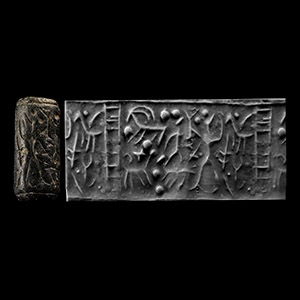
Levantine Black Stone Cylinder Seal
Circa 1200-1000 B.C.Sold for (Inc. bp): £286
Cylinder with cord and bead handles; accompanied by a copy of an old scholarly note, typed and signed by W.G. Lambert, late Professor of Assyriology, University of Birmingham, 1970-1993, which states: 'Description of Cylinder Seal of soft, black stone, 29 x 18 mm. A scene is contained within upper and lower rules and a ladder pattern repeated at left and right. The main figure is a standing deity holding up items in each raised hand. he wears a pointed cap and might be meant as Hadad/Teshub/Baal, the storm god, but the symbols held are not sufficiently clear to be certain. In front of him is a small figure of human form, and three horned quadrupeds; behind him is a bird, a fish(?) and a scorpion. Vacant spaces are filled with dots, and linear devices. The seal is a typical "Levantine" cylinder c. 1200-1000 B.C. from Syria or Anatolia. it is cut with a hand-held pointed graving tool and the drill. Though worn, the design is completely clear.'; supplied with a museum-quality impression. 9.72 grams, 28 mm
UK private collection, acquired 1980-1983. Accompanied by a copy of a scholarly note, typed and signed by Professor Wilfrid George Lambert in October 1987. This lot has been cleared against the Art Loss Register database, and is accompanied by an illustrated lot declaration signed by the Head of the Antiquities Department, Dr Raffaele D'Amato. -
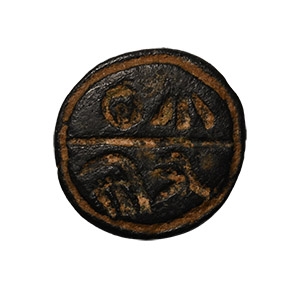
Western Asiatic Hebrew Stamp Seal Matrix
Early 1st millennium A.D.Sold for (Inc. bp): £650
Conical body with large ribbed loop above, four incised characters to the underside. 3.65 grams, 14 mm
From the collection of a gentleman, acquired on the London art market in the 1990s. This lot has been cleared against the Art Loss Register database, and is accompanied by an illustrated lot declaration signed by the Head of the Antiquities Department, Dr Raffaele D'Amato. -
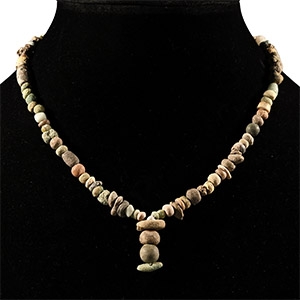
Western Asiatic Ceramic Bead Necklace String
1st millennium B.C. and laterSold for (Inc. bp): £20
Restrung to a Y-shape using variously shaped beads in blue, green and cream. 19.3 grams, 37.5 cm
Ex London, UK, collection, 1990s. This lot has been cleared against the Art Loss Register database, and is accompanied by an illustrated lot declaration signed by the Head of the Antiquities Department, Dr Raffaele D'Amato. -
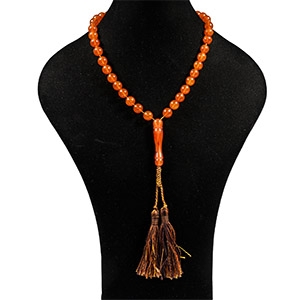
Western Asiatic Amber-Coloured Prayer Beads
20th century A.D.Sold for (Inc. bp): £72
Composed of forty-one spherical beads with two oblate beads, and a large minaret bead with two tassels to the bottom. 54 grams, 58 cm
Acquired in the 1990s. Ex Abelita family collection. This lot has been cleared against the Art Loss Register database, and is accompanied by an illustrated lot declaration signed by the Head of the Antiquities Department, Dr Raffaele D'Amato. -
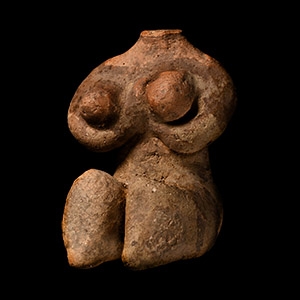
Tell Halaf Seated Goddess Idol
6th-5th millennium B.C.Sold for (Inc. bp): £338
Modelled in the round with legs bent in a crouching posture, arms bent to support the breasts, bands of pigment; head absent. 50.4 grams, 56 mm
Acquired on the German art market, 1989-1995. with The Museum Gallery, 19 Bury Place, London, WC1, UK, 1998-2003. Property of a London based academic, 2003-present. This lot has been cleared against the Art Loss Register database, and is accompanied by an illustrated lot declaration signed by the Head of the Antiquities Department, Dr Raffaele D'Amato. -
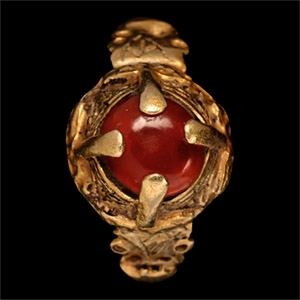
Western Asiatic Gold Ring with Cornelian Gemstone
12th-13th century A.D.Sold for (Inc. bp): £715
D-section hoop with openwork floral shoulders, domed bezel with inset cabochon in a claw setting. 3.51 grams, 23.66 mm overall, 15.89 mm internal diameter (approximate size British K 1/2, USA 5 1/2, Europe 10.58, Japan 10)
Acquired in the 1980s. Private collection, Switzerland, thence by descent. Private collection, since the late 1990s. This lot has been cleared against the Art Loss Register database, and is accompanied by an illustrated lot declaration signed by the Head of the Antiquities Department, Dr Raffaele D'Amato. -
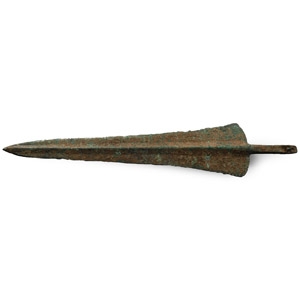
Luristan Bronze Dagger Blade
2nd-1st millennium B.C.Sold for (Inc. bp): £156
Triangular double-edged blade with raised midrib and short tang with a rivet in situ. 263 grams, 34.5 cm
Ex North London, UK, collection, 1990s. This lot is accompanied by an illustrated lot declaration signed by the Head of the Antiquities Department, Dr Raffaele D'Amato. -
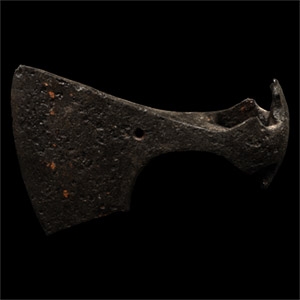
Viking Age Bearded Battle Axehead
Early 11th-12th century A.D.Sold for (Inc. bp): £234
A Baltic hand-forged iron axehead with scooped socket, broad blade with extension to the lower edge, hole to the blade. 532 grams total, axe: 14.7 cm
Acquired on the London art market, 1990s. Private collection, London. This lot is accompanied by an illustrated lot declaration signed by the Head of the Antiquities Department, Dr Raffaele D'Amato.
The more common weapons of Finno-Ugrian people were axes, commonly found from all Finnic areas, as well as spears. Among Baltic-Finnic people, especially in Finland and Karelia, knives called 'puukko' were common, as well as axes, spears, flat bows and longbows, while swords were usually imported from Germanic areas, Sweden or from elsewhere Scandinavia, some having often typically Scandinavian animal ornaments. Iron axeheads of this typology show a sub-trapezoidal asymmetrical blade, often perforated through the centre. They are characterised by two projecting spurs from the top and the bottom of the back of the shaft-hole.

