-
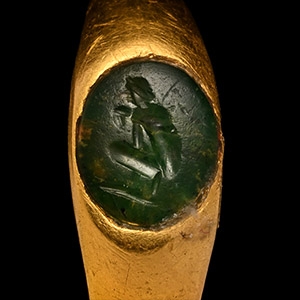
Roman Gold Ring with Green Quartz Gemstone of a Crouching Figure
2nd-3rd century A.D.Sold for (Inc. bp): £780
With tapering shank, inset cloison with intaglio crouching figure (Faunus?). 8.29 grams, 19.88 mm overall, 14.54 x 11.23 mm internal diameter (approximate size British -, USA -, Europe -, Japan -)
Acquired by the current owner's family in the 1980s. with Christie’s, New York, Ancient Jewellery, 11 December 2003, no.463. This lot has been cleared against the Art Loss Register database, and is accompanied by an illustrated lot declaration signed by the Head of the Antiquities Department, Dr Raffaele D'Amato. -
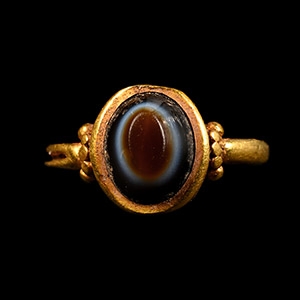
Roman Gold Ring with Eye Cabochon
3rd-4th century A.D.Sold for (Inc. bp): £715
Round-section hoop with granule cluster to each shoulder, ellipsoid cell with inset sardonyx cabochon; one end of bezel and outer edge of hoop damaged. 2.45 grams, 20.32 mm overall, 11.79 x 16.35 mm internal diameter (approximate size British E 1/2, USA 2 1/2, Europe 3, Japan 3)
Private family collection, acquired in the 1980s. with Christie's, New York, Ancient Jewellery, 11 December 2003, no.506. Property of a European collection. Accompanied by a copy of an Art Loss Register certificate, no.S00029664 This lot is accompanied by an illustrated lot declaration signed by the Head of the Antiquities Department, Dr Raffaele D'Amato. -
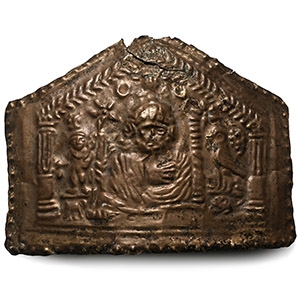
Late Roman Silver Plaque with Figures
4th-7th century A.D.Sold for (Inc. bp): £650
With repoussé detailing; central facing bust wearing a toga between two columns supporting a laurel-wreath vault; to the left, facing Mercury standing with caduceus, to the right, an eagle in profile; mounted in a fabric-covered frame. 148 grams, 17.2 cm wide
Acquired in the late 1980s-early 1990s. Private collection, London. This lot is accompanied by an illustrated lot declaration signed by the Head of the Antiquities Department, Dr Raffaele D'Amato. -
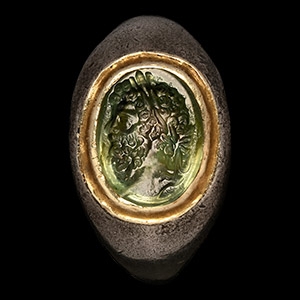
Roman Aquamarine Gemstone with Portrait of Emperor Septimius Severus in Silver and Gold Ring
2nd-3rd century A.D.Sold for (Inc. bp): £9,100
With the bust of the emperor facing left, laurel wreath in his curly hair with ribbons falling behind his head, beard with characteristic forked tip, mounted in a large broad silver hoop widening to an oval bezel inset with a gold border. 18.89 grams, 28.88 mm overall, 21.34 mm internal diameter (approximate size British X 1/2, USA 11 3/4, Europe 26.92, Japan 25)
English private collection, 1980s-1990s. with Christie's, London, 7 October 2010, no.204. European private collection, acquired in 2010. Accompanied by copies of the relevant Christie's catalogue pages. Accompanied by an academic report by Dr Raffaele D’Amato. This lot has been checked against the Interpol Database of stolen works of art and is accompanied by a search certificate number no.12609-234621. This lot has been cleared against the Art Loss Register database, and is accompanied by an illustrated lot declaration signed by the Head of the Antiquities Department, Dr Raffaele D'Amato.
Comparison with contemporary coinage confirms that this bust with its prominent nose, chin, curly hair and forked tip beard, represents Septimius Severus (193-211 A.D.), and the image certainly conveys the strong character of the commander who led the Roman army to victory, not only in Europe but also in the Middle East. A similar portrait can be seen on the cameo in the Museum of Fine Arts, Boston (accession no.99.368). In the Boston cameo the emperor is likewise seen in profile, facing right, and his beard, with the forked tip, is identical. Another good comparison is with the cameo of the Imperial family preserved at the Cabinet des Medailles, Paris (Petruccioli, 2011, fig.230). Cameos and rings of this typology were often gifted and gifted to members of the Imperial entourage, and were a great instrument of Imperial propaganda. -
.jpg)
Roman Bronze Jupiter Dolichenus Eagle on the Head of a Stag
2nd century A.D.Sold for (Inc. bp): £1,690
The eagle modelled in the round standing on top of a large head of a stag with curving antlers touching the bird's wings, the eagle with its legs held apart and its long talons spread across the head, the wings slightly raised and the head turned to the right whilst gazing down towards the stag; detailed plumage; accompanied by a custom-made display stand. 544 grams, 97 mm (621 grams total, 15 cm high including stand)
Acquired in 1997 from a Canadian dealership. From a North American gentleman's collection. This lot has been cleared against the Art Loss Register database, and is accompanied by an illustrated lot declaration signed by the Head of the Antiquities Department, Dr Raffaele D'Amato.
The motif of an eagle and a stag or a deer is typically associated with the God Jupiter/Zeus Dolichenus and his wife Juno Dolichena, name derived from his sanctuary in Doliche, Anatolia. Jupiter Dolichenus was a soldier god, usually portrayed wearing full military attire and standing on a bull, while his consort would have been shown standing on a deer or stag. -
.jpg)
Roman Silver Mouse Statuette Holding a Nut
3rd-4th century A.D.Sold for (Inc. bp): £845
Modelled in the round with its tail curled on its back, a large disc held in the extended forepaws; mounted on a custom-made display stand. 67 grams total, mouse: 38 mm long
Ex Cambridge, UK, collection, 1990-2010. This lot is accompanied by an illustrated lot declaration signed by the Head of the Antiquities Department, Dr Raffaele D'Amato. -
.jpg)
Roman Terracotta Lamp with Minerva
1st-2nd century A.D.Sold for (Inc. bp): £715
Comprising a pierced lug handle and short nozzle; shoulder with band of radiating feathers, discus with Minerva standing facing wearing a cuirass and holding spear and shield; concentric rings and scrolls to underside. 85 grams, 10.3 cm
with Münzen und Medaillen AG, Basel, Switzerland, 1974. Swiss private collection. Mr F. collection, Los Angeles, acquired in 2005. This lot is accompanied by an illustrated lot declaration signed by the Head of the Antiquities Department, Dr Raffaele D'Amato. -
.jpg)
Roman Terracotta Lamp with Griffin
1st-2nd century A.D.Sold for (Inc. bp): £780
Discoid body and sunken discus with bas-relief advancing winged goat, D-shaped nozzle with impressed pellets flanking; maker's stamp to base 'MNOVIVST' 59 grams, 10.5 cm
with Münzen und Medaillen AG, Basel, Switzerland, 1974. Swiss private collection. Mr F. collection, Los Angeles, acquired in 2005. This lot is accompanied by an illustrated lot declaration signed by the Head of the Antiquities Department, Dr Raffaele D'Amato. -
.jpg)
Roman Terracotta 'Favsti' Oil Lamp
1st century B.C.-1st century A.D.Sold for (Inc. bp): £2,340
An impressive oil lamp with rounded body and long nozzle with volute scrolls, deep discus with concentric circles and radiating lines emphasising the depth, loop handle beneath the leaf-shaped reflector; maker's marks 'FAVSTI' on the base. 443 grams, 31.9 cm
From the private collection of Ambassador G.P., no.126, before 1965. with Galerie Rhéa, Zurich, Switzerland. This lot is accompanied by an illustrated lot declaration signed by the Head of the Antiquities Department, Dr Raffaele D'Amato.
Donald Bailey (curator emeritus at the British Museum) believes that the workshop of 'FAVSTI' oil lamps was Italian in origin, later relocating to Petra and Egypt. A large quantity of these oil lamps were also found in Cyprus including those of the Cesnola Collection at the Metropolitan Museum of Art. -
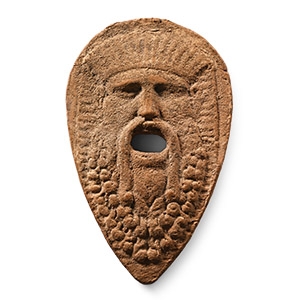
Romano-British Votive Terracotta Mask of Silenus
3rd century A.D.Sold for (Inc. bp): £1,820
A teardrop-shaped plaque bearing the head of a mature man in raised relief, his open mouth framed by long moustache and long, dressed beard, sunken small eyes and a prominent nose, wearing a striated headdress extending to the shoulders. 101 grams, 12.2 cm
Charles Winn (1795-1874), 8th Baronet of Nostell Priory, Yorkshire, UK; thence by descent. with Christie's, London, UK, 1998, no.319. with Galerie Rhéa, Zurich, Switzerland. This lot is accompanied by an illustrated lot declaration signed by the Head of the Antiquities Department, Dr Raffaele D'Amato. -
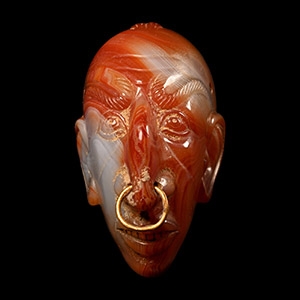
Roman Agate Head of a Grotesque
1st-2nd century A.D.Sold for (Inc. bp): £3,640
Carved in the round with carinated profile, grotesque head with pierced nose furnished with a small gold ring; later added nose piercing. 41.5 grams, 44 mm
From the 'S' collection, acquired 1970-1990s. The collection was seen and studied by W.G. Lambert, late Professor of Assyriology at the University of Birmingham, 1970-1993. This lot has been cleared against the Art Loss Register database, and is accompanied by an illustrated lot declaration signed by the Head of the Antiquities Department, Dr Raffaele D'Amato. -
.jpg)
Roman Bloodstone Intaglio with Horus, Osiris and Ouroboros
2nd-3rd century A.D.Sold for (Inc. bp): £4,160
Egyptizing intaglio representing the myth of Osiris, with the mummy of the god resting above the snake Ouroboros and surmounted by his son, the falcon god Horus, a star above. 1.31 grams, 17 mm
Giorgio Sangiorgi (1886-1965), Rome, acquired and brought to Switzerland, late 1930s; thence by continuous descent to the current owner. with Christie's Ancient Jewellery, New York, 6 December 2007, no.338. This lot has been checked against the Interpol Database of stolen works of art and is accompanied by a search certificate number no.12582-232140. This lot has been cleared against the Art Loss Register database, and is accompanied by an illustrated lot declaration signed by the Head of the Antiquities Department, Dr Raffaele D'Amato.
The image of Ouroboros (a snake eating its own tail) is usually associated with stars and Egyptian mythology as represented in Roman gnostic intaglios. Ouroboros is continuously re-birthing itself and depicted as a circle, representing eternity and the cyclical nature of things that start once they end. It is also the symbol of duality and dualising power.

