-
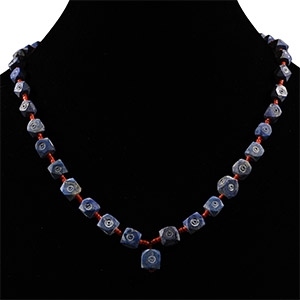
Bactrian Style Lapis Lazuli Bead Necklace String
20th century A.D.Sold for (Inc. bp): £33
Group of cornerless cube beads with incised ring-and-dot motif to each face. 40 grams, 41 cm
Ex London, UK, collection, 1990s. This lot has been cleared against the Art Loss Register database, and is accompanied by an illustrated lot declaration signed by the Head of the Antiquities Department, Dr Raffaele D'Amato. -
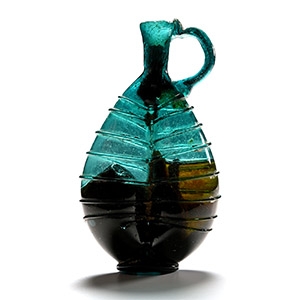
Western Asiatic Glass Ribbed Double Unguent with Contents
7th-8th century A.D.Sold for (Inc. bp): £2,340
Comprising two conjoined kidney-shaped cells decorated with applied trails, extending to a single short neck with everted rim, discoid foot to the base and an applied handle to the shoulder; containing free flowing liquid and congealed organic substance to both cells. 90 grams, 11.1 cm
with Christie's, London, Islamic Art, 16 October 2001, no.285. Private collection, Europe. This lot has been checked against the Interpol Database of stolen works of art and is accompanied by a search certificate number no.12432-226701. This lot has been cleared against the Art Loss Register database, and is accompanied by an illustrated lot declaration signed by the Head of the Antiquities Department, Dr Raffaele D'Amato.
Many objects of this type were made in Syrian and Mesopotamian workshops and under both Eastern Roman and Sassanid domination. The type was probably already produced in the workshops of the Roman Empire, but it lasted until the early Islamic Period. -
.jpg)
Western Asiatic Mixed Bead Necklace String
2nd-1st millennium B.C. and laterSold for (Inc. bp): £26
Restrung group of melon, biconvex, faceted and other beads in stone and ceramic. 28.5 grams, 35.5 cm
Ex London, UK, collection, 1990s. This lot has been cleared against the Art Loss Register database, and is accompanied by an illustrated lot declaration signed by the Head of the Antiquities Department, Dr Raffaele D'Amato. -
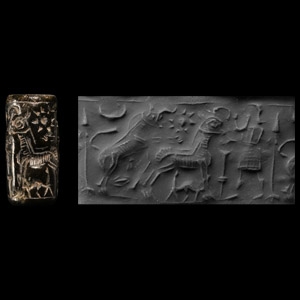
Neo-Assyrian Black Stone Cylinder Seal with Bull and Cow
Circa 900-700 B.C.Sold for (Inc. bp): £260
Accompanied by a copy of an old scholarly note, typed and signed by W.G. Lambert, late Professor of Assyriology, University of Birmingham, 1970-1993, which states: 'Cylinder Seal of Black Stone 22.5 x 12mm. The design, which is put between upper and lower rulings, shows a mounting a cow from behind as it suckles its young. A farmer stands in front holding out his hands. In the sky there is a lunar crescent and a solar disc. The stylus, symbol of the god Nabû, appears within the scene, and the spade of Marduk serves as a terminal. This is a Neo-Assyrian seal, c. 900-700 B.C. It is a rare type of Neo-Assyrian seal, but is somewhat worn.'; supplied with a museum-quality impression. 5.28 grams, 23 mm
From the private collection of a North American lady, formed 1970s-early 1990s, with collection reference no.590/1. Accompanied by a copy of a scholarly note, typed and signed by Professor Wilfrid George Lambert. This lot has been cleared against the Art Loss Register database, and is accompanied by an illustrated lot declaration signed by the Head of the Antiquities Department, Dr Raffaele D'Amato. -
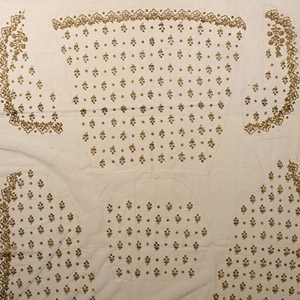
Western Asiatic Textile with Gold Embroidery
19th-20th century A.D.Sold for (Inc. bp): £46
A large netted textile with delicate embroidery in silver and gold thread, traced outlines for a garment surrounding each embroidery group. 474 grams, 133 x 230 cm
Private collection of a London gentleman, acquired between 1965-2020. This lot has been cleared against the Art Loss Register database, and is accompanied by an illustrated lot declaration signed by the Head of the Antiquities Department, Dr Raffaele D'Amato. -
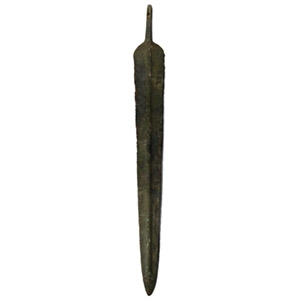
Very Large Luristan Bronze Sword
Early 1st millennium B.C.Sold for (Inc. bp): £157
Tapering leaf-shaped blade with a raised midrib developing to a short rectangular-section tang, pierced at the end. 482 grams, 49 cm
Ex London art market, 1980-1990s. This lot has been cleared against the Art Loss Register database, and is accompanied by an illustrated lot declaration signed by the Head of the Antiquities Department, Dr Raffaele D'Amato.
The Luri people produced a quantity of fine metalwork, which according to Dr. Khorasani, could be due to a settled period which arose as a result of the defeat of the Elamites by the Babylonians, leaving the Luristani people in relative peace for a period of time after 1200 BC. According to Khorasani 'A culture of innovation and experimentation flourished, and the repertoire of the Luristan smiths expanded in the period between 1150-1050 B.C.' -
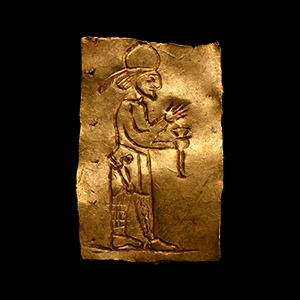
Parthian Gold Plaque with Engraved Figure
2nd-3rd century A.D. or laterSold for (Inc. bp): £845
Rectangular in plan with incised profile figure wearing a knee-length tunic and coiled leggings, a bulbous hat, holding a chalice in one hand; tooling marks to rear edge. 4.26 grams, 32 mm
Acquired in the 1980s. Ex Mayfair gallery, London, UK. Private collection, London. This lot has been cleared against the Art Loss Register database, and is accompanied by an illustrated lot declaration signed by the Head of the Antiquities Department, Dr Raffaele D'Amato. -
.jpg)
Western Asiatic Silver-Coloured Metal Bead Group
Circa 18th-19th century A.D.Sold for (Inc. bp): £20
Comprising eleven oval beads with central filigree collar and beaded collar to each end. 42 grams total, 20-21 mm
Ex collection of a late London, UK, collector, 1970s. This lot has been cleared against the Art Loss Register database, and is accompanied by an illustrated lot declaration signed by the Head of the Antiquities Department, Dr Raffaele D'Amato. -
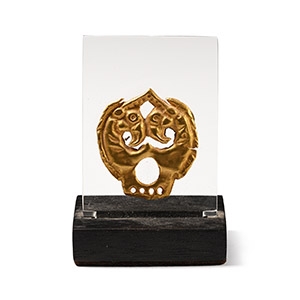
Western Asiatic Gold Appliqué with Gryphon Heads
8th-7th century B.C.Sold for (Inc. bp): £364
D-shaped with openwork and repoussé design of opposed gryphons; mounted on a custom-made stand. 25.61 grams total, head: 30 mm
Acquired before 2000. Ex Mayfair, London, UK, collection reference no.172. Private collection, London, UK. This lot has been cleared against the Art Loss Register database, and is accompanied by an illustrated lot declaration signed by the Head of the Antiquities Department, Dr Raffaele D'Amato. -
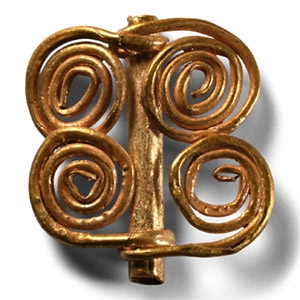
Mesopotamian Multi Spiral Gold Pendant Bead
2nd-1st millennium B.C.Sold for (Inc. bp): £208
Comprising a tubular body with a pair of applied wire spirals to each side. 0.31 grams, 11 mm
Ex property of a late Japanese collector, 1970-2000s. This lot has been cleared against the Art Loss Register database, and is accompanied by an illustrated lot declaration signed by the Head of the Antiquities Department, Dr Raffaele D'Amato. -
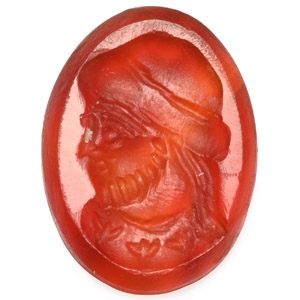
Sasanian Carnelian Gemstone with Portrait
4th-5th century A.D.Sold for (Inc. bp): £143
Oval-shaped with an engraved profile bust of a bearded man wearing a headdress. 0.49 grams, 12 mm
with a London, UK gallery 1971-early 2000s. Private collection, London. This lot has been cleared against the Art Loss Register database, and is accompanied by an illustrated lot declaration signed by the Head of the Antiquities Department, Dr Raffaele D'Amato. -
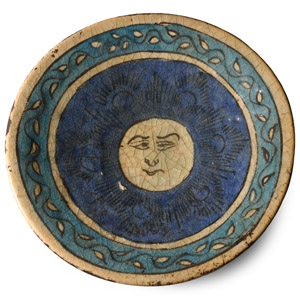
Qajar Glazed Dish with Face
1796-1925 A.D.Sold for (Inc. bp): £260
Cream-glazed with low basal ring, obverse with cerulean ring enclosing a running tendril with reserved leaves, inner dark blue panel with radiating starburst, centre a reserved disc with human mask. 619 grams, 22.5 cm
Acquired from old English collections via the UK art market since the mid 1970s. From the private collection of Peran Dachinger, thence by descent. From the family collection of a Maida Vale lady, UK. This lot has been cleared against the Art Loss Register database, and is accompanied by an illustrated lot declaration signed by the Head of the Antiquities Department, Dr Raffaele D'Amato.

