-
.jpg)
Roman Mosaic with Floral Motif
4th century A.D.Sold for (Inc. bp): £6,500
A large rectangular polychrome floor mosaic fragment with opposing large flowers and roundels; set in a modern matrix. 38.6 kg, 168 x 50 cm
Embedded in the floor of a reputable jewellery shop in Zurich, installed by the owner in the late 1970s to early 1980s. with Galerie Rhéa, Zurich, Switzerland. This lot has been checked against the Interpol Database of stolen works of art and is accompanied by a search certificate number no.12676-236416. This lot has been cleared against the Art Loss Register database, and is accompanied by an illustrated lot declaration signed by the Head of the Antiquities Department, Dr Raffaele D'Amato. -
.jpg)
Roman Mosaic with Pomegranate
4th century A.D.Sold for (Inc. bp): £2,340
Rectangular fragment with a central pomegranate motif on black background surrounded by a stylised dolphin or a fish; set in a modern matrix. 26 kg, 76 x 76 cm
Embedded in the floor of a reputable jewellery shop in Zurich, installed by the owner in the late 1970s to early 1980s. with Galerie Rhéa, Zurich, Switzerland. This lot has been checked against the Interpol Database of stolen works of art and is accompanied by a search certificate number no.12677-236415. This lot has been cleared against the Art Loss Register database, and is accompanied by an illustrated lot declaration signed by the Head of the Antiquities Department, Dr Raffaele D'Amato. -
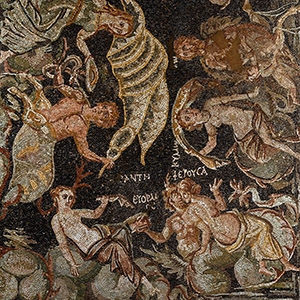
Roman Mosaic Depicting Nereids and Tritons
Circa 270-350 A.D.Sold for (Inc. bp): £65,000
At the centre of the mosaic a company of three Nereid-nymphs riding across the sea on the back of two fish-tailed Tritons accompanied by a putto; the Nereids covered only by a red-mauve and cerulean cloak (chlamys) with yellow edges, draped around their legs; one of them waving a garment over her head; fourth Nereid dressed in a long green-blue chiton, with yellow collar and fastened at the waist by a red and yellow belt, offering a phiale to a centaur and waving a long cerulean cloak over her head, the centaur grasping the hem of her cloak and holding a snake in his right hand; the fish tails of the Tritons unfolding in elegant spirals on the seabed; Greek inscriptions with the names of the Nereids ΦΕΡΟΙϹΑ (= Ferousa, the ‘carrier’), ΚΥΜω (Kymo, goddess of the waves), (ΕΥΚ) ΡΑΝΤΗ (Eukrante, the Nereid of the successful voyages and fishing) and probably the name of one of the Triton, ΕΥΟΡΜΟΣ (Euormos, ‘safe harbour for mooring’) or a Roman Age contraction of the name of a fourth Nereid, Euarne, 'the well lambed'; some restoration. 53.1 kg, 162 x 151 cm
From the private collection of V. Colin, Belgium, 1960s. with Ariadne Galleries Inc, New York, 2008. Accompanied by a copy of an Art Loss Register certificate no.S00017755, dated 11 September 2008. Accompanied by an academic report by Dr Raffaele D'Amato. Accompanied by a copy of the Art & Antiques article. This lot has been checked against the Interpol Database of stolen works of art and is accompanied by a search certificate number no.12605-230246. This lot has been cleared against the Art Loss Register database, and is accompanied by an illustrated lot declaration signed by the Head of the Antiquities Department, Dr Raffaele D'Amato.
The thiasos theme with marine cycles was very popular in the Hellenistic and Roman times. In the late Roman period, especially in the Greek speaking Eastern provinces of the Empire, the mythological subjects of heroes and goddesses multiplied in the rich villas and public buildings, like basilicas and thermae (public baths). -
.jpg)
Roman Gold Necklace Element and Earring Set
2nd century A.D.Sold for (Inc. bp): £1,895
Comprising a matching pair of earrings, each composed of a hollow crescentic body tapering to slender coiled wire terminals, a suspension loop to each shoulder, large tear-shaped cell to front with granulated border, set with a polished garnet cabochon, gold bulbs below in the form of a bunch of grapes, adorned with smaller granules and three cells set with polished garnet cabochons; the necklace elements comprising graduated beads, alternating between roughly spherical polished garnets and sheet-gold beads of various types including gusseted, biconical and tubular, two floral filigree pendants flanking a central pendant ornamented with 'plaited' and plain filigree wire with granules to the outside, finial of trefoil bulbs, central corrugated cell set with a polished garnet cabochon; mounted on a custom-made perspex display base. 435 grams total, display stand: 30 x 23.5 cm (earrings: 38 mm each)
Ex private European collection, 1970s. with Genève Enchères, 14 December 2017, no.999. Accompanied by an academic report by Dr Raffaele D’Amato. This lot has been checked against the Interpol Database of stolen works of art and is accompanied by search certificate number no.11584-199015. This lot has been cleared against the Art Loss Register database, and is accompanied by an illustrated lot declaration signed by the Head of the Antiquities Department, Dr Raffaele D'Amato.
Beryls, used as small pendants, and not placed horizontally, characterised Roman necklaces of 2nd century A.D. A typical example is the necklace found in the grave of Crepereia Tryphaena. The contents of the grave are dated to the Antonine age based on the sarcophagus, the inscription, and the hairstyle of the doll it contains. -
.jpg)
Roman Gold Amuletic Case Pendant with Menorah
1st-4th century A.D.Sold for (Inc. bp): £5,460
Comprising a barrel-shaped hematite body with gold-sheet caps to each end with suspension loop above and a central band with similar loop above; the central band with an applied menorah to the centre, lulav, etrog, shofar and incense shovel on the sides; lower edge with small suspension attachments with a horizontal gold wire holding three pomegranate pendants and two amethyst beads, one of the pomegranates retaining its original pearl. 9.67 grams, 37 mm
Private collection, kept in Europe since the 1960s. Accompanied by a positive scientific statement from Striptwist Limited, a London-based company run by historical precious metal specialist Dr Jack Ogden, reference number 190901. This lot has been checked against the Interpol Database of stolen works of art and is accompanied by a search certificate number no.12679-235461. This lot has been cleared against the Art Loss Register database, and is accompanied by an illustrated lot declaration signed by the Head of the Antiquities Department, Dr Raffaele D'Amato. -
.jpg)
Roman Gold Amulet in the Shape of a Phallus
1st-2nd century A.D. or laterSold for (Inc. bp): £2,340
Amuletic pendant of a phallus with testes, square suspension loop to the rear. 8.35 grams, 23 mm
Acquired in the mid 1980s-1990s. Private collection, Switzerland, thence by descent. Private collection, since the late 1990s. This lot has been checked against the Interpol Database of stolen works of art and is accompanied by a search certificate no.12593-232171. This lot has been cleared against the Art Loss Register database, and is accompanied by an illustrated lot declaration signed by the Head of the Antiquities Department, Dr Raffaele D'Amato.
Phallic amulets, symbols of fertility, prosperity and happiness in the Roman world, are represented by numerous examples in most museums and in many private collections. The typologies are various within the four main series: a) phallus seen from the front; b) phallus seen from the side; c) double phallus and d) triple phallus. -
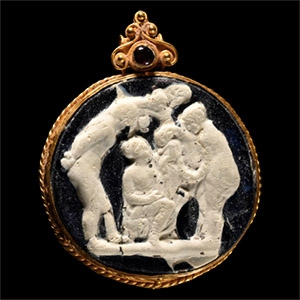
Roman Glass Cameo Tondo with Baby Dionysos, Raised by Nymphs on Mount Nysa, in Gold Pendant Setting
Late 1st century B.C.-1st century A.D. and laterSold for (Inc. bp): £2,600
Blue glass disc with white glass past overlay imitating onyx, showing the nurturing of baby Dionysos, raised by nymphs on Mount Nysa: the infant god standing on the lap of a nymph, another standing right, Silenus standing left and leaning in on the scene, a tree in the background; set into a later gold setting with applied wire scrolls and tendrils on the sides with an applied filigree band below, wide loop above fronted by an applied decorative plaque set with a garnet cabochon. 21.36 grams, 48 mm
Private collection of a London gentleman, acquired between 1965-2020. Accompanied by an academic report by Dr Ittai Gradel. This lot has been checked against the Interpol Database of stolen works of art and is accompanied by a search certificate number no.12680-235465. This lot has been cleared against the Art Loss Register database, and is accompanied by an illustrated lot declaration signed by the Head of the Antiquities Department, Dr Raffaele D'Amato.
Dr Ittai Gradel writes: 'Cameos with Dionysiac motifs were especially popular in the mid- to later first century BC, and the prolific workshop of the gem carver Sostratos specialized in such motifs (see I. Gradel, ‘A tale of two fragments: a Sostratos cameo reconstructed’, The Burlington Magazine 162 (March 2020), 181-87). The original, lost stone cameo, from which this glass version was cast, belongs in this period and ambience. The glass cast was presumably contemporary with the original cameo, possibly slightly later, but the glass is in any case clearly ancient (corrosion, iridescence).' -
.jpg)
Late Roman Gold Earrings with Pearl Drops
4th-6th century A.D.Sold for (Inc. bp): £819
Matched pair, each a crescent hoop with four gold chain dangles with pearl finials. 13.44 grams total, 56 mm each
Ex Gorny & Mosch, Munich, Germany, December 2010. From the collection of a London, UK, gentleman. This lot is accompanied by an illustrated lot declaration signed by the Head of the Antiquities Department, Dr Raffaele D'Amato. -
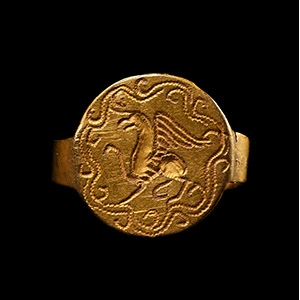
Late Roman Gold Ring with Engraved Bezel
Iberia, 4th-7th century A.D.Sold for (Inc. bp): £1,580
Flat-section hoop and disc bezel, scrolled tendril border and stylised gryphon. 1.78 grams, 17.72 mm overall, 15.63 mm internal diameter (approximate size British H, USA 3 3/4, Europe 6.18, Japan 6)
Acquired in the mid 1980s-1990s. Private collection, Switzerland, thence by descent. Private collection, since the late 1990s. This lot has been cleared against the Art Loss Register database, and is accompanied by an illustrated lot declaration signed by the Head of the Antiquities Department, Dr Raffaele D'Amato. -
.jpg)
Roman Gold Ring with Spes Gemstone
1st century A.D.Sold for (Inc. bp): £780
Slender hoop and integral lobe bezel inset intaglio standing robed figure of Spes holding a wreath. 2.04 grams, 17.57 mm overall, 15.02 mm internal diameter (approximate size British F, USA 2 3/4, Europe 3.67, Japan 3)
Private Swiss collection. Acquired in 1998. This lot is accompanied by an illustrated lot declaration signed by the Head of the Antiquities Department, Dr Raffaele D'Amato. -
.jpg)
Roman Gold Ring with Goddess Fortuna Gemstone
2nd-3rd century A.D.Sold for (Inc. bp): £780
Keeled hoop with angled shoulders, oval bezel set with a red carnelian intaglio bearing the image of the goddess Fortuna with her hands raised. 6.65 grams, 25.00 mm overall, 19.90 x 16.42 mm internal diameter (approximate size British N 1/2, USA 6 3/4, Europe 14.35, Japan 13)
Ex German art market, 2000s. Acquired from an EU collector living in London. From the collection of a Surrey, UK, gentleman. This lot is accompanied by an illustrated lot declaration signed by the Head of the Antiquities Department, Dr Raffaele D'Amato. -
.jpg)
Roman Gold Ring with Eros Gemstone
1st-2nd century A.D.Sold for (Inc. bp): £1,105
Hollow-formed shank, integral plaque with inset glass disc, low-relief Eros face in three-quarter view. 2.35 grams, 21.19 mm overall, 15.00 mm internal diameter (approximate size British D 1/2, USA 2, Europe 1.78, Japan 1)
Acquired in 1992. Private collection, Switzerland, thence by descent. Private collection, since the late 1990s. This lot is accompanied by an illustrated lot declaration signed by the Head of the Antiquities Department, Dr Raffaele D'Amato.

