-
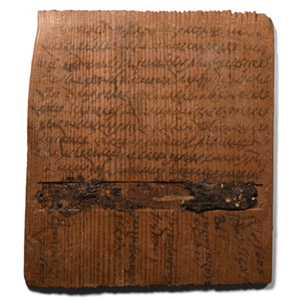
Dated Roman Inked Reused Wooden Wax Tablet by Julius Maianus
328 A.D.Sold for (Inc. bp): £8,775
Well preserved rectangular, probably cedarwood tablet with a groove (sulcus) and inked text to one face, two small holes and remains of wax within the sulcus; five personal signatures of witnesses above the sulcus, the text of the document starts with the date: in the year after the consulate of Flavius Constantius and Valerius Maximus (= AD 328), the following text regards testaments kept by Julius Maianus who is called depositarius, in the following lines the textual style is very short and several times verbs seem to be missing, therefore, the document probably was some kind of report or protocol, we are lacking parallels of similar documents, which makes this tablet unique and important. 32 grams, 14.5 x 13 cm
Acquired by Albert Sfez in the early 1950s. Formerly the property of Monsieur Alain Sfez, a Belgium collector; acquired by gift from his father Albert Sfez, in 1965. Acquired by a London dealer in 1973. From an important London collection since 1975; thence by descent. Accompanied by a copy of a four page illustrated academic report by Professor Dr. phil. Peter Rothenhöfer. This lot has been checked against the Interpol Database of stolen works of art and is accompanied by a search certificate number no.12672-230807. This lot has been cleared against the Art Loss Register database, and is accompanied by an illustrated lot declaration signed by the Head of the Antiquities Department, Dr Raffaele D'Amato. -
.jpg)
Roman Lead Curse Tablet Targeting a Legionary Commander and His Military Unit
Late 1st century A.D.Sold for (Inc. bp): £1,690
The names of high-ranking officers of a Roman legion engraved in two columns in retrograde script, inter alia the Senatorial Commander of a Roman Legion (legatus legionis), two Tribunes and several Centurions being cursed; with holes to fix it to an object with nails, both being magical practices of antiquity aiming for the malediction of enemies; a unique and important document; it has been proposed to identify the legate with Q. Pomponius Rufus, consul in the year A.D. 95. 151 grams total, 87 mm each
Private collection of the gentleman, J.L. Fernández, Switzerland, before 2000. From the private academic collection of Professor P.M.A.R. Accompanied by a copy of the academic paper Rothenhoefer, P., Römische Offiziere auf einer tabella defixionum. Ein außergewöhnliches Dokument magischen Schadenzaubers gegen eine Legionskommandeur und weitere Mitglieder des Offizierskorps, Epigraphica 78, 2016, pp.235-251, where this unique curse tablet is published. This lot is accompanied by an illustrated lot declaration signed by the Head of the Antiquities Department, Dr Raffaele D'Amato. -
.jpg)
Two Roman Sandstone Architectural Frieze Sections
Circa 1st century B.C.-1st century A.D.Sold for (Inc. bp): £6,435
Each rectangular with raised upper lip and a raised decorative frieze with rosettes and a bull's head (bucranium) separated by triple pilasters. 76.2 kg total, 76.5 cm each
with Georges Joseph Demotte (1877-1923) and Andrée Macé (1918-2000), Belgium and New York. Collection Demotte/Andrée Macé; Jean-Claude Renard Auction, Suresnes, 3 September 2013, no.87. with Galerie Chenel, Paris, 2021. This lot has been checked against the Interpol Database of stolen works of art and is accompanied by a search certificate number no.12624-236336. This lot has been cleared against the Art Loss Register database, and is accompanied by an illustrated lot declaration signed by the Head of the Antiquities Department, Dr Raffaele D'Amato.
In classical Rome bovine skulls decorated the friezes of entablatures. Often, they were positioned in the metopes of Doric entablatures, but also in Ionic and Corinthian friezes, sometimes connected by floral or drapery swags. The architectural term for these skulls is bucranium (pl. bucrania or bucranes), a word derived from the Latin bos, meaning ox or cow, and cranium, the Medieval Latin term for a skull. The skulls allude to the ancient Greek and Roman ceremonies of sacrifice. -
.jpg)
Roman Marble Statue Fragment with Dog
2nd-3rd century A.D.Sold for (Inc. bp): £12,350
Trapezoidal in plan base fragment with figures carved in the round: tree with bands of horizontal ribbing; left foot, ankle and calf of a male wearing open-toed sandal and military-style boot, the upper part decorated with the skin of a lion cub; body of a dog sitting at heel beside the tree. 13.9 kg, base: 30 cm long
Acquired in the mid 1980s-1990s. Private collection, Switzerland, thence by descent. Private collection, since the late 1990s. Accompanied by an academic report by Dr Raffaele D’Amato. This lot has been checked against the Interpol Database of stolen works of art and is accompanied by search certificate number no.12578-232182. This lot has been cleared against the Art Loss Register database, and is accompanied by an illustrated lot declaration signed by the Head of the Antiquities Department, Dr Raffaele D'Amato.
The military boot cothurnus worn here by a hunter or a military commander, was widely used by commanders of the Roman army, and sometimes by actors playing military heroes. Officers wore splendid closed cothurni of various colours, like those realised in blue leather and worn by an officer represented on a fresco from Stabiae (D’Amato-Sumner, 2009, p.13). -
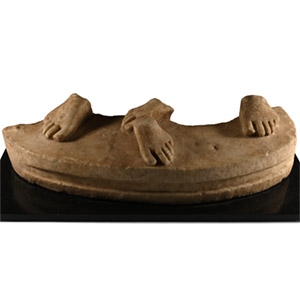
Roman Marble Statue Base with Feet
1st century A.D.Sold for (Inc. bp): £2,600
Fragment of an elliptical base for a statuary group, with gusset to the forward edge; upper face with two pairs of bare human feet modelled in the half-round, with the left foot of the right pair placed before the right foot of the other pair, suggesting a family group (e.g. parents with baby in their arms) standing very close to each other; mounted on a custom-made stand. 6.2 kg total, 38.5 cm including stand
Pierre Sciclounoff collection, acquired in 1970. Byron Zoumboulakis collection, acquired in 1986. Accompanied by a copy of an Art Loss Register certificate, dated 11 August 2004. This lot has been checked against the Interpol Database of stolen works of art and is accompanied by a search certificate number no.12673-234639. This lot has been cleared against the Art Loss Register database, and is accompanied by an illustrated lot declaration signed by the Head of the Antiquities Department, Dr Raffaele D'Amato.
Pierre Sciclounoff was a noted 20th century collector with a particular interest in classical and Near Eastern antiquities. His collection was widely regarded for its scholarly depth and was formed during a period of active collecting in Europe during the post-war decades. Byron Zoumboulakis, a prominent Greek collector and art dealer, is known for his extensive contributions to the art world through the Zoumboulakis Galleries in Athens, established by his family. His collection spans antiquities, modern, and contemporary art, and he has played a key role in promoting cultural heritage in Greece. -
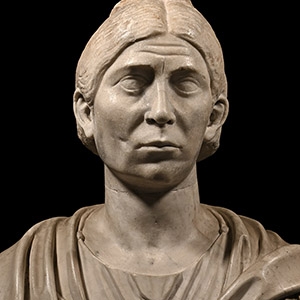
Lifesize Roman Marble Portrait Head of a Patrician Woman
3rd century A.D.Sold for (Inc. bp): £28,600
Carved in fine-grained marble, the head depicting a matron of the patrician class with angular features, pronounced cheekbones and a softly wrinkled brow; her lips finely curved and gently closed, the heavy-lidded eyes incised with irises and drilled pupils, lending an expression of composed attentiveness; the hair parted centrally, arranged in thick curls drawn behind the prominent ears, coiled into a low chignon at the nape and continued as a braided tail over the crown, a coiffure closely associated with the mid-3rd century A.D.; attached to an antique bust, some restoration. 49 kg, 76.5 cm high
French private collection, 18th century. with Mercier & Cie, Lille, France, 6 October 2019, no.199. Private collection, Europe. Accompanied by a copy of French passport no.217723, dated 27 February 2020. This lot has been checked against the Interpol Database of stolen works of art and is accompanied by a search certificate number no.12674-236274. This lot has been cleared against the Art Loss Register database, and is accompanied by an illustrated lot declaration signed by the Head of the Antiquities Department, Dr Raffaele D'Amato.
The present work exhibits a distinctive coiffure that gained prominence among aristocratic Roman women during the mid-3rd century A.D., most notably under the empresses Furia Sabinia Tranquillina, consort of Gordian III, and Otacilia Severa, wife of Philippus Arabs. This elaborate arrangement - central parting, voluminous curls, and a braided crown - is a key chronological indicator, allowing the portrait to be securely dated to this period. The head is mounted on an 18th century bust inscribed 'IVLIA MAESA'. While this identification reflects an earlier attribution, current stylistic analysis suggests a slightly later date, aligning the portrait more plausibly with the generation following Julia Maesa’s death in A.D. 224/225. -
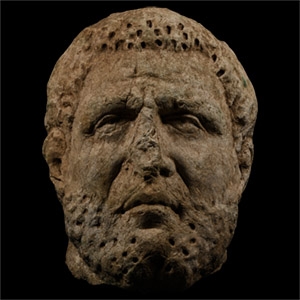
Over Life-Sized Roman Marble Head of a Tetrarch
3rd-4th century A.D.Sold for (Inc. bp): £9,100
Carved in the round with stern facial features, short curly hair and beard with light moustache; the broad brow modelled with characterful creasing, the eyebrows slightly drooping and eyes deep-set, the nose angular and small pinched mouth; possibly an emperor or a tetrarch; possibly retouched in places. 26.5 kg, 27 cm high
Private collection, Europe. Acquired on the European art market, 2002. Private Swiss collection. Accompanied by an academic report by Dr Raffaele D’Amato. This lot has been checked against the Interpol Database of stolen works of art and is accompanied by a search certificate number no.12574-232106. This lot has been cleared against the Art Loss Register database, and is accompanied by an illustrated lot declaration signed by the Head of the Antiquities Department, Dr Raffaele D'Amato.
The portrait, for style and artistic structure, can be compared with the ones of Diocletian and his colleague Maximianus Herculius, and with most of the emperors of the so-called Tetrarchic Period. Like in the portrait of Diocletian and Maximianus, this military man is portrayed with bags under his eyes and with a harsh facial expression. The wrinkles on his forehead and around his mouth show the feelings of a man engaged in difficult times. Stylistically the face presents affinity with the portrait of Diocletian or Maximianus Herculius at the Uffizi (inv.242), some elements also recall the portrait of Decius at the Musei Capitolini (inv.482). We can therefore date the artwork in the period between the second half of the 3rd century and the first decade of the 4th century A.D. -
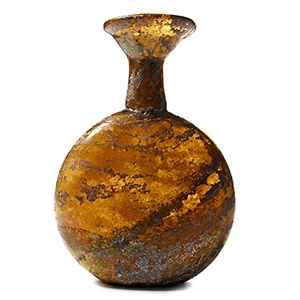
Large Roman Amber Glass Pilgrim's Flask
2nd-3rd century A.D.Sold for (Inc. bp): £910
Comprising a flat discoid body and trumpet-shaped neck with rolled rim. 108 grams, 15.2 cm high
Ex London gallery, UK, 1986. Ex private UK collection. This lot is accompanied by an illustrated lot declaration signed by the Head of the Antiquities Department, Dr Raffaele D'Amato. -
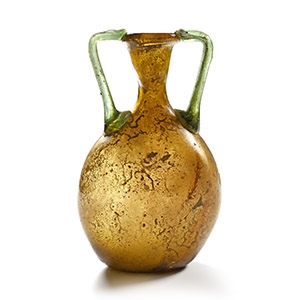
Roman Honey and Green Double-Handled Glass Pilgrim's Flask
1st-4th century A.D.Sold for (Inc. bp): £1,170
Amphoriskos with flat disc-shaped body, tubular neck with flared rim, two lateral knee-shaped handles to the shoulder. 105 grams, 13.9 cm
From an important London collection of glass, 1990s. This lot is accompanied by an illustrated lot declaration signed by the Head of the Antiquities Department, Dr Raffaele D'Amato. -
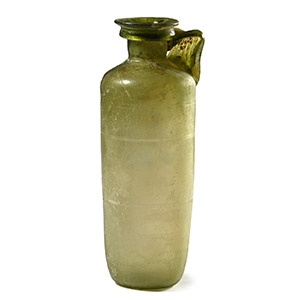
Large Roman Glass Bottle with Wheel-Cut Lines
1st century A.D.Sold for (Inc. bp): £780
With dimple base, gently flared body, sloping shoulder and folded rim, ribbed and angled handle; five circumferential bands of wheel-cut line detailing. 204 grams, 20 cm
From a private Scottish collection pre 1980, by descent. This lot is accompanied by an illustrated lot declaration signed by the Head of the Antiquities Department, Dr Raffaele D'Amato. -
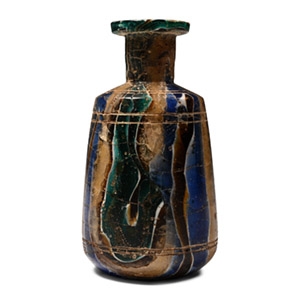
Roman Marbled Gold in Glass Bottle
Early 1st century A.D.Sold for (Inc. bp): £19,500
Cylindrical polychrome body tapering towards the angled shoulder, tubular neck and flat rim; circumferential lathe-cut lines to the body, base and rim. 85 grams, 89 mm
Acquired in the mid 1980s-1990s. Private collection, Switzerland, thence by descent. Private collection, since the late 1990s. Accompanied by an academic report by Dr Raffaele D’Amato. This lot has been checked against the Interpol Database of stolen works of art and is accompanied by a search certificate number no.12613-234626. This lot has been cleared against the Art Loss Register database, and is accompanied by an illustrated lot declaration signed by the Head of the Antiquities Department, Dr Raffaele D'Amato.
Small bottles, lidded pyxides (boxes) of this type and luxury gold-band glass were made during the Julio-Claudian period. The production and widespread use of tableware in marbled glass in the Western empire took place between the end of the age of Augustus and the beginning of the age of Tiberius (circa 10-16 A.D.), reaching its peak in the period of Nero (54-68 A.D.). -
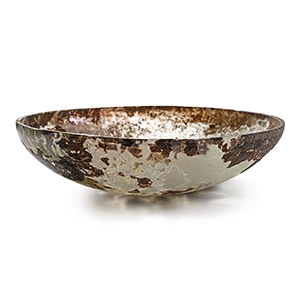
Roman Cast Glass Dish
1st century A.D.Sold for (Inc. bp): £1,040
With shallow convex body and slightly inturned rim; iridescent surface. 161 grams, 16.5 cm
From an important London collection of glass, 1990s. This lot is accompanied by an illustrated lot declaration signed by the Head of the Antiquities Department, Dr Raffaele D'Amato.

