-
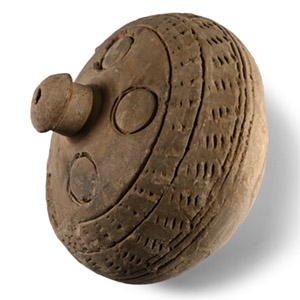
Byzantine 'Greek Fire' Ceramic Fire Bomb or Hand Grenade
9th-11th century A.D.Sold for (Inc. bp): £182
Piriform in profile with narrow point and domed mouth; impressed annulets surrounding the neck, two wide circumferential bands of hatching to the shoulder; intended to be filled with explosive liquid and wick, used as a hand grenade. 992 grams, 13.6 cm wide
From an important specialist collection, London, UK, 1990s onwards. Accompanied by an academic paper by military specialist Dr Raffaele D'Amato, dated 15 July 2019 and titled 'Eastern Roman Empire - Greek Fire Bomb or Hand Grenade (μεσαίον kακάβιον) 9th-11th century AD'. This lot is accompanied by an illustrated lot declaration signed by the Head of the Antiquities Department, Dr Raffaele D'Amato.
Apart from the use of siphons or manual flame-throwers called cheirosiphona, special corps of Roman soldiers employed terracotta grenades, in the form of small jars, abundantly evidenced in archaeological excavations. They were called μεσαία kακαβιά or κυτροκακάβια where the former had a bulbous shape and the latter a more cylindrical form. -
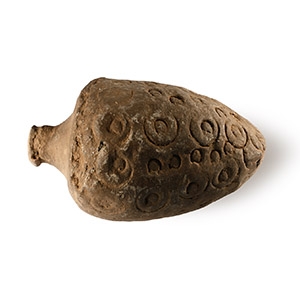
Byzantine 'Greek Fire' Ceramic Fire Bomb or Hand Grenade
9th-11th century A.D.Sold for (Inc. bp): £143
Piriform in profile with narrow point and domed mouth; the body decorated with annulets and concentric circles; intended to be filled with explosive liquid and a wick, and used as a hand grenade. 795 grams, 14.5 cm
From an important specialist collection, London, UK, 1990s onwards. Accompanied by an academic paper by military specialist Dr Raffaele D'Amato, dated 15 July 2019 and titled 'Eastern Roman Empire - Greek Fire Bomb or Hand Grenade (μεσαίον kακάβιον) 9th-11th century AD'. This lot is accompanied by an illustrated lot declaration signed by the Head of the Antiquities Department, Dr Raffaele D'Amato.
Apart from the use of siphons or manual flame-throwers called cheirosiphona, special corps of Roman soldiers employed terracotta grenades, in the form of small jars, abundantly evidenced in archaeological excavations. They were called μεσαία kακαβιά or κυτροκακάβια where the former had a bulbous shape and the latter a more cylindrical form. -
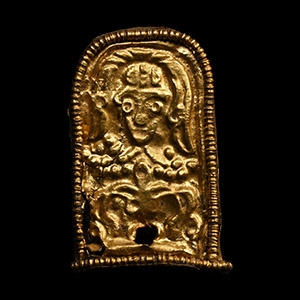
Byzantine Gold Strap End with Facing Figure
Circa 7th-8th century A.D.Sold for (Inc. bp): £315
The hollow-formed, tongue-shaped body adorned with a filigree border, repoussé figure with pellets on the torso and serpents framing the head; two ancient repairs to verso. 7.40 grams, 39 mm
Acquired 1990s-early 2000s. East Anglian private collection. This lot is accompanied by an illustrated lot declaration signed by the Head of the Antiquities Department, Dr Raffaele D'Amato.
The beautiful burials of horsemen found in the Avar necropolis of central Europe date to the last third of the 7th century A.D. and the early 8th century A.D. show wealth and pomp. This type of belt element, although present in the Avar graves, was probably produced in the workshops of the Eastern Roman Empire, from where they reached the Avar lands as imperial gifts or spoils of war. They could be simple fastenings for belts, or part of multiple belts, to which sabres and knives were attached, commonly used among Avars, Bulgars and Romans during the 6th -7th centuries A.D. -
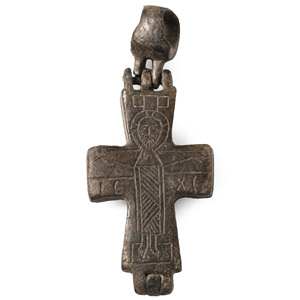
Byzantine Bronze Reliquary Cross Pendant
10th-12th century A.D.Sold for (Inc. bp): £169
Comprising two hinged plates with articulated loop above; obverse with an incised figure of Corpus Christi with inscription 'IC XC' beneath his arms. 15.7 grams, 57 mm
Ex German art market, 2000s. Acquired from an EU collector living in London. From the collection of a Surrey, UK, gentleman. This lot is accompanied by an illustrated lot declaration signed by the Head of the Antiquities Department, Dr Raffaele D'Amato. -
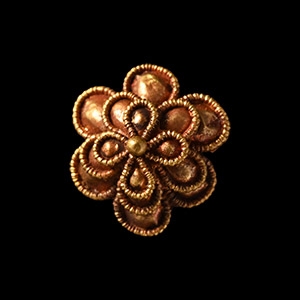
Byzantine Floral Gold Applique
Circa 6th-8th century A.D.Sold for (Inc. bp): £156
Formed as three-tiered flower with filigree wire framing the petals, applied pellet to the centre. 0.69 grams, 10 mm
Ex property of a late Japanese collector, 1970-2000s. This lot is accompanied by an illustrated lot declaration signed by the Head of the Antiquities Department, Dr Raffaele D'Amato. -
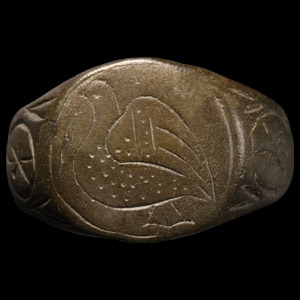
Byzantine Bronze Ring with Bird
14th-15th century A.D.Sold for (Inc. bp): £111
Flat-section hoop and a large discoid bezel with a stylised bird, possibly a dove, with its wings spread. 6.23 grams, 22.66 mm overall, 19.73 mm internal diameter (approximate size British T, USA 9 1/2, Europe 21.26, Japan 20)
Ex German art market, 2000s. Acquired from an EU collector living in London. From the collection of a Surrey, UK, gentleman. This lot is accompanied by an illustrated lot declaration signed by the Head of the Antiquities Department, Dr Raffaele D'Amato. -
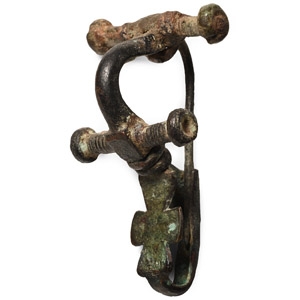
Byzantine Bronze Bow Brooch with Cross
6th-8th century A.D.Sold for (Inc. bp): £156
With deep bow flanked by two pairs of lateral disc-headed studs, cruciform foot returning to form the catch and with loop around the shank, spring and pin to reverse. 17 grams, 53 mm
Ex important German collection of brooches, 1980s. This lot is accompanied by an illustrated lot declaration signed by the Head of the Antiquities Department, Dr Raffaele D'Amato. -
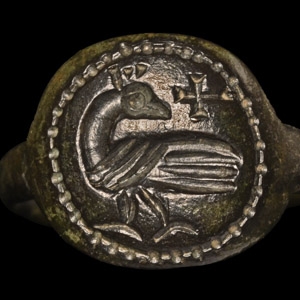
Byzantine Bronze Ring with Bird
6th-7th century A.D.Sold for (Inc. bp): £338
A slender hoop with discoid bezel decorated with a bird facing back, a cross above the back of the bird, pelletted border. 2.95 grams, 19.95 mm overall, 16.52 mm internal diameter (approximate size British K, USA 5 1/4, Europe 9.95, Japan 9)
Ex German art market, 2000s. Acquired from an EU collector living in London. From the collection of a Surrey, UK, gentleman. This lot is accompanied by an illustrated lot declaration signed by the Head of the Antiquities Department, Dr Raffaele D'Amato. -
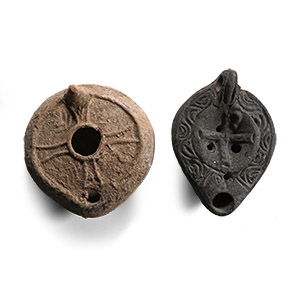
Byzantine Ceramic Oil Lamp Collection
5th-6th century A.D.Sold for (Inc. bp): £169
Comprising: a piriform oil lamp with short nozzle and ring handle, low discus with three filler holes and a Chi Rho motif, base fragmentary; a round lamp with a low-relief expanding cross on the discus, a palm branch to the top left quadrant, and the other three quadrants with different symbols, a cross beneath the nozzle with wavy lines circulating the low basal ring. 194 grams total, 9.5-10 cm
with Galerie Rhéa, Zurich, Switzerland. This lot is accompanied by an illustrated lot declaration signed by the Head of the Antiquities Department, Dr Raffaele D'Amato. -
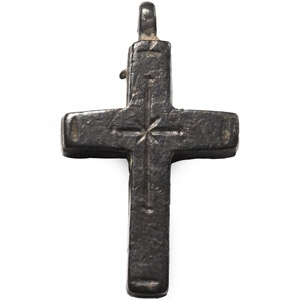
Byzantine Silver Reliquary Cross Pendant
14th-15th century A.D.Sold for (Inc. bp): £59
Composed of two pieces secured together by a rivet, incised cross motif to both faces. 5.15 grams, 30 mm
Ex German art market, 2000s. Acquired from an EU collector living in London. From the collection of a Surrey, UK, gentleman. This lot is accompanied by an illustrated lot declaration signed by the Head of the Antiquities Department, Dr Raffaele D'Amato. -
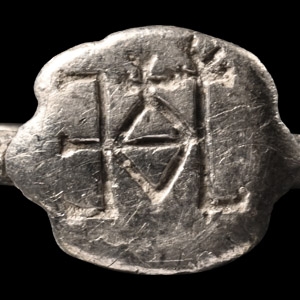
Byzantine Silver Ring with Monogram
6th-7th century A.D.Sold for (Inc. bp): £78
Comprising a round-section hoop with applied discoid bezel bearing a monogram. 2.39 grams, 21.45 mm overall, 17.95 mm internal diameter (approximate size British N 1/2, USA 6 3/4, Europe 14.35, Japan 13)
Ex German art market, 2000s. Acquired from an EU collector living in London. From the collection of a Surrey, UK, gentleman. This lot is accompanied by an illustrated lot declaration signed by the Head of the Antiquities Department, Dr Raffaele D'Amato. -
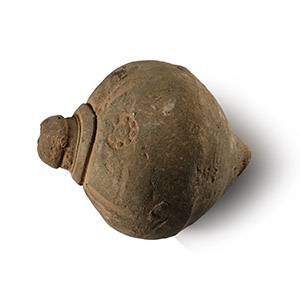
Byzantine 'Greek Fire' Ceramic Fire Bomb or Hand Grenade
9th-11th century A.D.Sold for (Inc. bp): £85
Piriform in profile with narrow point and domed mouth; rosettes separated by vertical lines to the upper body; intended to be filled with explosive liquid and a wick, and used as a hand grenade. 417 grams, 11 cm
From an important specialist collection, London, UK, 1990s onwards. Accompanied by an academic paper by military specialist Dr Raffaele D'Amato, dated 15 July 2019 and titled 'Eastern Roman Empire - Greek Fire Bomb or Hand Grenade (μεσαίον kακάβιον) 9th-11th century AD'. This lot is accompanied by an illustrated lot declaration signed by the Head of the Antiquities Department, Dr Raffaele D'Amato.
Apart from the use of siphons or manual flame-throwers called cheirosiphona, special corps of Roman soldiers employed terracotta grenades, in the form of small jars, abundantly evidenced in archaeological excavations. They were called μεσαία kακαβιά or κυτροκακάβια where the former had a bulbous shape and the latter a more cylindrical form.

