-
![Archaeological Books - British Museum - Anglo-Saxon and Early Iron Age Antiquities [2]](https://timelineauctions.com/upload/images/items/small/161926-s(1).jpg)
Archaeological Books - British Museum - Anglo-Saxon and Early Iron Age Antiquities [2]
Published 1994 and 1994 ADSold for (Inc. bp): £7
Smith, R. A., British Museum Guide to Anglo-Saxon Antiquities, Anglia, 1993 (reprint of 1923 edition), hardback with dustwrapper; well illustrated; Smith, R. A., British Museum Guide to Early Iron Age Antiquities, Anglia, 1994 (reprint of 1925 edition), hardback with dustwrapper; well illustrated. 887 grams total, 22.5 x 14 cm each
Near as new. -
![Benets Artefacts Books and Coins of England [4]](https://timelineauctions.com/upload/images/items/small/228391-s.jpg)
Benet's Artefacts Books and Coins of England [4]
2015-2021 A.D.Sold for (Inc. bp): £124
Comprising: Hammond, B., Benet's, Medieval Artefacts of England and the United Kingdom, 2015; Hammond, B., Benet's, Roman Artefacts of England and the United Kingdom, 2016; Hammond, A., Benet's Artefacts of England and the United Kingdom, Fourth Edition, 2021; Coins of England & The United Kingdom, Pre-Decimal Issues and Decimal Issues, 2017. 4.75 kg total, 22.2 x 14.5 cm each
Property of a UK gallery. -
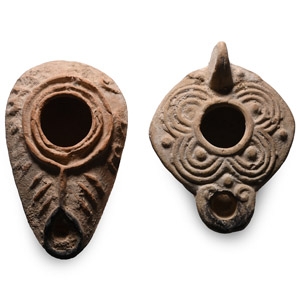
Roman and Byzantine Ceramic Oil Lamp Collection
4th-7th century A.D.Sold for (Inc. bp): £117
Comprising: a squat lamp with short nozzle, raised scrolls surrounding the hole, raised four-petalled flower motif surrounding the filler hole with raised bosses, the base with concentric circles and a maker's mark; a slipper-shaped lamp with sharply raised linear decoration and Greek inscription on the upper body. 173 grams total, 9.2-10.4 cm
with Galerie Rhéa, Zurich, Switzerland. This lot is accompanied by an illustrated lot declaration signed by the Head of the Antiquities Department, Dr Raffaele D'Amato. -
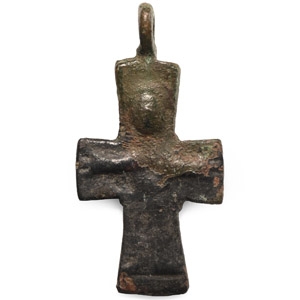
Byzantine Bronze Cross Pendant
10th-12th century A.D.Sold for (Inc. bp): £59
With low-relief Corpus Christi on the obverse; integral suspension loop. 4.85 grams, 39 mm
Ex German art market, 2000s. Acquired from an EU collector living in London. From the collection of a Surrey, UK, gentleman. This lot is accompanied by an illustrated lot declaration signed by the Head of the Antiquities Department, Dr Raffaele D'Amato. -
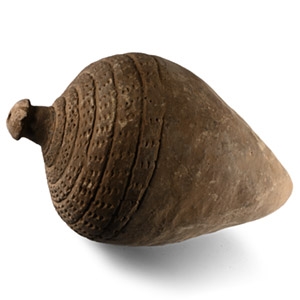
Byzantine 'Greek Fire' Ceramic Fire Bomb or Hand Grenade
9th-11th century A.D.Sold for (Inc. bp): £124
Piriform in profile with narrow point and domed mouth; concentric circles with regularly arranged pointillé decoration to the upper body, intended to be filled with explosive liquid and wick, used as a hand grenade. 1.25 kg, 21.2 cm
From an important specialist collection, London, UK, 1990s onwards. Accompanied by an academic paper by military specialist Dr Raffaele D'Amato, dated 15 July 2019 and titled 'Eastern Roman Empire - Greek Fire Bomb or Hand Grenade (μεσαίον kακάβιον) 9th-11th century AD'. This lot is accompanied by an illustrated lot declaration signed by the Head of the Antiquities Department, Dr Raffaele D'Amato.
Apart from the use of siphons or manual flame-throwers called cheirosiphona, special corps of Roman soldiers employed terracotta grenades, in the form of small jars, abundantly evidenced in archaeological excavations. They were called μεσαία kακαβιά or κυτροκακάβια where the former had a bulbous shape and the latter a more cylindrical form. -
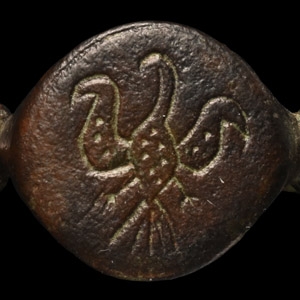
Byzantine Bronze Ring with Bird
14th-15th century A.D.Sold for (Inc. bp): £85
D-section hoop with decorative shoulders, discoid bezel with splayed bird. 5.97 grams, 23.32 mm overall, 19.25 mm internal diameter (approximate size British R, USA 8 1/2, Europe 18 3/4, Japan 18)
Ex German art market, 2000s. Acquired from an EU collector living in London. From the collection of a Surrey, UK, gentleman. This lot is accompanied by an illustrated lot declaration signed by the Head of the Antiquities Department, Dr Raffaele D'Amato. -
.jpg)
Byzantine Silver Merchant's Ring with Monogram
6th century A.D.Sold for (Inc. bp): £416
Discoid bezel with central cross pommee flanked by enigmatic characters. 4.22 grams, 25.08 mm overall, 21.10 mm internal diameter (approximate size British V 1/2, USA 10 3/4, Europe 24.4, Japan 23)
Ex Mr A. collection, Florida, USA. Private collection, Switzerland. This lot is accompanied by an illustrated lot declaration signed by the Head of the Antiquities Department, Dr Raffaele D'Amato. -
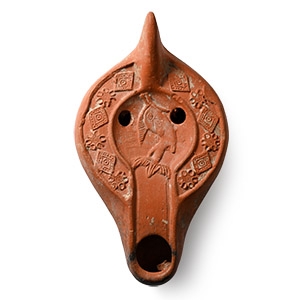
Byzantine Terracotta Oil Lamp with Dolphin
5th-7th century A.D.Sold for (Inc. bp): £468
Central figure of a stylised dolphin in low-relief with two filling holes on each side, horseshoe-shaped decorative band of flowers and lozenges on the rim; low basal ring and rounded nozzle. 175 grams, 14.3 cm
Private collection, Switzerland. Acquired by Galerie Rhéa, Zurich, from the above in 2011. This lot is accompanied by an illustrated lot declaration signed by the Head of the Antiquities Department, Dr Raffaele D'Amato. -
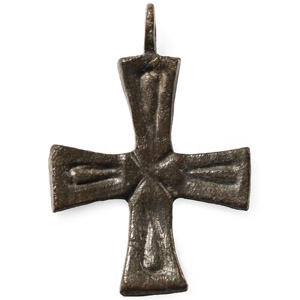
Byzantine Bronze Cross Pendant
12th-14th century A.D.Sold for (Inc. bp): £65
Expanding cross with a central X-motif, integral suspension loop. 4.63 grams, 35 mm
Ex German art market, 2000s. Acquired from an EU collector living in London. From the collection of a Surrey, UK, gentleman. This lot is accompanied by an illustrated lot declaration signed by the Head of the Antiquities Department, Dr Raffaele D'Amato. -
.jpg)
Byzantine Group of Three Gold Filigree Beads
Circa 6th-8th century A.D.Sold for (Inc. bp): £208
Each with openwork filigree decoration, and two with applied granules. 1.98 grams total, 6-9 mm
Ex property of a late Japanese collector, 1970-2000s. This lot is accompanied by an illustrated lot declaration signed by the Head of the Antiquities Department, Dr Raffaele D'Amato. -
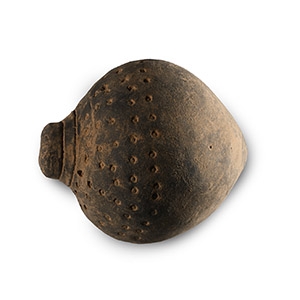
Byzantine 'Greek Fire' Ceramic Fire Bomb or Hand Grenade
9th-11th century A.D.Sold for (Inc. bp): £98
Piriform in profile with narrow point and domed mouth; the upper body decorated with impressed pellets; intended to be filled with explosive liquid and wick, used as a hand grenade. 441 grams, 10.7 cm
From an important specialist collection, London, UK, 1990s onwards. Accompanied by an academic paper by military specialist Dr Raffaele D'Amato, dated 15 July 2019 and titled 'Eastern Roman Empire - Greek Fire Bomb or Hand Grenade (μεσαίον kακάβιον) 9th-11th century AD'. This lot is accompanied by an illustrated lot declaration signed by the Head of the Antiquities Department, Dr Raffaele D'Amato.
Apart from the use of siphons or manual flame-throwers called cheirosiphona, special corps of Roman soldiers employed terracotta grenades, in the form of small jars, abundantly evidenced in archaeological excavations. They were called μεσαία kακαβιά or κυτροκακάβια where the former had a bulbous shape and the latter a more cylindrical form. -
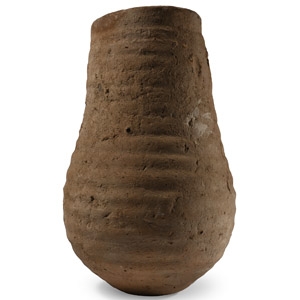
Byzantine Terracotta Storage Jar
Circa 6th-8th century A.D.Sold for (Inc. bp): £117
With tapering sidewall and rounded base, coil-built with ridged surfaces. 3.92 kg, 32.5 cm
Ex London, UK, gallery, 1980s. This lot is accompanied by an illustrated lot declaration signed by the Head of the Antiquities Department, Dr Raffaele D'Amato.

