-
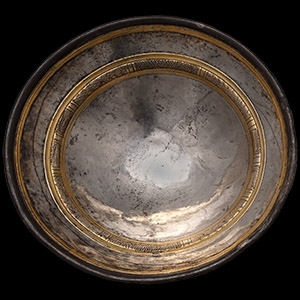
Hellenistic Silver-Gilt Bowl
2nd century B.C.Sold for (Inc. bp): £7,800
With carinated profile, rolled rim, circumferential bands to the inner face, gilt concentric bands and hatched wreath; in a velvet-lined presentation case. 354 grams, 18.6 cm wide
UK private collection before 2000. Acquired on the UK art market. Private collection, London. Accompanied by an academic report by Dr Raffaele D'Amato. This lot has been checked against the Interpol Database of stolen works of art and is accompanied by a search certificate number no.12662-236222. This lot has been cleared against the Art Loss Register database, and is accompanied by an illustrated lot declaration signed by the Head of the Antiquities Department, Dr Raffaele D'Amato. -
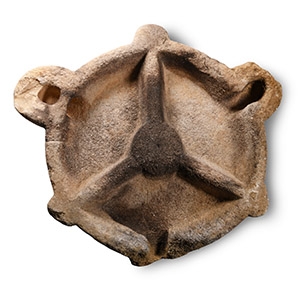
Archaic Marble Oil Lamp
Eastern Greek, 6th century B.C.Sold for (Inc. bp): £1,300
Circular with an open oil-chamber divided into three compartments with a central omphalos, three semi-circular nozzles projecting from each compartment bridging over the wick rests; flat base with a central hole for support. 2.61 kg, 22 cm
Ex HAC, Basel, Switzerland, 1990s. with Galerie Rhéa, Zurich, Switzerland. This lot is accompanied by an illustrated lot declaration signed by the Head of the Antiquities Department, Dr Raffaele D'Amato. -
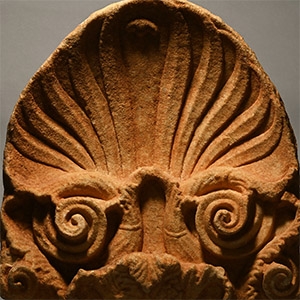
'The Stanford Place Collection' Attic Marble Stele Anthemion Finial
4th century B.C.Sold for (Inc. bp): £31,200
Carved in the form of an elaborate palmette with stems in the form of spiral tendrils rising from acanthus leaves, a small rosette at the top between the converging fronds; holes on the reverse for attachment to shaft; mounted on a custom-made display stand. 57 kg total, 47 cm (53.5 cm including stand)
Acquired on the New York, USA, art market, 1994. with Christie's, London, The Stanford Place Collection of Antiquities, 26 April 2006, no.30. Private collection, UK. Accompanied by an academic report by Dr Raffaele D’Amato. Accompanied by copies of the relevant Christie's 'Stanford Place Collection' catalogue pages. This lot has been checked against the Interpol Database of stolen works of art and is accompanied by search certificate number no.12614-235145. This lot has been cleared against the Art Loss Register database, and is accompanied by an illustrated lot declaration signed by the Head of the Antiquities Department, Dr Raffaele D'Amato.
This iconography was adapted from the Egyptian and Asiatic honeysuckle, also known as lotus palmette. First depicted on Attic white-ground lekythoi; in the 5th century B.C., then as architectural decoration, carved marble examples of this type of funerary monument were erected in the 5th-4th century B.C. It was not unusual for the anthemion to be of higher quality than the figures sculpted and painted beneath it. One splendid example is the stele of Paramythion (cf. Brinkmann-Wünsche, 2004, pp.148ff.). These memorials, originally painted, were venerated by families, anointed with oil, decorated with ribbons, and graced with offerings of food. -
.jpg)
Large Attic Greek Terracotta Statue of Kore with Sea Encrustations
5th century B.C.Sold for (Inc. bp): £3,510
Hollow-form and standing on a pedestal with her right knee slightly bent, both hands holding the edges of her flowing peplos, wearing a polos crown, naturalistic detailing to face; traces of pigment remaining, a rectangular cut-out on her back. 604 grams, 31.5 cm
From the collection of Pierre and Claude Vérité, Paris, France, acquired between 1930 and 1960. with Christie's, Paris, Collection Pierre et Claude Vérité, 20 December 2011, no.121 (part). Ex Galerie Günter Puhze GmbH, Germany, 2012. Private collection, Bern, Switzerland. Accompanied by copies of the relevant Christie's catalogue pages. This lot has been checked against the Interpol Database of stolen works of art and is accompanied by a search certificate number no.12664-236370. This lot has been cleared against the Art Loss Register database, and is accompanied by an illustrated lot declaration signed by the Head of the Antiquities Department, Dr Raffaele D'Amato. -
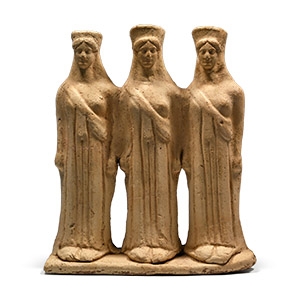
Greek Terracotta Triple Kore
Circa 450 B.C.Sold for (Inc. bp): £2,600
Comprising three standing korai on a rectangular base, each wearing a chiton and a himation draped diagonally from the right shoulder, centrally parted hair topped with a polos crown; hollow back, middle head restored. 480 grams, 19.3 cm
Private Swiss collection, 1990s. with Galerie Rhéa, Zurich, Switzerland. This lot has been checked against the Interpol Database of stolen works of art and is accompanied by a search certificate number no.12665-236417. This lot has been cleared against the Art Loss Register database, and is accompanied by an illustrated lot declaration signed by the Head of the Antiquities Department, Dr Raffaele D'Amato.
Korai (young women) were common votive dedications in the Archaic and Classical world, particularly at sanctuaries of Demeter, Persephone, and Hera. To have a group of maidens, such as this example, is highly unusual, and evokes the ritual dances of marriageable young women in the Greek world. -
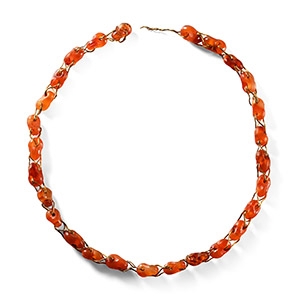
Greek Gold and Carnelian Necklace
1st century B.C.-1st century A.D.Sold for (Inc. bp): £1,895
A section of a necklace of carnelian drop-shaped beads, each pierced in two planes and linked loop-in-loop with thin twisted gold wires, possibly later. 8.16 grams, 26 cm long
The Gans collection, Hebling Dec, Berlin, 1929. with Christie's, New York, 8 December 1999, lot 51. Accompanied by a copy of the relevant Christie's catalogue pages. This lot has been checked against the Interpol Database of stolen works of art and is accompanied by search certificate no.11608-198969. This lot has been cleared against the Art Loss Register database, and is accompanied by an illustrated lot declaration signed by the Head of the Antiquities Department, Dr Raffaele D'Amato. -
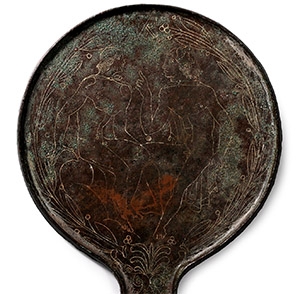
Etruscan Bronze Mirror Depicting Two Male Figures
Late 4th-3rd century B.C.Sold for (Inc. bp): £4,680
Discoid mirror with a short tang to accept an organic handle, the reverse with a palmette above the handle; the obverse with two figures seated on rocks and facing each other, to the right: Turms (Hermes) wearing a winged cap, and a young man on the left, both wearing cloaks draped over their backs, with folds visible over their shoulders and fastened at the neck; Turms depicted making an expressive gesture with his right hand while his companion listens attentively, looking toward Hermes and resting his left hand on his knee; a palmette below at the centre of the scene, two laurel branches extending upwards to form a framing arch around the composition, ending at the top in a geometric ornament. 260 grams, 22.5 cm
Private collection, Zurich, Switzerland. Accompanied by a copy of a report by the late Han Jucker (1918-1984), 1 February 1982. This lot has been checked against the Interpol Database of stolen works of art and is accompanied by a search certificate number no.12668-236379. This lot has been cleared against the Art Loss Register database, and is accompanied by an illustrated lot declaration signed by the Head of the Antiquities Department, Dr Raffaele D'Amato.
Hans Jucker (1918-1984) was a distinguished Swiss art historian and classical archaeologist, renowned for his expertise in Greek and Roman art. He was particularly recognised for his scholarly contributions to the study of ancient sculpture and iconography. Jucker served as a curator and later director at the Bernisches Historisches Museum in Switzerland, where he was instrumental in expanding and refining the museum’s collection of classical antiquities. His research and publications, marked by precision and clarity, helped shape modern understanding of Roman portraiture and the visual language of the ancient world. Through both his academic work and curatorial leadership, Jucker earned a lasting reputation as one of Switzerland’s foremost authorities on classical art. -
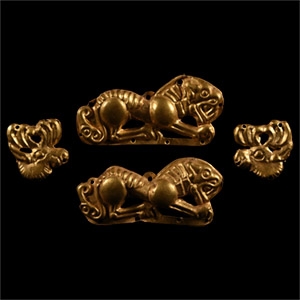
Scythian Gold Appliqué Collection
5th-3rd century B.C.Sold for (Inc. bp): £4,680
Group of sheet-gold appliqué mounts with repoussé detailing comprising a pair of advancing lions with coiled tail and open mouth; a pair of elk heads with curved antlers; supplied with a custom-made presentation mount. 5.28 grams total, 19-47 mm (124 grams total, mount: 11.5 cm high)
German art market. European private collection, 1970s-early 2000s. Acquired from the above; thence by descent. Private collection, London, UK. This lot has been checked against the Interpol Database of stolen works of art and is accompanied by a search certificate number no.12670-234552. This lot has been cleared against the Art Loss Register database, and is accompanied by an illustrated lot declaration signed by the Head of the Antiquities Department, Dr Raffaele D'Amato. -
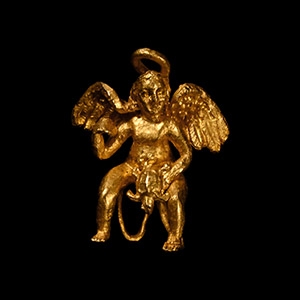
Greek Gold Eros Holding a Turtle Pendant
4th century B.C.Sold for (Inc. bp): £4,420
A delicately crafted pendant depicting a seated Eros with spread wings, holding a small turtle with his left hand and his right hand raised, feather detailing to wings and carefully modelled face with a smiling expression; a double suspension loop underneath and a single loop above; likely from an earring. 1.41 grams, 13 mm
Solothurn exhibition catalogue 1967, no.421. Notable Swiss private scholarly collection. with Galerie Rhéa, Zurich, Switzerland. This lot has been checked against the Interpol Database of stolen works of art and is accompanied by a search certificate number no.12671-236392. This lot has been cleared against the Art Loss Register database, and is accompanied by an illustrated lot declaration signed by the Head of the Antiquities Department, Dr Raffaele D'Amato. -
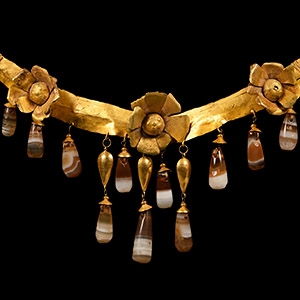
Eastern Greek Gold Necklace Element with Agate Drops
Circa 3rd century B.C.Sold for (Inc. bp): £4,940
Crescentic frontal panel from a necklace or collar; sheet gold band with slight carination, lightly incised leaf and berry detailing; applied filigree band to each end with double-loop attachment points; three applied foil rosettes; eleven banded agate dangles to the lower edge with sheet gold suspension; a marriage of ancient parts. 33.84 grams, 15.2 cm
Acquired in the mid 1980s-1990s. Private collection, Switzerland, thence by descent. Private collection, since the late 1990s. Accompanied by an academic report by Dr Raffaele D’Amato. This lot has been checked against the Interpol Database of stolen works of art and is accompanied by a search certificate number no.12591-232174. This lot has been cleared against the Art Loss Register database, and is accompanied by an illustrated lot declaration signed by the Head of the Antiquities Department, Dr Raffaele D'Amato.
Rosettes were one of the most desired decorations on jewellery. Diadems with rosettes are attested from the archaic period onwards. One of the rosette types was the so-called flower-head from Madytos, which most closely resembled the common wild or dog rose. The rose was, of course, much prized in ancient times for its wonderful scent and as the favoured flower of Aphrodite, the goddess of love: the lyric poet Anakreon called it ‘the perfume of gods, the joy of men’. -
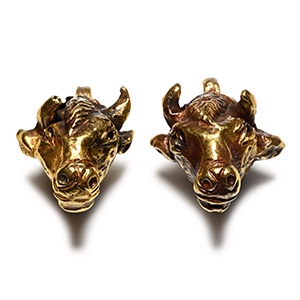
Cypriot Gold Bull-Headed Pendant Pair
7th century B.C.Sold for (Inc. bp): £6,500
Matched pair of hollow-formed pendants, each a bull's head modelled in the round with a rosette to the rear beneath the loop. 5.39 grams total, 23-24 mm
Acquired in 1986. with Taisei Gallery, Gold & Silver Auction, Part II, Ancient to Renaissance, 5 November 1992, The Conrad Salon, The Waldorf-Astoria, New York, no.165. This lot has been checked against the Interpol Database of stolen works of art and is accompanied by search certificate no.11969-210472. This lot has been cleared against the Art Loss Register database, and is accompanied by an illustrated lot declaration signed by the Head of the Antiquities Department, Dr Raffaele D'Amato.
In Cyprus, the cult of the bull developed from the 3rd millennium B.C. until the 6th century B.C. The bull was a 'frequently invoked manifestation of divinity', and its cult was widespread since the Minoan Age. The appearance of gold bull-head pendants in tombs had an aesthetic and social value, but at the same time it also had a deeper symbolic and religious meaning. -
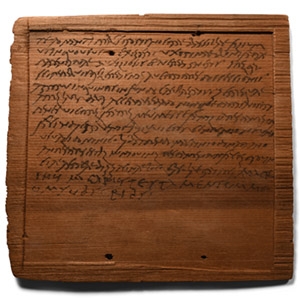
Roman Inked Wooden Tablet, a Testament Overseen by Bonatianus with the Head Witness Being Iulius Lovianus
Mid 4th century A.D.Sold for (Inc. bp): £9,750
A reused rectangular wax tablet with a shallow recessed panel to one face and thirteen lines of Roman cursive script; the text contains the end of testamentary instructions followed by the obligatory mancipatory formula which includes the ritual purchase of the entire property of the deceased (familia testamenti faciundi erga emit), with the "Libripens" (balance holder) being Bonatianus, and the first of the witnesses was Iulius Lovianus; in the last lines the testator's handwritten signature, after he had dictated his will to a friend; on the outer face two sulci, which were filled with wax into which the signet rings of the witnesses could be impressed, with traces of the signatures of witnesses; four small holes for attachment. 50 grams, 17.7 x 16.6 cm
Acquired by Albert Sfez in the early 1950s. Formerly the property of Monsieur Alain Sfez, a Belgium collector; acquired by gift from his father Albert Sfez, in 1965. Acquired by a London dealer in 1973. From an important London collection since 1975; thence by descent. Accompanied by a copy of a four page illustrated academic report by Professor Dr. phil. Peter Rothenhöfer. This lot has been checked against the Interpol Database of stolen works of art and is accompanied by a search certificate number no.12568-218137. This lot has been cleared against the Art Loss Register database, and is accompanied by an illustrated lot declaration signed by the Head of the Antiquities Department, Dr Raffaele D'Amato.
The contract follows standard Roman legal formulae.

