-
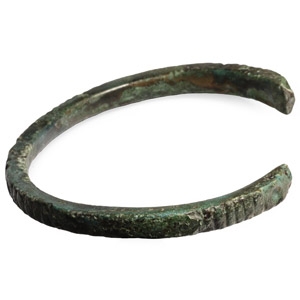
Late Roman Bronze Military Bracelet with Beast-Heads
4th-5th century A.D.Sold for (Inc. bp): £52
Rectangular-section penannular body with bands of ribbing and punched pellets, the finials fashioned as stylised beast heads. 27.9 grams, 67 mm
Ex German art market, 2000s. Acquired from an EU collector living in London. From the collection of a Surrey, UK, gentleman. This lot is accompanied by an illustrated lot declaration signed by the Head of the Antiquities Department, Dr Raffaele D'Amato. -
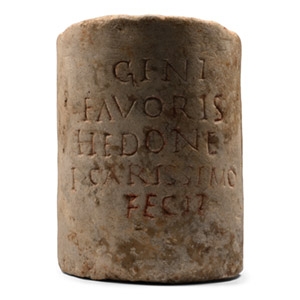
Roman Marble Column Fragment with Latin Inscription
3rd century A.D.Sold for (Inc. bp): £1,430
Provincial columnar fragment with inscription in rustic capitals: 'GENI / FAVORIS /IHEDONE / I CARISSIMO / FECIT' [With the favour of the Genius Hedone made it for the dearest]; traces of red pigment. 1.81 kg, 12 cm
Private collection, 2005. This lot is accompanied by an illustrated lot declaration signed by the Head of the Antiquities Department, Dr Raffaele D'Amato.
The dedicatory inscription seems to refer to a funerary monument erected by a certain Hedone for a loved one (probably her husband). It is a late inscription which justifies the use of the genitive and not the ablative for GENI FAVORIS (instead of GENII FAVORE). Hedone is a Greek name which, however, occurs in Italic sepulchral inscriptions. -
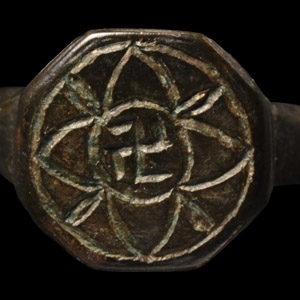
Late Roman Bronze Ring with Fylfot
4th-5th century A.D.Sold for (Inc. bp): £91
With a D-section hoop and octagonal bezel with a fylfot within a quatrefoil. 4.32 grams, 22.84 mm overall, 17.44 mm internal diameter (approximate size British O, USA 7, Europe 14.98, Japan 14)
Ex German art market, 2000s. Acquired from an EU collector living in London. From the collection of a Surrey, UK, gentleman. This lot is accompanied by an illustrated lot declaration signed by the Head of the Antiquities Department, Dr Raffaele D'Amato. -
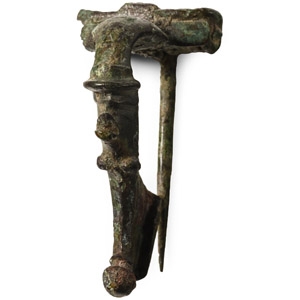
Roman Bronze Bow Brooch
2nd century A.D.Sold for (Inc. bp): £26
Of kraftig profilierte type with tapering bow with scooped sides, collar to the bow and spur beneath, swept forward edge to the foot with knop finial; spring and pin to reverse. 16 grams, 47 mm
From the private collection of John Fox, Nottingham, Nottinghamshire, UK, antiquarian and archaeologist; his collection assembled in the 1950s-1970s. This lot is accompanied by an illustrated lot declaration signed by the Head of the Antiquities Department, Dr Raffaele D'Amato. -
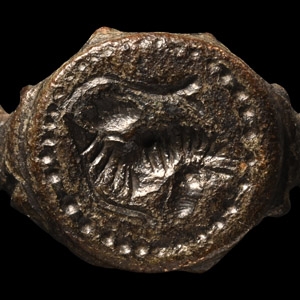
Late Roman Bronze Ring with Animal
4th-5th century A.D.Sold for (Inc. bp): £52
Comprising a slender hoop and balustered shoulders, raised discoid bezel with a hippocampus within a pelletted border. 5.41 grams, 24.65 mm overall, 19.90 mm internal diameter (approximate size British S, USA 9, Europe 20, Japan 19)
Ex German art market, 2000s. Acquired from an EU collector living in London. From the collection of a Surrey, UK, gentleman. This lot is accompanied by an illustrated lot declaration signed by the Head of the Antiquities Department, Dr Raffaele D'Amato. -
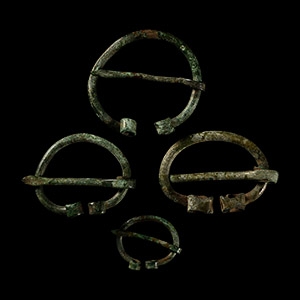
Roman Bronze Penannular Brooch Group
Circa 3rd-4th century A.D.Sold for (Inc. bp): £78
Of various sizes, each with finials scrolled in line with the shank. 8.81 grams total, 17-27 mm
From a private, UK, collection in the 1980s. Property of a London, UK, antiquarian. This lot is accompanied by an illustrated lot declaration signed by the Head of the Antiquities Department, Dr Raffaele D'Amato. -
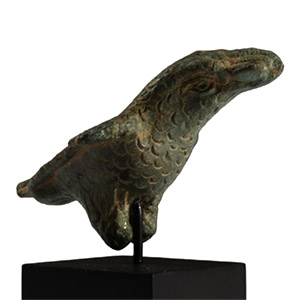
'The Kempsey' Roman Bronze Military Eagle Statuette
Circa 43-410 A.D.Sold for (Inc. bp): £390
Modelled in the round as a standing eagle with its wings spread, the overlapping wingtips covering the short tail; incised feather detailing to the body and wings, wide head with detailed eyes, remains of a military insignia (a victory wreath or fish?) held in its hooked beak; mounted on a custom-made display stand. 180 grams total, 76 mm high including stand
Found Kempsey, Malvern Hills, Worcestershire, UK. Accompanied by a copy of the British Museum's Portable Antiquities Scheme (PAS) report no.WAW-19C7C8. This lot is accompanied by an illustrated lot declaration signed by the Head of the Antiquities Department, Dr Raffaele D'Amato.
Both Ovid and Plutarch place the inception of manipular ensigns with Romulus, where bundles (manipuli) of hay were tied to high poles which served as rallying points for units of the army. Eventually, icons of animals replaced these ensigns: the eagle, wolf, Minotaur, horse, and boar. In 107 B.C., Gaius Marius made sweeping military reforms and the Aquila became the sole standard of the legion, which according to (Pliny NH. 10.5.16) ‘By making the Aquila the standard for all legions improved unity and gave soldiers a symbol that expressed their attachment to an all-encompassing body, to which the soldiers’ loyalty could be directed’. Due to its place at the head of each legion, it became the emblem of the Roman legions, which enforced Roman rule in the provinces, giving the eagle its connotation of dominion. -
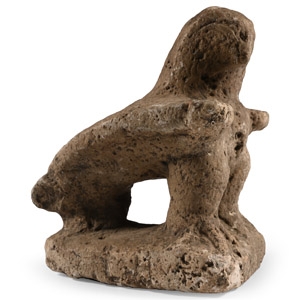
Roman Stone Eagle Statue
3rd-4th century A.D.Sold for (Inc. bp): £208
Carved standing on a plinth with its head turned to the right, wings folded. 987 grams, 13 cm high
Acquired in the mid 1980s-1990s. Private collection, Switzerland, thence by descent. Private collection, since the late 1990s. This lot is accompanied by an illustrated lot declaration signed by the Head of the Antiquities Department, Dr Raffaele D'Amato. -
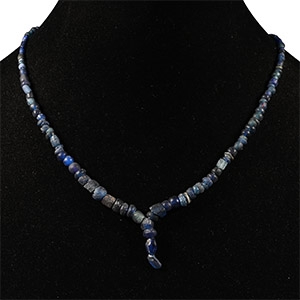
Roman Blue Glass Bead Necklace String
1st-4th century A.D. and laterSold for (Inc. bp): £65
Graduated string of mainly oblate beads, restrung to a Y-shape. 12.2 grams, 37 cm
Ex London, UK, collection, 1990s. This lot is accompanied by an illustrated lot declaration signed by the Head of the Antiquities Department, Dr Raffaele D'Amato. -
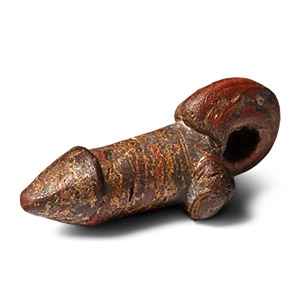
Roman Glass Phallic Pendant
1st-2nd century A.D.Sold for (Inc. bp): £1,235
In dark red glass with anatomical detailing, large suspension loop to the rear. 3.52 grams, 31 mm
with Sasu Boscher Encheres, 8 August 2022, no.228. with Galerie Rhéa, Zurich, Switzerland. This lot is accompanied by an illustrated lot declaration signed by the Head of the Antiquities Department, Dr Raffaele D'Amato. -
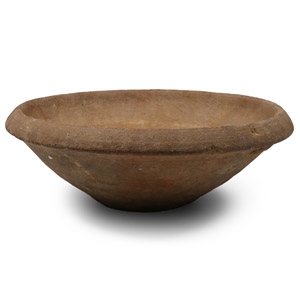
Roman Terracotta Mortarium
1st-4th century A.D.Sold for (Inc. bp): £156
With dimple base, broad body and carinated rim. 1.19 kg, 22 cm wide
Acquired in the 1990s. Ex Abelita family collection. This lot is accompanied by an illustrated lot declaration signed by the Head of the Antiquities Department, Dr Raffaele D'Amato. -
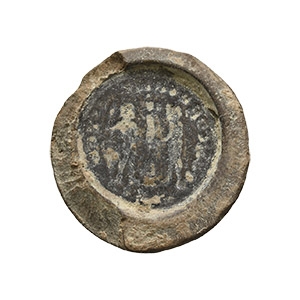
Roman Diocletian Terracotta Forger's Coin Mould
Late 3rd century A.D.Sold for (Inc. bp): £124
Terracotta disc with Diocletian (284-305 A.D.) coin impression to each face from which to cast counterfeit coins. 5.3 grams, 27 mm
From the collection of a gentleman, acquired on the London art market in the 1990s. This lot is accompanied by an illustrated lot declaration signed by the Head of the Antiquities Department, Dr Raffaele D'Amato.

