-
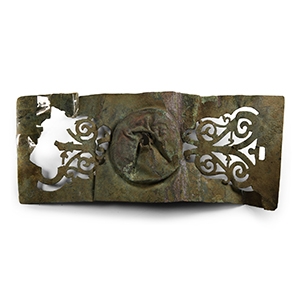
Large Roman Bronze Military Mount
2nd-3rd century A.D.Sold for (Inc. bp): £117
Composed of a central domed boss and openwork volutes to the sides; for a sword belt or a chariot, one corner separated. 69 grams, 14 cm wide
Good condition, very rare
Acquired 1960s-1990s. Late Alison Barker collection, a retired London barrister. This lot is accompanied by an illustrated lot declaration signed by the Head of the Antiquities Department, Dr Raffaele D'Amato.
In the 3rd century A.D. the sword (spatha) was mainly carried suspended from a broad baldric usually on the soldier’s left side. This sword’s shoulder belt, visible on many monuments related to the 3rd century, was composed from a leather strap, reinforced on the rims. The four specimens of Vimose provided valuable information about the shape of the baldric: one end was broad and finished in a straight edge, the other tapered to a narrow strip. They were decorated with silver disks (phalerae) of circa 6.4 cm of diameter, with rings on the reverse for fastening. These phalerae were of different shapes, styles and decorations: we can observe a range from simple copper-alloy discs to bronze openwork pieces fitted with a plate or an openwork disc showing elaborate figures. They were usually attached at about 29-30 cm from the wider and squared top of the baldric. One of the finial parts of the baldric was in fact very wide and ended with a straight edge, upon which could be placed a hinged rectangular openwork terminal plate (like our specimen), attached to a belt terminal pendant. The lack of holes for the attachment rivets in our specimen could also support the thesis that the piece is not for a baldric, but a mount for cart or chariot as some examples in a similar style found in Roman North Africa. -
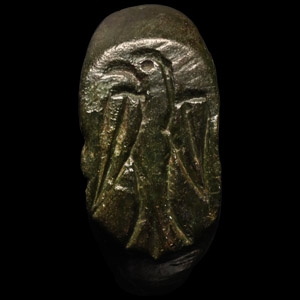
Late Roman Bronze Ring with Eagle
4th-5th century A.D.Sold for (Inc. bp): £111
Comprising a D-section hoop and oval bezel with splayed eagle. 4.54 grams, 22.42 mm overall, 19.23 mm internal diameter (approximate size British S, USA 9, Europe 20, Japan 19)
Ex German art market, 2000s. Acquired from an EU collector living in London. From the collection of a Surrey, UK, gentleman. This lot is accompanied by an illustrated lot declaration signed by the Head of the Antiquities Department, Dr Raffaele D'Amato. -
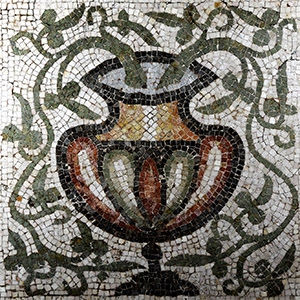
Roman Mosaic with Kantharos and Vines
4th-6th century A.D.Sold for (Inc. bp): £9,100
An attractive rectangular panel of mosaic tesserae with central ribbed kantharos executed in coral pink, amber-yellow, and green segments with tiered foot; issuing from the scaphoid opening two vines with curled tendrils and trefoil leaves in pale green; white field with grey-black border; restored and set into a mid 20th century reinforced mortar matrix. 56 kg, 67.5 x 67.5 cm
Acquired in the 1950s-early 1990s. From the Igor Karmiloff (1925-2016) collection, UN economist and author of Flashbacks, Icons of Impermanence, Bloomington, 2009. This lot has been checked against the Interpol Database of stolen works of art and is accompanied by a search certificate number no.12746-233888. This lot has been cleared against the Art Loss Register database, and is accompanied by an illustrated lot declaration signed by the Head of the Antiquities Department, Dr Raffaele D'Amato.
The motif of the kantharos, krater or amphora with vines emerging from the mouth is widely represented in classical art and was seemingly a popular motif for the mosaicist with examples found in areas as widespread as North Africa and northern Britain. The origins of the motif are probably to be found in the cult of Bacchus (Greek Dionysos) with its ritualised drunkenness expressed in the vine which gives rise to the grapes to be transformed into wine, and the drinking cup from which it is received. In later Roman times, the motif was reinterpreted as Christ (the Eucharist symbolised by the cup) from whom the vine grows representing the spread of the Christian message and the growth of the church (Watts, 1991, p.208). -
.jpg)
Roman Maximian Terracotta Forger's Coin Mould
Circa late 3rd century A.D.Sold for (Inc. bp): £59
Terracotta disc with Maximian (280-305 A.D.) coin impression to each face from which to cast counterfeit coins. 4.61 grams, 27 mm
From the collection of a gentleman, acquired on the London art market in the 1990s. This lot is accompanied by an illustrated lot declaration signed by the Head of the Antiquities Department, Dr Raffaele D'Amato. -
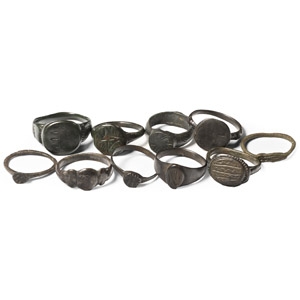
Roman to Medieval Bronze Ring Collection
1st-16th century A.D.Sold for (Inc. bp): £117
Comprising ten rings with bezels, including one with a dagger-shaped bezel. 41.93 grams total, 21-26 mm
Ex German art market, 2000s. Acquired from an EU collector living in London. From the collection of a Surrey, UK, gentleman. This lot is accompanied by an illustrated lot declaration signed by the Head of the Antiquities Department, Dr Raffaele D'Amato. -
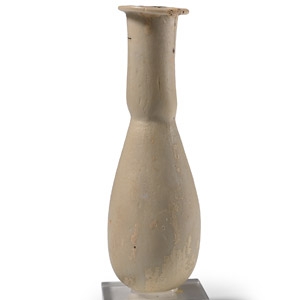
Roman White Glass Bottle
2nd century A.D.Sold for (Inc. bp): £143
A small piriform unguentarium with everted rim; mounted on a display stand. 12.3 grams total, 7.2 cm (7.6 cm including stand)
From the collection of the 'Römer Apotheke', Glarus, Switzerland. with Galerie Rhéa, Zurich, Switzerland. This lot is accompanied by an illustrated lot declaration signed by the Head of the Antiquities Department, Dr Raffaele D'Amato. -
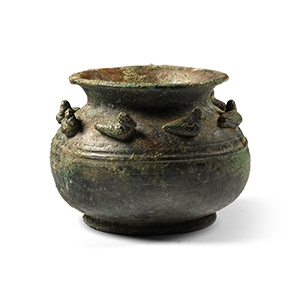
Romano-Celtic Bronze Vessel with Ducks
1st-2nd century A.D.Sold for (Inc. bp): £351
Bulbous vessel with applied foot formed of concentric circles, raised circumferential band on the shoulder with a frieze of applied swimming ducks above. 216 grams, 64 mm
Ex German art market, 2000s. Acquired from an EU collector living in London. From the collection of a Surrey, UK, gentleman. This lot is accompanied by an illustrated lot declaration signed by the Head of the Antiquities Department, Dr Raffaele D'Amato. -
.jpg)
Roman Constantine I Terracotta Forger's Coin Mould
Circa early 4th century A.D.Sold for (Inc. bp): £130
Terracotta disc with possibly Constantine I (307-337) coin impression to each face from which to cast counterfeit coins. 4.68 grams, 28 mm
From the collection of a gentleman, acquired on the London art market in the 1990s. This lot is accompanied by an illustrated lot declaration signed by the Head of the Antiquities Department, Dr Raffaele D'Amato. -
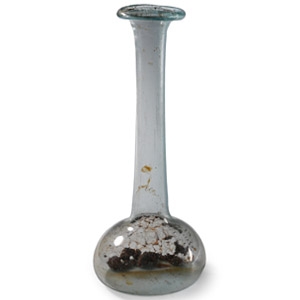
Roman Glass Unguentarium
1st-2nd century A.D.Sold for (Inc. bp): £117
With plano-convex body and flat base, gently tapering neck and everted rolled rim. 27.1 grams, 13 cm
From an important London collection of glass, 1990s. This lot is accompanied by an illustrated lot declaration signed by the Head of the Antiquities Department, Dr Raffaele D'Amato. -
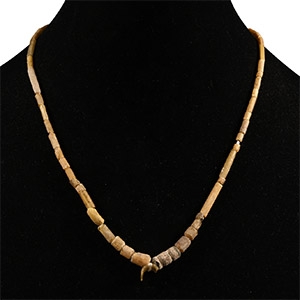
Roman Pale Yellow Glass Bead Necklace String
1st-4th century A.D. and laterSold for (Inc. bp): £72
Restrung group of tubular, cylindrical, drum-shaped and other beads. 10.5 grams, 46 cm
Ex London, UK, collection, 1990s. This lot is accompanied by an illustrated lot declaration signed by the Head of the Antiquities Department, Dr Raffaele D'Amato. -
.jpg)
Roman Silver Figure of a Man
2nd-3rd century A.D.Sold for (Inc. bp): £338
Standing erect wearing a draped toga, bearded and with thick bowl-cut hair. 9.05 grams, 39 mm
Acquired in the mid 1980s-1990s. From the family collection of Mr S.A., Switzerland, thence by descent. Private collection since the late 1990s. This lot is accompanied by an illustrated lot declaration signed by the Head of the Antiquities Department, Dr Raffaele D'Amato. -
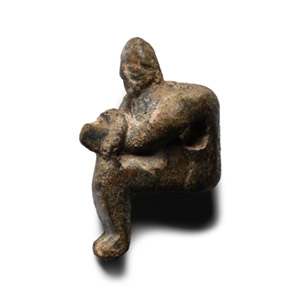
Roman Bronze Bound Captive Toggle
Late 2nd century A.D.Sold for (Inc. bp): £202
Depicted as a male seated and naked with rope binding the hands together; pierced vertically at the shoulders; probably a sliding mount for a thong or cord. 35 grams, 40 mm
From the collection of a gentleman, acquired on the London art market in the 1990s. This lot is accompanied by an illustrated lot declaration signed by the Head of the Antiquities Department, Dr Raffaele D'Amato.

