-
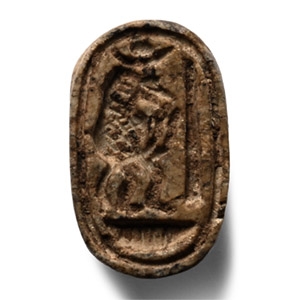
Egyptian Faience Duck Scaraboid with Hieroglyphs
Late Period, 664-332 B.C.Sold for (Inc. bp): £286
Modelled as a resting duck with its neck curved around the upper body, feather detailing on the wings, tail, and body, and delicately formed head; the underside features a baboon in a posture of adoration before an obelisk, wearing a lunar disc and crescent headdress, with a neb sign below. 2.82 grams, 19 mm
From the property of a London, UK, gentleman, 1970-2000s. This lot is accompanied by an illustrated lot declaration signed by the Head of the Antiquities Department, Dr Raffaele D'Amato.
Baboons were observed worshipping the rising sun with raised arms, a behaviour that Egyptians interpreted as divine reverence. The scarab's imagery symbolises cosmic harmony and sacred wisdom, with the baboon (a manifestation of Thoth in his lunar aspect) showing reverence to an obelisk (a symbol of the solar god, Ra). Thus, it blends moon and sun symbolism, embodying balance, cyclical renewal, divine order, and the interplay between knowledge (Thoth) and power (Ra). The neb sign indicates lordship or possession over all the celestial forces. -
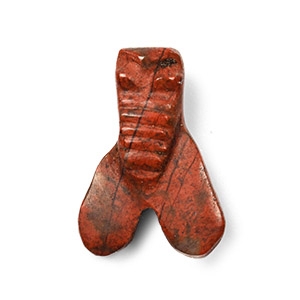
Egyptian Jasper Fly Amulet
New Kingdom, 1550-1070 B.C.Sold for (Inc. bp): £85
With incised line detailing to the body, pierced longitudinally for suspension. 0.33 grams, 11 mm
Ex London and Home Counties collection, UK, 1920-1940. This lot is accompanied by an illustrated lot declaration signed by the Head of the Antiquities Department, Dr Raffaele D'Amato.
Fly amulets are first attested during the Predynastic period (pre 3,100 BC). It is possible that they represented a wish to emulate the fly's renowned fecundity. These amulets were made in a variety of materials, including gold, and golden flies were used in the New Kingdom as an honorific award for military valour. No fewer than thirty-three fly amulets came from the tomb of the wives of Tuthmoses III. -
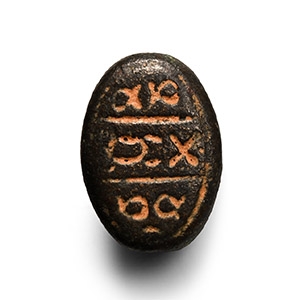
Phoenician Inscribed Bronze Scaraboid Seal
Late 1st millennium B.C.Sold for (Inc. bp): £117
With plain body and three lines of characters including a scarab to the underside. 3.5 grams, 13 mm
Ex London, UK, gentleman, 1990. This lot is accompanied by an illustrated lot declaration signed by the Head of the Antiquities Department, Dr Raffaele D'Amato. -
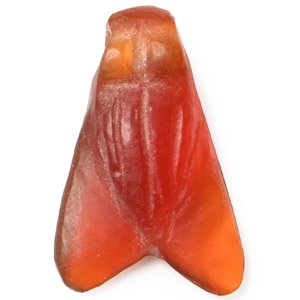
Egyptian Carnelian Fly Amulet
Late Period, 664-332 B.C.Sold for (Inc. bp): £195
Carved with simple body and eye detailing and polished; drilled through the eyes for suspension. 0.32 grams, 12 mm
Ex North London, UK, gallery, early 2000s. This lot is accompanied by an illustrated lot declaration signed by the Head of the Antiquities Department, Dr Raffaele D'Amato.
Egyptian artists often depicted fly whisks with pharaohs and officials, suggesting flies were just nuisances. In reality, Egyptians valued flies for their speed and persistence. Small fly amulets appeared around 3200 B.C. in Naqada II burials, gaining popularity and varying materials during the New Kingdom, including gold, silver, lapis lazuli, carnelian, amethyst, faience, and gemstones. These amulets were thought to protect against insect bites and troublesome creatures via apotropaic magic and possibly symbolised fecundity. Pharaohs awarded gold fly-shaped pendants to honour soldiers' bravery in battle. -
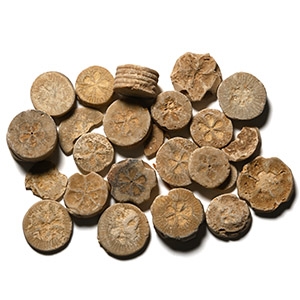
Egyptian Limestone Floral Inlay Group
Roman Period, 30 B.C.-323 A.D. or earlierSold for (Inc. bp): £104
Group of cylindrical and discoid inlay plaques or gaming counters, crinoids with cinquefoil motif. 48.8 grams total, 12-20 mm
From a central London ADA dealership, 1980-1990. This lot is accompanied by an illustrated lot declaration signed by the Head of the Antiquities Department, Dr Raffaele D'Amato.
Flowers were symbolic of rebirth due to the daily reopening of their petals after nightfall. As a result, they were widely used in domestic settings, religious and funerary contexts, and as adornments. Similar rosette discs, like those recovered from the Ramesside Period palace at Qantir, were used as decorative elements in royal palaces. -
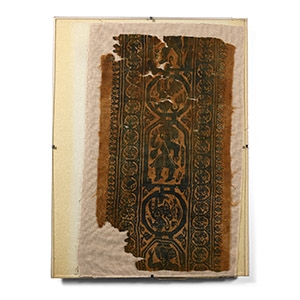
Coptic Textile Section with Figures and Animals
4th-6th century A.D.Sold for (Inc. bp): £338
Rectangular panel of woven fabric with borders of discs each with a lion passant, midian band with standing human figures and regardant beasts between; mounted in a glazed frame. 577 grams total, 30.5 x 23 cm
Acquired in the late 1980s-early 1990s. Private collection, London. This lot is accompanied by an illustrated lot declaration signed by the Head of the Antiquities Department, Dr Raffaele D'Amato. -
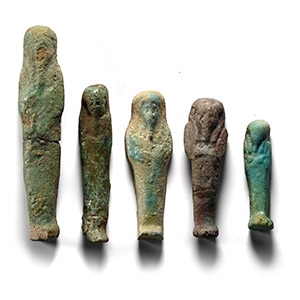
Egyptian Glazed Faience Shabti Collection
Ptolemaic Period, 332-30 B.C.Sold for (Inc. bp): £312
Comprising five mummiform figures in different colours, each with a false beard and wearing a lappet wig. 54 grams total, 46-91 mm
Acquired on the UK art market before 2000. Property of an Essex, UK, gentleman. This lot is accompanied by an illustrated lot declaration signed by the Head of the Antiquities Department, Dr Raffaele D'Amato.
Shabti figures were created to perform heavy manual tasks on behalf of a person in the afterlife. The body of a shabti typically resembled a mummy from the neck down and was often depicted holding tools such as baskets, mattocks, and hoes. Over time, the number of shabtis in a standard elite burial increased, so that from the Third Intermediate Period onward, it became common to have at least 401 figurines, comprising 365 workers, one for each day of the year, plus 36 overseers, one for every ten workers. -
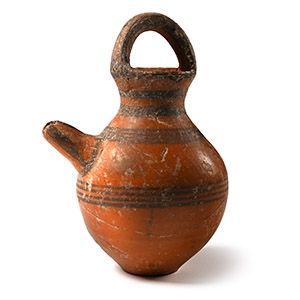
Cypriot Terracotta Vessel
Cypro-Archaic, 750-600 B.C.Sold for (Inc. bp): £286
Miniature ewer with tapering spout to the shoulder, flared neck and rounded rim with applied loop handle; painted decorative bands. 51 grams, 88 mm
Acquired in the mid 1980s-1990s. Private collection, Switzerland, thence by descent. Private collection, since the late 1990s. This lot is accompanied by an illustrated lot declaration signed by the Head of the Antiquities Department, Dr Raffaele D'Amato. -
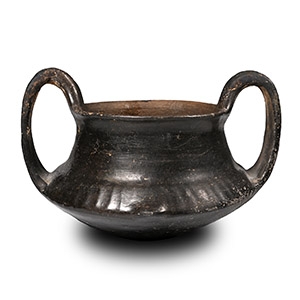
Villanovan Terracotta Two-Handled Bowl
9th-8th century B.C.Sold for (Inc. bp): £390
A squat vessel with a small base, raised neck and slightly projecting rim, carinated shoulder with two projecting bosses and a pair of high strap handles. 221 grams, 13.4 cm wide
Old Basel private collection. Elsa Bloch-Diener, Antike Kunst, Bern, 27 July 1990. Private collection, Bern, Switzerland. This lot is accompanied by an illustrated lot declaration signed by the Head of the Antiquities Department, Dr Raffaele D'Amato. -
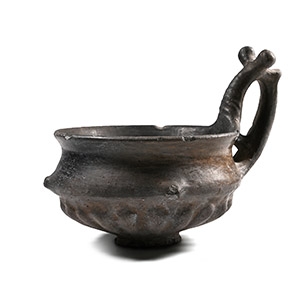
Villanovan Impasto Kyathos with Zoomorphic Handle
7th century B.C.Sold for (Inc. bp): £338
Modelled with squat body and raised openwork handle with two projecting lobes to the top, the body with three raised bosses on the shoulder and the base with raised petals radiating from the low foot. 208 grams, 13.3 cm wide
Ulrike Feuz-Lauprecht, NIKE Kunst der Antike, Bremgarten 9 April 1991. Private collection, Bern, Switzerland. This lot is accompanied by an illustrated lot declaration signed by the Head of the Antiquities Department, Dr Raffaele D'Amato. -
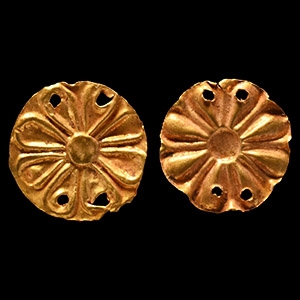
Greek Gold Floral Applique Pair
Circa 5th-3rd century B.C.Sold for (Inc. bp): £98
Comprising two sheet-gold repoussé mounts depicting eight-petalled flowers, two pairs of piercings to the outer edge. 0.21 grams total, 9-10 mm
Ex property of a late Japanese collector, 1970-2000s. This lot is accompanied by an illustrated lot declaration signed by the Head of the Antiquities Department, Dr Raffaele D'Amato. -
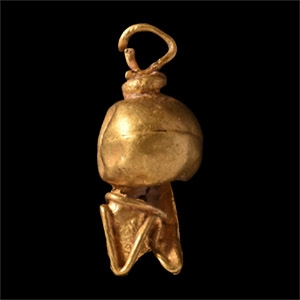
Graeco-Roman Gold Pomegranate Pendant
2nd-1st century B.C.Sold for (Inc. bp): £124
Composed of a hollow-form spherical body with long wings beneath forming the calyx. 0.22 grams, 9 mm
Ex property of a late Japanese collector, 1970-2000s. This lot is accompanied by an illustrated lot declaration signed by the Head of the Antiquities Department, Dr Raffaele D'Amato.

