-
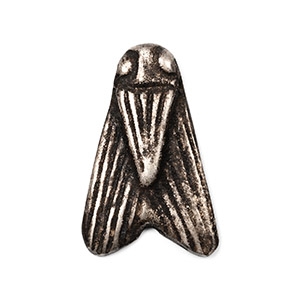
Egyptian Silver Fly Amulet
Late-Ptolemaic Period, 664-30 B.C.Sold for (Inc. bp): £143
With linear detailing to wings, raised eyes, pierced for suspension. 1.3 grams, 19 mm
From an early 20th century collection. This lot is accompanied by an illustrated lot declaration signed by the Head of the Antiquities Department, Dr Raffaele D'Amato. -
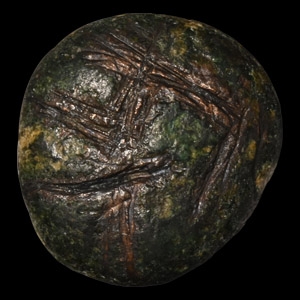
Phoenician Bronze Stamp Seal
Late 1st millennium B.C.Sold for (Inc. bp): £46
With domed head and pierced rectangular shank, hatched detailing. 5.53 grams, 24.5 mm
Ex London, UK, gentleman, 1990. This lot is accompanied by an illustrated lot declaration signed by the Head of the Antiquities Department, Dr Raffaele D'Amato. -
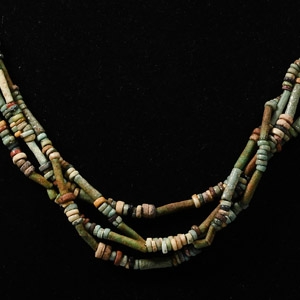
Egyptian Multi-Stranded Mummy Bead Necklace
Late Period, 664-332 B.C.Sold for (Inc. bp): £312
Four-stranded designer necklace composed of beads of mainly annular and tubular types. 21 grams, 67 cm
Acquired before 1979. From the private collection of Mr F.A., South Kensington, London, UK; thence by descent 2014. This lot is accompanied by an illustrated lot declaration signed by the Head of the Antiquities Department, Dr Raffaele D'Amato.
For thousands of years, artisans in Egypt created vibrant ceramics to echo the beauty of rare jewels. These ornaments were created with almost every material, colour, and texture imaginable and they come from across Egypt and beyond: vibrant blue lapis lazuli from Afghanistan, glossy black obsidian from Turkey, and aqua-green turquoise from the Sinai. They were worn in life and, after death, they served as precious ornamentation for mummies. -
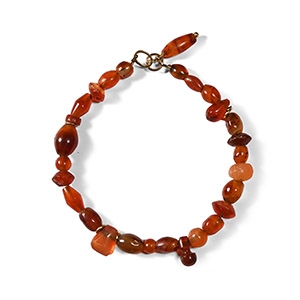
Egyptian Carnelian Bead Bracelet
Late Period, 664-332 B.C. or laterSold for (Inc. bp): £286
Composed mainly of biconical, oblate, and other beads with three larger pendants; with modern gold attachment. 16.4 grams total, 21 cm long
From the private collection of the late Mrs Belinda Ellison, a long time member of the Egyptian Exploration Society, c.1940-2020. This lot is accompanied by an illustrated lot declaration signed by the Head of the Antiquities Department, Dr Raffaele D'Amato. -
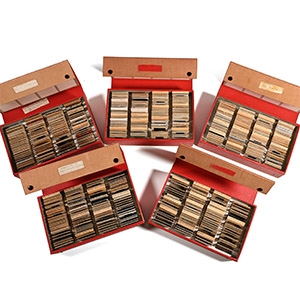
Historic Collection of 772 Slides of Archaeological Sites in Egypt
1960s-1980s A.D.Sold for (Inc. bp): £1,300
Housed in five linen-covered boxes, covering Saqqara, Step Pyramids, The Serapeum, Giza, Karnak, Tombs of the Nobles, Deir-el Medina Tombs, Ummuh Bured Tombs, Denderah and Edfu, etc. 4.17 kg total, 26.5 x 16.5 x 6.5 cm each box
Property of archaeologist Stephanie Gee, N.W. London, UK, 1960s-1980s. This lot is accompanied by an illustrated lot declaration signed by the Head of the Antiquities Department, Dr Raffaele D'Amato.
Stephanie Gee was a prominent archaeologist who took part in several expeditions in Egypt. She was a trusted assistant to the British-Australian archaeologist Veronica Seton-Williams, who excavated in Egypt, Britain, and the Near East. Stephanie also took part in the Tell El-Farâ'în expeditions of 1965-1968, and assisted Seton-Williams with preparing the 1966 expedition report. Their collaboration continued and Stephanie helped with the manuscript of Seton-Williams’ book ‘The Road to El-Aguzein’, a narrative account of her life that was first published in 1988. -
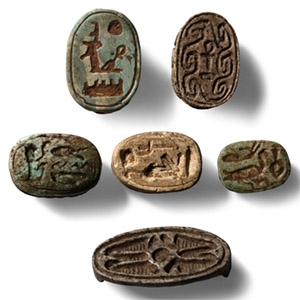
Egyptian Mixed Scarab Collection
2nd-1st millennium B.C.Sold for (Inc. bp): £585
Comprising (from left to right, top to bottom): 1) a scarab with an oval border containing the throne name of the 19th Dynasty pharaoh, Seti I (Men-Maat-Re); 2) a scarab with an oval outer border containing a continuous oblong scroll border framing a neb and ankh symbol; 3) a scarab with an oval border containing a seated adorant before a sa, water, and neb symbol; 4) a scarab with an oval border containing the throne name of the 19th Dynasty pharaoh, Ramesses II (User-Maat-Re), atop a neb sign; 5) a scarab with two signs, possibly representing the word for ‘bread’ above a goose, with a beer jar in front; 6) and a scaraboid with a stretched oval border containing mirrored pairs of rearing cobras surrounding a central sun disc. 18.64 grams total, 14-27 mm
From the collection of a gentleman, acquired on the London art market in the 1990s. This lot is accompanied by an illustrated lot declaration signed by the Head of the Antiquities Department, Dr Raffaele D'Amato. -
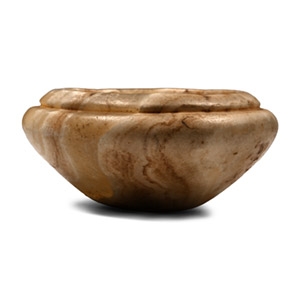
Egyptian Alabaster Bowl
1st Dynasty, circa 3000 B.C.Sold for (Inc. bp): £1,300
Of conical profile with flattened base, carinated shoulder and stepped rounded rim, possibly for accepting a lid. 380 grams, 11.6 cm wide
Property from an American deceased estate, acquired between 1970-1989. with Bonhams, London, 28 October 2009, no.16 (Part). Private European collection. Accompanied by copies of the relevant Bonhams catalogue pages. This lot has been checked against the Interpol Database of stolen works of art and is accompanied by a search certificate number no.12071-215259. This lot is accompanied by an illustrated lot declaration signed by the Head of the Antiquities Department, Dr Raffaele D'Amato. -
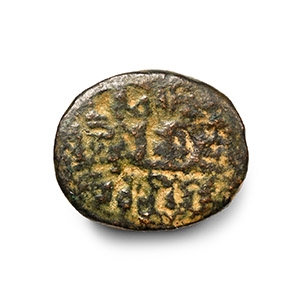
Phoenician Inscribed Bronze Scaraboid Seal
Late 1st millennium B.C.Sold for (Inc. bp): £52
Plain domed body pierced longitudinally, inscribed underside. 8.9 grams, 17 mm
Ex London, UK, gentleman, 1990. This lot is accompanied by an illustrated lot declaration signed by the Head of the Antiquities Department, Dr Raffaele D'Amato.
Although it is difficult to make out for certain, the outer design appears to be composed of the 'a-n-r' hieroglyphs. The signs do not form a word and are thought to have been a decorative device used by Asiatic scarab makers, employing recognisably Egyptian hieroglyphs. -
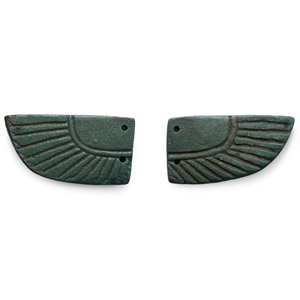
Egyptian Faience Scarab Wing Pair
Late Period, 664-332 B.C.Sold for (Inc. bp): £143
Each flat-section with a band of feathers within the border, two attachment holes. 15 grams total, 43-44 mm
From the private collection of the late Julian Bird, UK, formed since the 1970s. This lot is accompanied by an illustrated lot declaration signed by the Head of the Antiquities Department, Dr Raffaele D'Amato.
These wings were once part of a central scarab amulet. Winged scarabs often served as funerary adornments and were believed to symbolise the rebirth and regeneration of the deceased. -
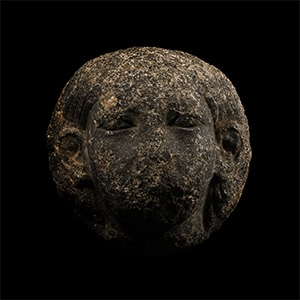
Egyptian Black Stone Head of a Female
Middle Kingdom, late 12th Dynasty, 1862-1787 B.C.Sold for (Inc. bp): £1,235
Carved in the round head with almond-shaped eyes and copious hair, detailed ears; jawline, neck and cheeks abraded. 1.1 kg, 94 mm
Acquired in the mid 1980s-1990s. Private collection, Switzerland, thence by descent. Private collection, since the late 1990s. This lot is accompanied by an illustrated lot declaration signed by the Head of the Antiquities Department, Dr Raffaele D'Amato.
The nearly spherical shape suggests that the head was repurposed as a pounder. -
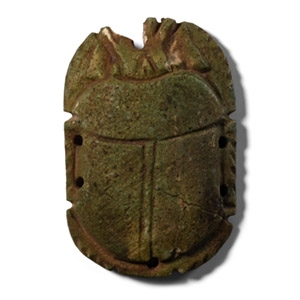
Large Egyptian Faience Heart Scarab
Late Period, 664-332 B.C.Sold for (Inc. bp): £169
Green-glazed with anatomical detailing, pierced through the outer edge. 48 grams, 73 mm
From an early 20th century collection London and Home counties, UK. This lot is accompanied by an illustrated lot declaration signed by the Head of the Antiquities Department, Dr Raffaele D'Amato.
The heart scarab served to protect the individual by silencing the heart so it would not testify against its owner. Many heart scarabs, especially those intended for elite burials, were mounted with outstretched wings—symbols of divine protection and rebirth. These wings echoed the iconography of protective deities like Isis and Nephthys, enhancing the amulet’s power to safeguard the soul on its journey to eternal life. The pierced holes on the side of this example were likely for the attachment of such wings. -
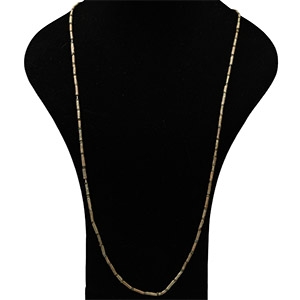
Egyptian Faience Bead Necklace String
Late Period, 664-332 B.C.Sold for (Inc. bp): £33
Composed of light blue tubular beads interspersed with darker coloured annular beads; restrung. 8.7 grams total, 101 cm long
Acquired on the UK art market, circa 1980. Property of an East London, UK, collector. This lot is accompanied by an illustrated lot declaration signed by the Head of the Antiquities Department, Dr Raffaele D'Amato.

