-
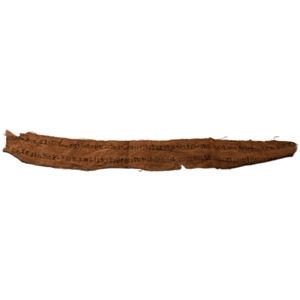
Egyptian Mummy Shroud Section with Hieratic Text
Late-Ptolemaic Period, circa 480-30 B.C.Sold for (Inc. bp): £715
A narrow strip of woven linen textile featuring two lines of neatly written hieratic text in black. 3.74 grams, 40 cm
From the collection of a gentleman, acquired on the London art market in the 1990s. This lot is accompanied by an illustrated lot declaration signed by the Head of the Antiquities Department, Dr Raffaele D'Amato.
From the fifth century B.C., mummy wrappings often feature hieratic script—a cursive form of Egyptian hieroglyphs used for daily and religious texts. These include excerpts from funerary works like the Book of the Dead, alongside prayers meant to protect the deceased in the afterlife. Often with vignettes, these texts were inscribed directly on linen strips during the mummification. Some bandages were notably long; one from Brussels, 6.2 cm wide, measures an incredible 26 metres. -
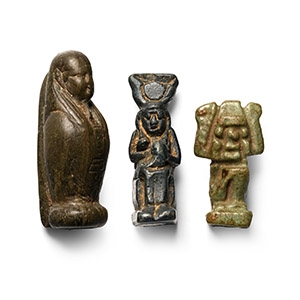
Egyptian Stone and Faience Amulet Group
Late Period-Roman Period, circa 664 B.C.-100 A.D.Sold for (Inc. bp): £572
Comprising: a seated figure of Isis suckling infant Horus on her lap, the goddess crowned with large cow horns flanking a solar disc, pierced behind the head; a mummiform Osiris-Canopus amulet wearing a nemes headdress and plain dorsal pillar, a winged scarab with solar disc above at the base of the figure; a kneeling Shu amulet, his arms raised above his head holding a large solar disc, pierced through the dorsal pillar. 6.47 grams total, 18-25 mm
Ex Prof. Dr Emil Vogt (1906-1974), The Former Director of the Swiss National Museum, Zürich, in his collection before 1970. with Galerie Rhéa, Zurich, Switzerland. This lot is accompanied by an illustrated lot declaration signed by the Head of the Antiquities Department, Dr Raffaele D'Amato. -
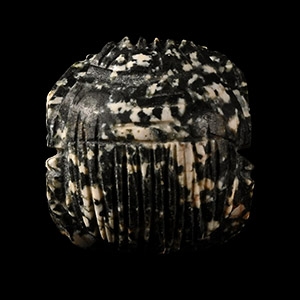
Egyptian Diorite Stone Scarab
Saite Period, 664-525 B.C.Sold for (Inc. bp): £156
Carved in the round with detailed carapace and legs; not pierced. 8.22 grams, 21 mm
Acquired in the mid 1980s-1990s. Private collection, Switzerland, thence by descent. Private collection, since the late 1990s. This lot is accompanied by an illustrated lot declaration signed by the Head of the Antiquities Department, Dr Raffaele D'Amato.
The scarab amulet was arguably the most ubiquitous symbol in ancient Egypt, representing rebirth, transformation, and protection. Modelled after the scarab beetle, which was associated with the sun god Khepri, believed to roll the sun across the sky, the amulet illustrated the cycle of life and regeneration. Scarabs were commonly placed with the deceased as funerary amulets to ensure safe passage into the afterlife. They also served as seals and personal charms, often inscribed with prayers, names, or protective formulas. Widely used from the early Middle Kingdom (c. 2050 BCE) onwards, scarab amulets reflect spiritual beliefs and everyday practices in ancient Egyptian life. -
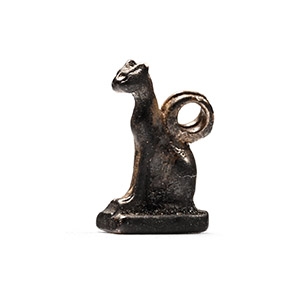
Egyptian Silver Bastet as Seated Cat Amulet
Late-Ptolemaic Period, 664-30 B.C.Sold for (Inc. bp): £715
Seated figure of a cat with pointed ears mounted on a rectangular base with a rounded end; suspension loop on the back. 0.34 grams, 8 mm
From an early 20th century collection. This lot is accompanied by an illustrated lot declaration signed by the Head of the Antiquities Department, Dr Raffaele D'Amato.
The cat was sacred to Bastet, a protective mother goddess and the daughter of the sun god Re. Amulets offered the wearer the goddess's protection. Her name means ‘she of the bast [ointment jar],’ which may have contained a substance favoured by or exclusive to royalty. Originally, Bastet was depicted as a woman with the head of a lioness, but by the late New Kingdom, she was usually shown with a cat's head. She is sometimes portrayed with kittens, emphasising her maternal role as a fierce protector of offspring. -
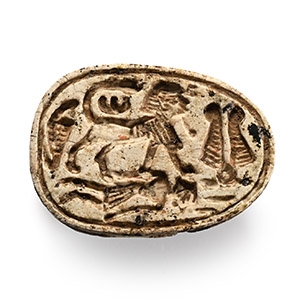
Large Egyptian Steatite Scarab with Sphinx
Late Period, 664-332 B.C.Sold for (Inc. bp): £468
With detailed carapace, head, and legs; the underside depicting the king as an advancing sphinx trampling a male enemy in a short kilt, with a rearing cobra behind, a pair of ostrich feathers atop a sun disc in front, and the symbol for foreign lands placed in the curl of the sphinx’s tail. 13.4 grams, 32 mm
From the collection of a gentleman, acquired on the London art market in the 1990s. This lot is accompanied by an illustrated lot declaration signed by the Head of the Antiquities Department, Dr Raffaele D'Amato. -
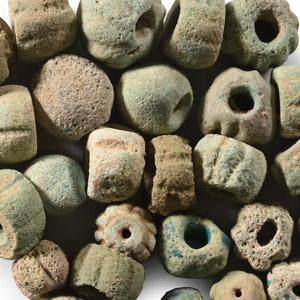
Romano-Egyptian Faience Melon Bead Collection
2nd-1st century B.C.Sold for (Inc. bp): £33
Comprising thirty green and blue beads in various sizes. 42 grams total, 8-18 mm
Ex H. Norry collection, Milton Keynes, UK, 1980s-1990s. This lot is accompanied by an illustrated lot declaration signed by the Head of the Antiquities Department, Dr Raffaele D'Amato. -
.jpg)
Egyptian Silver Bezel for the 'Treasurer of the god, chief keeper (of) the House of Gold'
25th Dynasty, 754-656 B.C.Sold for (Inc. bp): £2,080
Rectangular with sloping faces on the underside, the upper face with two lines of hieroglyphic inscription reading: ‘Treasurer of the god, chief keeper (of) the House of Gold, great (of) Ra, Pa-di-Ra son of Pa-khered-tawy (or Pa-shery-tawy)’. 2.56 grams, 12 mm
with Bonhams, London, 27 April 2006. with Galerie Rhéa, Zurich, Switzerland. This lot is accompanied by an illustrated lot declaration signed by the Head of the Antiquities Department, Dr Raffaele D'Amato.
The ‘Treasurer of the god’ is a long-attested title known since the Old Kingdom (Jones, D., An Index of Ancient Egyptian Titles, Epithets and Phrases of the Old Kingdom, vol. II, Oxford, 2000, p. 767, no. 2791). The ‘Chief keeper’ title is known from the New Kingdom (for a similar writing of the title, see Al-Ayedi, A.R., Index of Egyptian Administrative, Religious and Military Titles of the New Kingdom, Ismailia, 2006, p. 395, no. 1236). The last part of the title is somewhat curious; the determinative at the end, previously interpreted as ‘Ra’, does not match the determinative for this god in the second line. An alternative tentative interpretation could be ‘Chief keeper, of the gold of the Pharaoh’, treating the pr and ꜤꜢ signs, which are shown side-by-side, as writing ‘Pharaoh’, with the seated figure wearing the Dual Crown symbolising the ruler. -
.jpg)
Egyptian Bronze Statuette of Isis Seated with Young Horus
Late-Ptolemaic Period, 664-30 B.C.Sold for (Inc. bp): £130
Isis enthroned wearing a cow's horn headdress with a solar disc, suckling the infant Horus on her lap. 39 grams, 10.7 cm
From the property of a lady since the early to mid 20th century. From the private collection of Mr M.L. since circa 2005. This lot is accompanied by an illustrated lot declaration signed by the Head of the Antiquities Department, Dr Raffaele D'Amato.
In ancient Egyptian mythology, Isis was the sister-wife of Osiris and the mother of the sky god Horus. She is associated with aspects of fertility and motherhood and is often depicted in various artworks seated in a nursing pose with her son Horus on her lap, as here. -
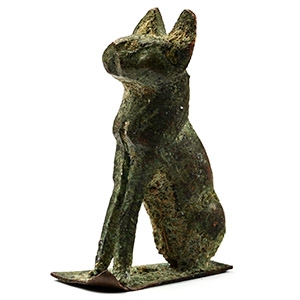
Egyptian Bronze Bastet Cat Amulet
Late Period, 664-332 B.C.Sold for (Inc. bp): £338
Modelled in the round as a seated cat on an oblong base, large pointed ears with a notch behind them. 14 grams, 30 mm
Private collection, 1970s. Private collection, 2017. This lot is accompanied by an illustrated lot declaration signed by the Head of the Antiquities Department, Dr Raffaele D'Amato.
In ancient times, the cat was revered as the sacred animal of the goddess Bastet, who was worshipped in Bubastis, located in the Nile Delta. She was a protective mother goddess and the daughter of the sun god Re. Amulets provided the wearer with the goddess's protection. -
.jpg)
Phoenician Stone Scaraboid Seal
Circa 750-700 B.C.Sold for (Inc. bp): £234
With incised hatched motif to underside. 2.96 grams, 18 mm
with Artemis Gallery, Munich, Germany, 1998. Private collection, Europe. This lot is accompanied by an illustrated lot declaration signed by the Head of the Antiquities Department, Dr Raffaele D'Amato. -
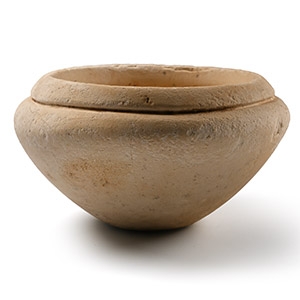
Egyptian Alabaster Bowl with Thickened Rim
3rd millennium B.C.Sold for (Inc. bp): £156
Comprising a squat conical body with narrow foot, groove beneath the thickened rim. 177 grams, 82 mm
Acquired in the mid 1980s-1990s. Private collection, Switzerland, thence by descent. Private collection, since the late 1990s. This lot is accompanied by an illustrated lot declaration signed by the Head of the Antiquities Department, Dr Raffaele D'Amato.
One of the most prestigious materials the Egyptians extracted was alabaster, more correctly referred to as travertine or calcite-alabaster. From the 1st through 3rd Dynasties, stone vessels were very popular items to include in the burials of pharaohs and nobles. No fewer than 30,000 stone vessels were found in the labyrinthine galleries below Djoser’s Step Pyramid at Saqqara, and Egyptian alabaster was used to make hundreds of those vessels. -
.jpg)
Egyptian Steatite Scarab
1st millennium B.C.Sold for (Inc. bp): £260
With detailed carapace and mouth, hieroglyphs to the underside depicting a pharaoh-headed sphinx, with hes-vase in front and the crowns of Lower and Upper Egypt behind. 0.80 grams, 12 mm
Ex R. Liechti (1934-2010) Geneva, Switzerland, formed between 1950-1990s. This lot is accompanied by an illustrated lot declaration signed by the Head of the Antiquities Department, Dr Raffaele D'Amato.

