-
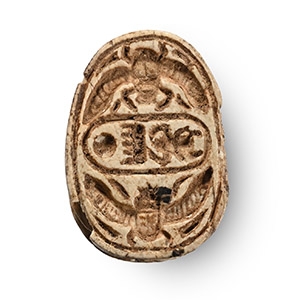
Egyptian Steatite Pharaoh Thutmose III Royal Scarab
New Kingdom, 1334-332 B.C. or laterSold for (Inc. bp): £468
With fine detailing to the clypeus, head and legs; underside with cartouche for Thutmose III flanked by winged scarabs. 7.42 grams, 25 mm
From the collection of a gentleman, acquired on the London art market in the 1990s. This lot is accompanied by an illustrated lot declaration signed by the Head of the Antiquities Department, Dr Raffaele D'Amato. -
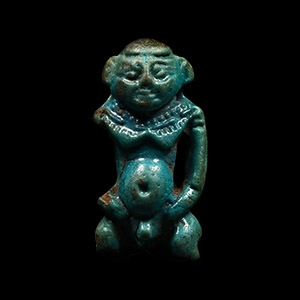
Egyptian Blue Glazed Faience Figure of Pataikos
Saite Period, 26th Dynasty, 664-545 B.C.Sold for (Inc. bp): £468
Wearing a broad collar and a stylised scarab on top of the head, elongated arms resting on the lower part of his protruding abdomen. 10.8 grams, 43 mm
Acquired in the mid 1980s-1990s. Private collection, Switzerland, thence by descent. Private collection, since the late 1990s. This lot is accompanied by an illustrated lot declaration signed by the Head of the Antiquities Department, Dr Raffaele D'Amato.
Herodotus mentions Pataikos as a dwarf-like representation of Ptah, although the ancient Egyptian name of the god remains unclear. These diminutive amulets symbolise Ptah’s immense magical power, which served to protect the wearer from dangerous creatures such as snakes and crocodiles. The role of the deity in the funerary sphere is explained in Spell 164 of the Book of the Dead, where a Pataikos is used to protect the deceased's heart from enemy attacks and the putrefaction of the body. -
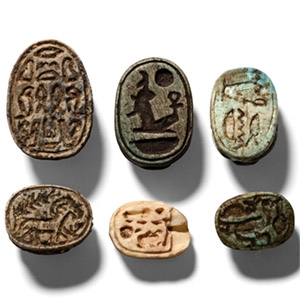
Egyptian Mixed Scarab Collection
2nd-1st millennium B.C.Sold for (Inc. bp): £572
Comprising (from left to right and top to bottom): 1) a scarab with an oval border containing, on either side, a maat feather, rearing cobra, and Dual Crown flanking a central column composed of ‘r’–‘n’–‘r’- sa (x2)-ka-neb signs; 2) a scarab with an oval border containing the throne name of pharaoh Amenhotep III (Neb-Maat-Re); 3) a scarab with an oval border containing a seated deity holding an ankh sign, facing sa, water, and neb signs; 4) a scarab with an oval border containing a running ibex surrounded by foliage; 5) a scarab with partially preserved design that gives the throne name of pharaoh Akhenaten (Nefer-kheperu-Re); 6) a scarab with an oval border containing a viper, duck and nefer signs. 19.5 grams total, 14-23 mm
From the collection of a gentleman, acquired on the London art market in the 1990s. This lot is accompanied by an illustrated lot declaration signed by the Head of the Antiquities Department, Dr Raffaele D'Amato. -
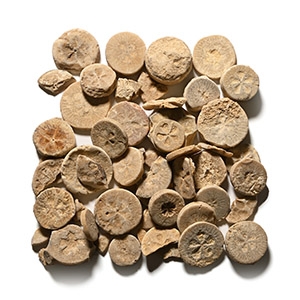
Egyptian Limestone Floral Inlay Group
Roman Period, 30 B.C.-323 A.D. or earlierSold for (Inc. bp): £59
Group of discoid inlay plaques or gaming counters, crinoids with cinquefoil motif; some fragmentary. 49 grams total, 6-17 mm
From a central London ADA dealership, 1980-1990. This lot is accompanied by an illustrated lot declaration signed by the Head of the Antiquities Department, Dr Raffaele D'Amato.
Flowers were symbolic of rebirth due to the daily reopening of their petals after nightfall. As a result, they were widely used in domestic settings, religious and funerary contexts, and as adornments. Similar rosette discs, like those recovered from the Ramesside Period palace at Qantir, were used as decorative elements in royal palaces. -
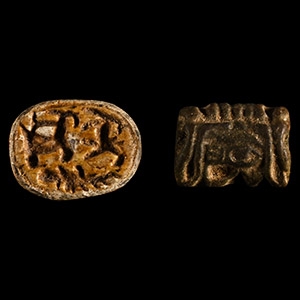
Egyptian Scarab and Amulet Group
Late Period, 664-332 B.C.Sold for (Inc. bp): £59
Comprising: a scarab with anatomical detailing to the carapace, underside with a crocodile and two quadrupeds; a rectangular Eye of Horus amulet with domed upper face. 3.04 grams total, 14-16 mm
Norfolk family collection, 1940s-1960s; thence by descent. This lot is accompanied by an illustrated lot declaration signed by the Head of the Antiquities Department, Dr Raffaele D'Amato. -
.jpg)
Egyptian Jasper Lion-Headed Cobra Amulet in Gold Frame
New Kingdom, circa 1550-1070 B.C.Sold for (Inc. bp): £1,895
The S-curved body resting on a tongue-shaped based, detailed hood, and delicate details to the head of a lioness; wrapped in a gold frame with suspension loop. 2 grams, 18 mm
Private collection of Mr K.A. Private collection, Europe, 26 June 2009. This lot has been checked against the Interpol Database of stolen works of art and is accompanied by a search certificate number no.12590-232325. This lot has been cleared against the Art Loss Register database, and is accompanied by an illustrated lot declaration signed by the Head of the Antiquities Department, Dr Raffaele D'Amato.
This amulet likely represents a goddess, either Sekhmet or Wadjet. Sekhmet is typically depicted as a lioness or lion-headed woman, while Wadjet appears in the form of a cobra. The lion-headed cobra form can be an allusion to the uraeus, worn on the crowns of royalty and deities for protection. -
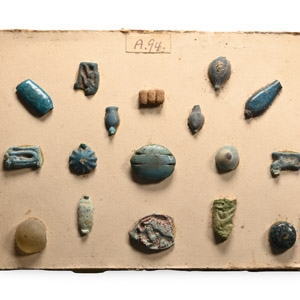
Egyptian Faience Bead and Amulet Collection
Late-Ptolemaic Period, 664-30 B.C.Sold for (Inc. bp): £520
Including floral, poppy seed, uraeus, an eye bead, a bull with solar disc, a standing deity holding a sceptre, and other types; mounted on cardboard backing with collector's label 'A.94.'. 24 grams total, 11.4 x 8.4 cm
From the private collection of Walter Thomas Gaze Cooper (1895-1980). This lot is accompanied by an illustrated lot declaration signed by the Head of the Antiquities Department, Dr Raffaele D'Amato. -
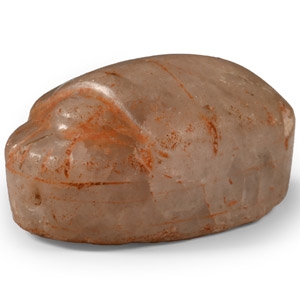
Egyptian Pink Quartz Scarab
Late Period, 664-332 B.C.Sold for (Inc. bp): £338
Carved with deep sides and carapace detailing to the upper face, pierced. 19.82 grams, 33 mm
From the private collection of the late Mrs Belinda Ellison, a long time member of the Egyptian Exploration Society, c.1940-2020. This lot is accompanied by an illustrated lot declaration signed by the Head of the Antiquities Department, Dr Raffaele D’Amato. This lot is accompanied by an illustrated lot declaration signed by the Head of the Antiquities Department, Dr Raffaele D'Amato. -
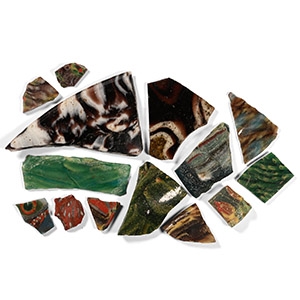
Egyptian and Other Mosaic Glass Fragment Collection
3rd century B.C.-4th century A.D.Sold for (Inc. bp): £234
Comprising fourteen polychrome fragments displaying vibrant colours and patterns, two with a rounded lip. 58 grams total, 15-71 mm
Ex Gallery Mikazuki before 1984. London gallery, latterly Mayfair, UK, collection. This lot is accompanied by an illustrated lot declaration signed by the Head of the Antiquities Department, Dr Raffaele D'Amato. -
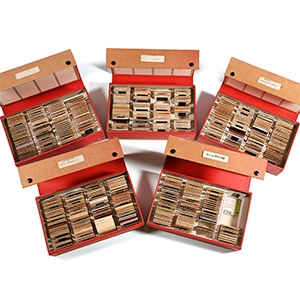
Historic Collection of 561 Slides of Archaeological Objects From Egypt
1960s-1980s A.D.Sold for (Inc. bp): £702
Housed in five linen-covered boxes, covering objects from the Old Kingdom, royal sculpture, general sculpture, and amulets, etc. 3.78 kg total, 26.5 x 16.5 x 6.5 cm each box
Property of archaeologist Stephanie Gee, N.W. London, UK, 1960s-1980s. This lot is accompanied by an illustrated lot declaration signed by the Head of the Antiquities Department, Dr Raffaele D'Amato.
Stephanie Gee was a prominent archaeologist who took part in several expeditions in Egypt. She was a trusted assistant to the British-Australian archaeologist Veronica Seton-Williams, who excavated in Egypt, Britain, and the Near East. Stephanie also took part in the Tell El-Farâ'în expeditions of 1965-1968, and assisted Seton-Williams with preparing the 1966 expedition report. Their collaboration continued and Stephanie helped with the manuscript of Seton-Williams’ book ‘The Road to El-Aguzein’, a narrative account of her life that was first published in 1988. -
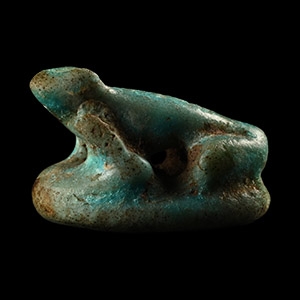
Egyptian Faience Frog Scaraboid
Ptolemaic Period, circa 300 B.C.Sold for (Inc. bp): £260
Discoid base with crouching frog pierced longitudinally for threading; underside with a solar disc and unidentified symbol. 0.56 grams, 13 mm
Ex R. Liechti (1934-2010) Geneva, Switzerland, formed between 1950-1990s. Accompanied by a copy of an old collection inventory note. This lot is accompanied by an illustrated lot declaration signed by the Head of the Antiquities Department, Dr Raffaele D'Amato. -
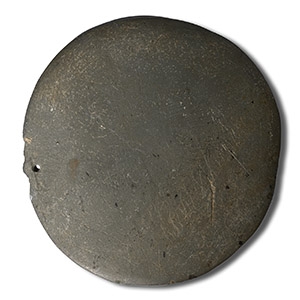
Egyptian Pre-Dynastic Greywacke Palette
Predynastic Period, Naqada III, circa 3300–2960 B.C.Sold for (Inc. bp): £468
Circular in plan with smoothed faces, pierced through the edge. 238 grams, 13.3 cm
Acquired in the mid 1980s-1990s. Private collection, Switzerland, thence by descent. Private collection, since the late 1990s. This lot is accompanied by an illustrated lot declaration signed by the Head of the Antiquities Department, Dr Raffaele D'Amato.
Palettes were utilitarian objects used in the Predynastic Period to grind and mix mineral-based eye pigments (including ochre, malachite, and haematite). Greywacke cosmetic palettes were easily carved in various shapes and sizes, including zoomorphic representations and geometric forms. The symbolism of this circular palette may be connected to the sun disc, which featured prominently in ancient Egyptian culture. The palette was so significant in Predynastic society that purely ceremonial versions, often impractically large for their original purpose, were produced for use in temple rituals. The most famous is the highly decorated Narmer Palette discovered at Hierakonpolis.

